
Pulp Fiction, 1925 · page 14 of 196
Adventure Magazine Cover — page 14: what you’re looking at
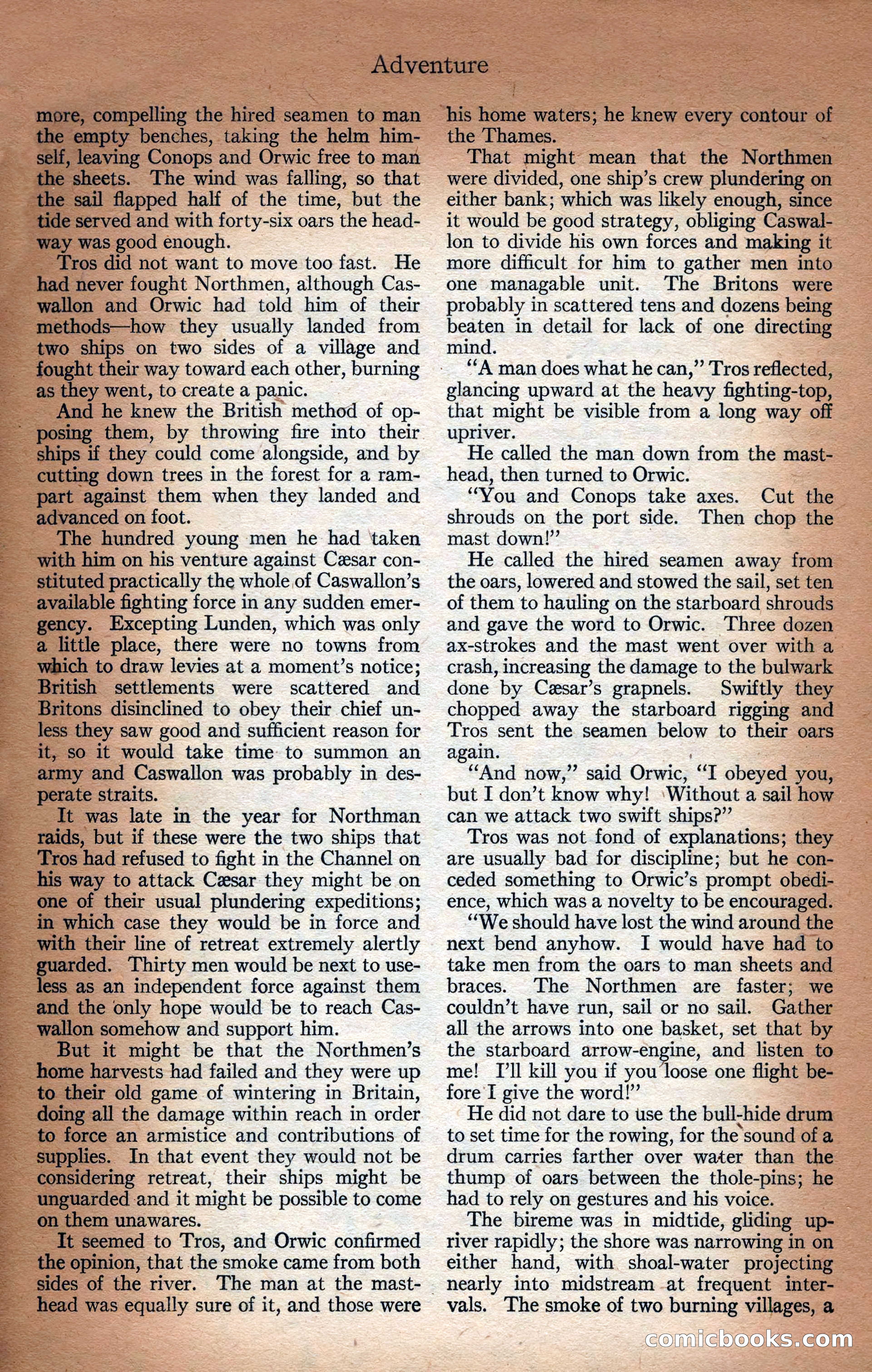
A restored page from Pulp Fiction, 1925. Page through the whole issue in the reader above.
📄 Transcribed text from this page (OCR, searchable)
Machine-transcribed from the original scan — historical spelling and the odd misread are preserved.
Adventure more, compelling the hired seamen to man the empty benches, taking the helm him- self, leaving Conops and Orwic free to man the sheets. The wind was falling, so that the sail flapped half of the time, but the tide served and with forty-six oars the head- way was good enough. Tros did not want to move too fast. He had never fought Northmen, although Cas- wallon and Orwic had told him of their methods—how they usually landed from two ships on two sides of a village and fought their way toward each other, burning as they went, to create a panic. And he knew the British method of op- _ posing them, by throwing fire into their ships if they could come alongside, and by cutting down trees in the forest for a ram- part against them when they landed and advanced on foot. The hundred young men he had ‘taken with him on his venture against Cesar con- stituted practically the whole of Caswallon’s available fighting force in any sudden emer- gency. Excepting Lunden, which was only a little place, there were no towns from waich to draw levies at a moment’s notice; British settlements were scattered and Britons disinclined to obey their chief un- less they saw good and sufficient reason for it, so it would take time to summon an army and Caswallon was probably in des- perate straits. It was late in the year for Norihifexn raids, but if these were the two ships that Tros had refused to fight in the Channel on his way to attack Cesar they might be on one of their usual plundering expeditions; in which case they would be in force and with their line of retreat extremely alertly guarded. Thirty men would be next to use- less as an independent force against them and the only hope would be to reach Cas- wallon somehow and support him. But it might be that the Northmen’s home harvests had failed and they were up to their old game of wintering in Britain, doing all the damage within reach in order to force an armistice and contributions of Supplies. In that event they would not be considering retreat, their ships might be unguarded and it might be possible to come on them unawares. Tt seemed to Tros, and Orwic confirmed the opinion, that the smoke came from both sides of the river. head was equally sure of it, and those were The man at the mast- © his wore waters; he knew every contour of the Thames. That might mean that the Northmen were divided, one ship’s crew plundering on either bank; which was likely enough, since it would be good strategy, obliging Caswal- lon to divide his own forces and making it more difficult for him to gather men into one managable unit. The Britons were probably in scattered tens and dozens being beaten in detail for lack of one directing mind. ‘‘A man does what he can,” Tros reflected, glancing upward at the heavy fighting-top, that might be visible from a long way off upriver. He called the man down from the mast- head, then turned to Orwic. “You and Conops take axes. Cut the shrouds on the port side. Then chop the mast down!” He called the hired seamen away from the oars, lowered and stowed the sail, set ten of them to hauling on the starboard shrouds and gave the word to Orwic. Three dozen ax-strokes and the mast went over with a- crash, increasing the damage to the bulwark done by Cesar’s grapnels. Swiftly they chopped away the starboard rigging and Tros sent the seamen below to their oars again. “And now,” said Orwic, “TI obeyed you, but I don’t know why! ‘Without a sail how can we attack two swift ships?” Tros was not fond of explanations; they are usually bad for discipline; but he con- ceded something to Orwic’s prompt obedi- ence, which was a novelty to be encouraged. “We should have lost the wind around the next bend anyhow. I would have had to take men from the oars to man sheets and braces. The Northmen are faster; we couldn’t have run, sail or no sail. Gather all the arrows into one basket, set that by the starboard arrow-engine, and listen to me! I'll kill you if you loose one flight be- fore I give the word!” He did not dare to use the bull-hide drum to set time for the rowing, for the sound of a drum carries farther over water than the thump of oars between the thole-pins; he had to rely on gestures and his voice. The bireme was in midtide, gliding up- river rapidly; the shore was narrowing in on either hand, with shoal-water projecting nearly into midstream at frequent inter- vals. The smoke of two burning villages, a Gomichbooks.com