
Pulp Fiction, 1925 · page 142 of 196
Adventure Magazine Cover — page 142: what you’re looking at
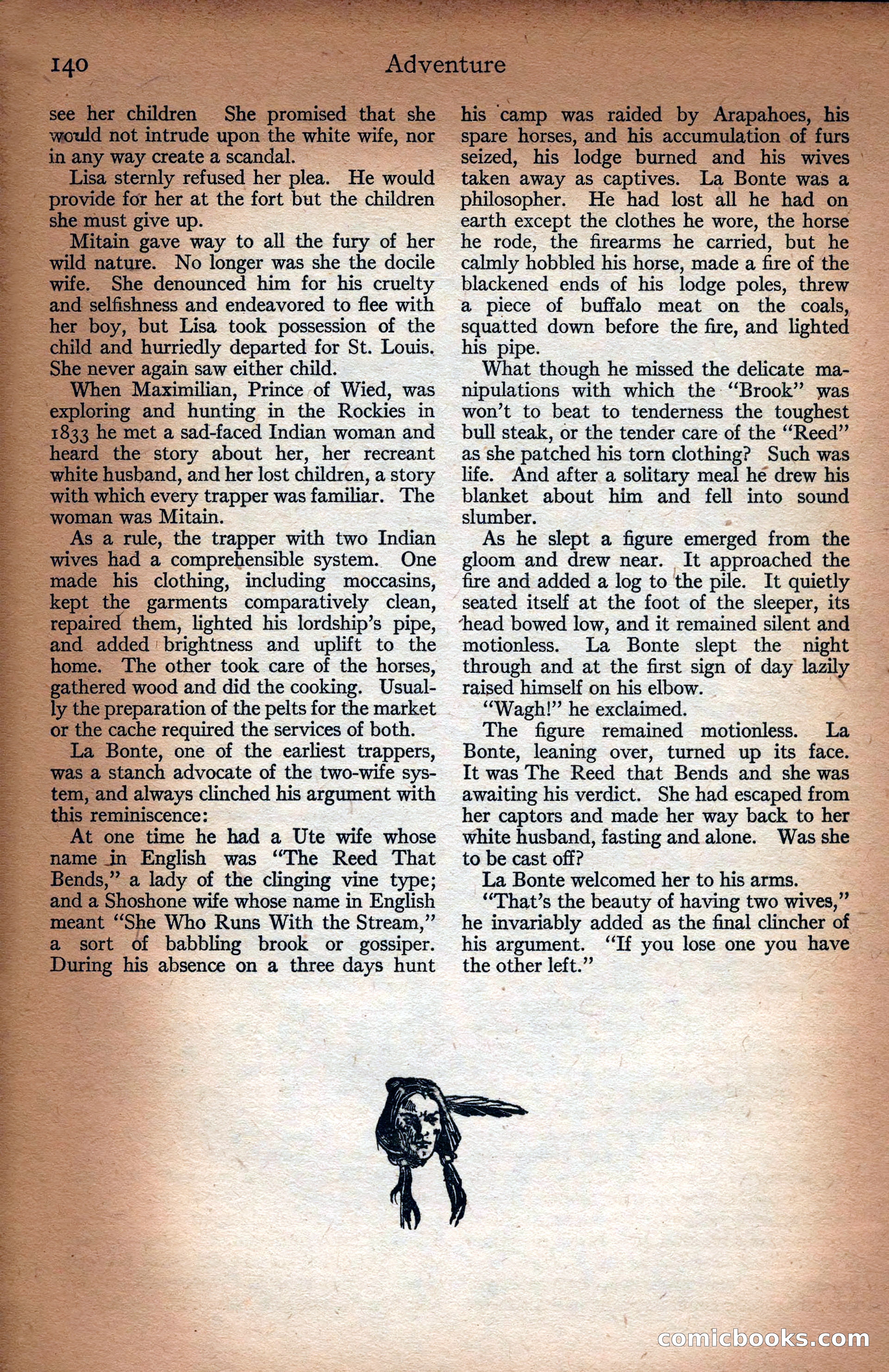
A restored page from Pulp Fiction, 1925. Page through the whole issue in the reader above.
📄 Transcribed text from this page (OCR, searchable)
Machine-transcribed from the original scan — historical spelling and the odd misread are preserved.
Se ~ - - 140 see her children She promised that she would not intrude upon the white wife, nor in any way create a scandal. Lisa sternly refused her plea. He would provide for her at the fort but the children she must give up. Mitain gave way to all the fury of her wild nature. No longer was she the docile wife. She denounced him for his cruelty and selfishness and endeavored to flee with her boy, but Lisa took possession of the child and hurriedly departed for St. Louis. She never again saw either child. When Maximilian, Prince of Wied, was exploring and hunting in the Rockies in 1833 he met a sad-faced Indian woman and heard the story about her, her recreant white husband, and her lost children, a story with which every trapper was familiar. The woman was Mitain. As a rule, the trapper with two Indian wives had a comprehensible system. One made his clothing, including moccasins, kept the garments comparatively clean, repaired them, lighted his lordship’s pipe, and added ‘brightness and uplift to the home. The other took care of the horses, gathered wood and did the cooking. Usual- ly the preparation of the pelts for the market or the cache required the services of both. La Bonte, one of the earliest trappers, was a stanch advocate of the two-wife sys- tem, and always clinched his argument with this reminiscence: At one time he had a Ute wife whose name in English was ‘The Reed That Bends,” a lady of the clinging vine type; and a Shoshone wife whose name in English meant “She Who Runs With the Stream,” a sort of babbling brook or gossiper. During his absence on a three days hunt ee ee a” Pee is ek ee 7 banys x ? - : = Adventure his camp was raided by Arapahoes, his spare horses, and his accumulation of furs seized, his lodge burned and his wives taken away as captives. La Bonte was a philosopher. He had lost all he had on earth except the clothes he wore, the horse he rode, the firearms he carried, but he calmly hobbled his horse, made a fire of the blackened ends of his lodge poles, threw a piece of buffalo meat on the coals, squatted down before the fire, and lighted his pipe. What though he missed the delicate ma- nipulations with which the “Brook” was won’t to beat to tenderness the toughest bull steak, or the tender care of the “Reed” as she patched his torn clothing? Such was life. And after a solitary meal he drew his blanket about him and fell into sound slumber. As he slept a figure emerged from the gloom and drew near. It approached the fire and added a log to the pile. It quietly seated itself at the foot of the sleeper, its ‘head bowed low, and it remained silent and motionless. La Bonte slept the night through and at the first sign of day lazily raised himself on his elbow. ““Wagh!”’ he exclaimed. The figure remained motionless. La Bonte, leaning over, turned up its face. It was The Reed that Bends and she was awaiting his verdict. She had escaped from her captors and made her way back to her white husband, fasting and alone. Was she to be cast off? La Bonte welcomed her to his arms. “‘That’s the beauty of having two wives,” he invariably added as the final clincher of his argument. “If you lose one you have the other left.” Eomichbooks.com