
Pulp Fiction, 1925 · page 19 of 196
Adventure Magazine Cover — page 19: what you’re looking at
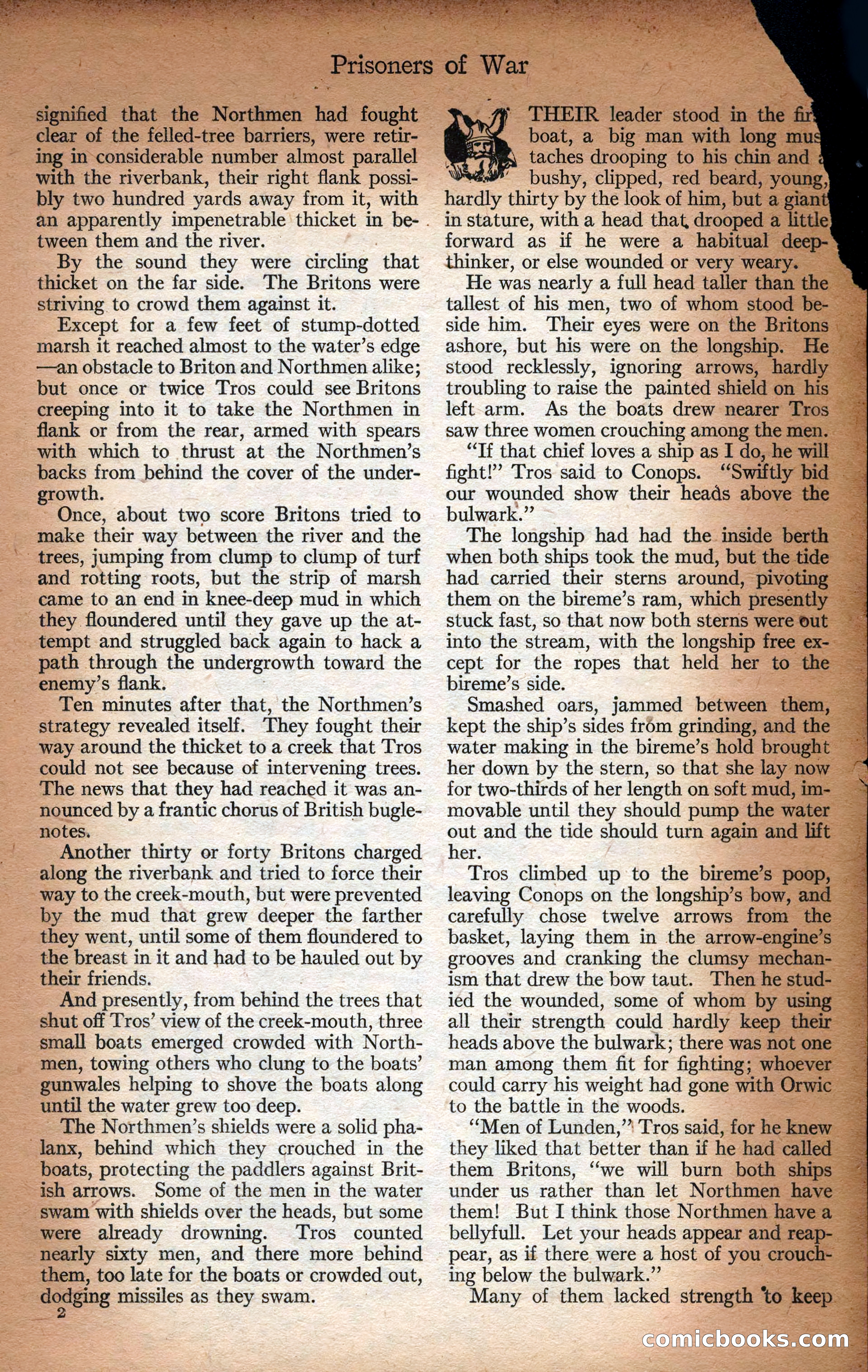
A restored page from Pulp Fiction, 1925. Page through the whole issue in the reader above.
📄 Transcribed text from this page (OCR, searchable)
Machine-transcribed from the original scan — historical spelling and the odd misread are preserved.
Prisoners signified that the Northmen had fought clear of the felled-tree barriers, were retir- ing in considerable number almost parallel with the riverbank, their right flank possi- bly two hundred yards away from it, with an apparently impenetrable thicket in be- . tween them and the river. By the sound they were circling that thicket on the far side. The Britons were striving to crowd them against it. Except for a few feet of stump-dotted marsh it reached almost to the water’s edge —an obstacle to Briton and Northmen alike; but once or twice Tros could see Britons creeping into it to take the Northmen in flank or from the rear, armed with spears with which to thrust at the Northmen’s backs from behind the cover of the under- growth. Once, about two score Britons tried to make their way between the river and the trees, jumping from clump to clump of turf and rotting roots, but the strip of marsh came to an end in knee-deep mud in which they floundered until they gave up the at- tempt and struggled back again to hack a path through the undergrowth toward the enemy’s flank. Ten minutes after that, the Northmen’s strategy revealed itself. They fought their way around the thicket to a creek that Tros could not see because of intervening trees. The news that they had reached it was an- nounced by a frantic chorus of British bugle- notes. Another thirty or forty Britons charged along the riverbank and tried to force their way to the creek-mouth, but were prevented by the mud that grew deeper the farther they went, until some of them floundered to the breast in it and had to be hauled out by their friends. And presently, from behind the trees that shut off Tros’ view of the creek-mouth, three small boats emerged crowded with North- men, towing others who clung to the boats’ gunwales helping to shove the boats along until the water grew too deep. The Northmen’s shields were a solid pha- lanx, behind which they crouched in the boats, protecting the paddlers against Brit- ish arrows. Some of the men in the water swam with shields over the heads, but some were already drowning. Tros counted nearly sixty men, and there more behind them, too late for the boats or crowded out, dodging missiles as they swam. ee 0 a Filet ee ee F ra rr mae Sanpete Lae ane gs 7 - ta ce i of War \ ’ THEIR leader stood in the “a boat, a big man with long m A taches drooping to his chin and dws” bushy, clipped, red beard, young, hardly thirty by the look of him, but a gian in stature, with a head that, drooped a little forward as if he were a habitual deep- thinker, or else wounded or very weary. He was nearly a full head taller than the tallest of his men, two of whom stood be- side him. Their eyes were on the Britons ashore, but his were on the longship. He stood recklessly, ignoring arrows, hardly troubling to raise the painted shield on his left-arm. As the boats drew nearer Tros saw three women crouching among the men. “Tf that chief loves a ship as I do, he will ~ fight!” Tros said to Conops. “Swittly bid | our wounded show their heads above the bulwark.” The longship had had the imside berth when both ships took the mud, but the tide had carried their sterns around, pivoting them on the bireme’s ram, which presently stuck fast, so that now both sterns were out into the stream, with the longship free ex- cept for the ropes that held her to the bireme’s side. Smashed oars, jammed between them, kept the ship’s sides from grinding, and the water making in the bireme’s hold brought her down by the stern, so that she lay now for two-thirds of her length on soft mud, im- movable until they should pump the water out and the tide should turn again and lift her. Tros climbed up to the bireme’s poop, leaving Conops on the longship’s bow, and carefully chose twelve arrows from the basket, laying them in the arrow-engine’s grooves and cranking the clumsy mechan- ism that drew the bow taut. Then he stud- ied the wounded, some of whom by using all their strength could hardly keep their heads above the bulwark; there was not one man among them fit for fighting; whoever could carry his weight had gone with Orwic to the battle in the woods. “Men of Lunden,”’ Tros said, for he knew they liked that better than if he had called them Britons, “we will burn both ships under us rather than let Northmen have them! But I think those Northmen have a bellyfull. Let your heads appear and reap- pear, as if there were a host of you crouch- ing below the bulwark.” Many of them lacked strength to keep Eomicbooks.com —