
Pulp Fiction, 1925 · page 191 of 196
Adventure Magazine Cover — page 191: what you’re looking at
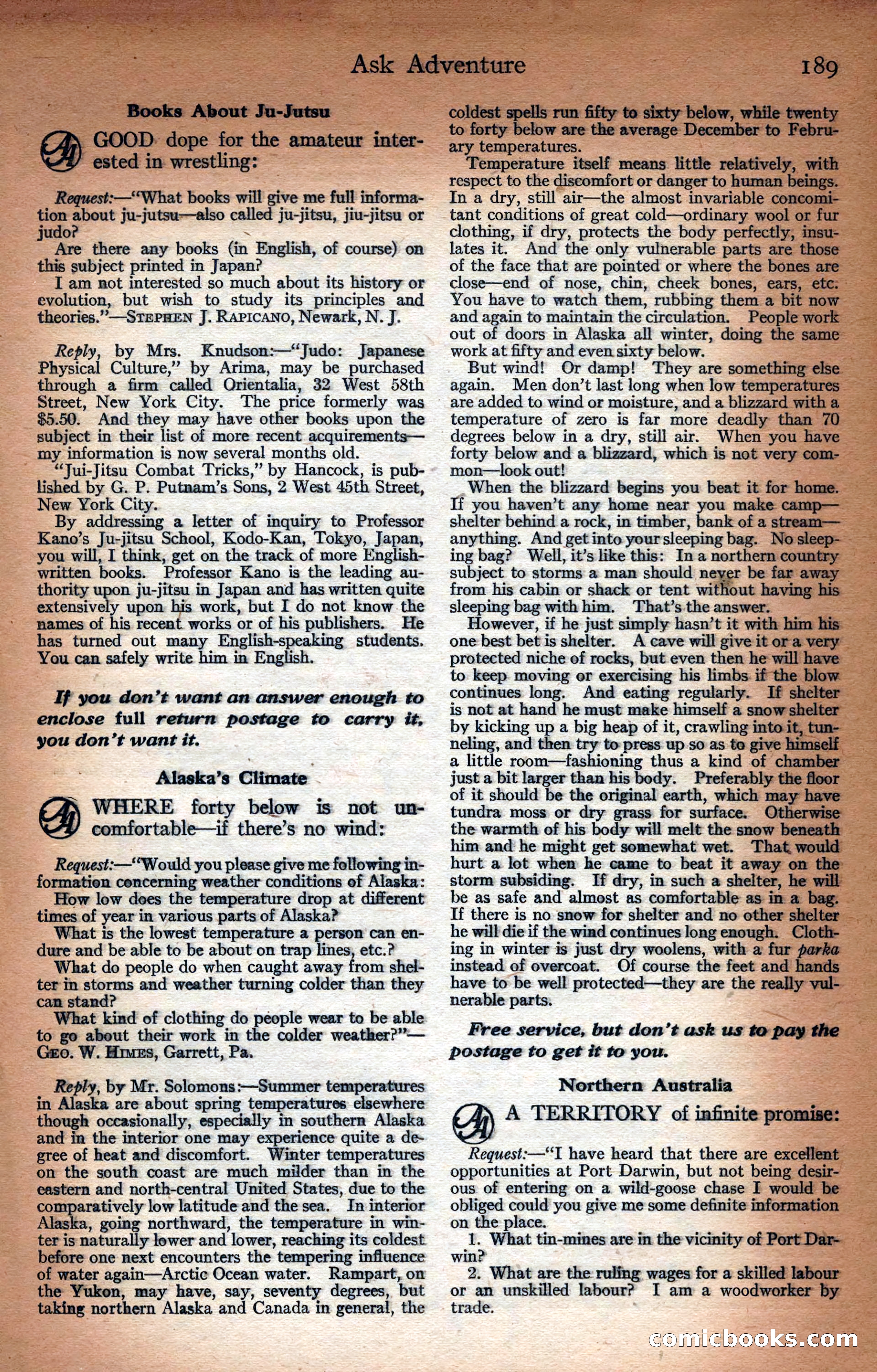
A restored page from Pulp Fiction, 1925. Page through the whole issue in the reader above.
📄 Transcribed text from this page (OCR, searchable)
Machine-transcribed from the original scan — historical spelling and the odd misread are preserved.
Ask Adventure Books About Ju-Jutsu GOOD: dope for the amateur inter- ested in wrestling: Request: —What books will give me full informa- an - asi ju-jutsu-—also called ju-jitsu, jiu-jitsu or udo : Are there any books Gn English, of course) on this subject printed in Japan? I am not interested so much about its history or evolution, but wish to study its principles and theories.” —StepsHEen J. Rapicano, Newark, N. J. Reply, by Mrs. Knudson:—“Judo: Japanese Physical Culture,” by Arima, may be purchased through a firm called Orientalia, 32 West 58th Street, New York City. The price formerly was $5.50. And they may have other books upon the subject in their list of more recent acquirements— my information is now several months old. “Jui-Jitsu Combat Tricks,” by Hancock, is pub- lished by G. P. Putmam’s Sons, 2 West 45th Street, New York City. By addressing a letter of inquiry to Professor Kano’s Ju-jitsu School, Kodo-Kan, Tokyo, Japan, you will, I think, get on the track of more English- written books. Professor Kano is the leading au- thority upon ju-jitsu in Japan and has written quite extensi ay upon. his work, but I do not know the names of his recent works or of his publishers. He bas turned out many English-speaking students. You can safely write him in English. If you don’t want an answer enough to enclose full return postage to carry it, you don’t want it. Alaska’s Climate Nm WHERE forty below is not un- comfortable—if there’s no wind: Request:—‘“Would you please give me following in- formation concerning weather conditions of Alaska: How low dees the temperature drop at different times of year in various parts of Alaska? What is the lowest temperature a person can en- dure and be able to be about on trap lines, etc.? What do people do when caught away from shel- ter in storms and weather turning colder than they can stand? What kind of clothing do people wear to be able to go about their work in the colder weather?”— Gero. W. Hues, Garrett, Pa. Reply, by Mr. Solomons:—Summer temperatures in Alaska are about spring temperatures elsewhere though occasionally, especially in southern Alaska and in the interior one may experience quite a de- gree of heat and discomfort. Winter temperatures on the south coast are much milder than im the eastern and north-central United States, due to the comparatively low latitude and the sea. In interior Alaska, going northward, the temperature in win- ter is naturally lewer and lower, reaching its coldest. before one next encounters the tempering influence of water again—Arctic Ocean water. Rampart, on the Yukon, may have, say, seventy degrees, but taking northern Alaska and Canada in general, the 189 coldest spells run fifty to sixty below, while twenty to forty below are the average December to Febru- ary temperatures. Temperature itself means little relatively, with respect to the discomfort or danger to human beings. In a dry, still air—the almost invariable concomi- tant conditions of great cold—ordinary wool or fur clothing, if dry, protects the body perfectly, imsu- lates it. And the only vulnerable parts are those of the face that are pointed or where the bones are close—end of nose, chin, cheek bones, ears, ete: You have to watch them, rubbing them a bit now and again to maintain the circulation. People work out of doors in Alaska all winter, doing the same work at fifty and even sixty below. But wind! Or damp! They are something else again. Men don’t last long when low temperatures are added to wind or moisture, and a blizzard with a temperature of zero is far more deadly than 70 degrees below in a dry, still air. When you have forty below and a blizzard, which is not very com- mon—look out! When the blizzard begins you beat it for home. If you haven’t any home near you make camp— shelter behind a rock, in timber, bank of a stream— anything. And get into yoursleeping bag. Nosleep- ing bag? Well, it’s like this: In a northern country subject. to storms a man should neyer be far away from his cabin or shack or tent without having his sleeping bag with him. That’s the answer. However, if he just simply hasn’t it with him his one best bet is shelter. A cave will give it or a very protected niche of rocks, but even then he will have to keep moving or exercising his limbs if the blow continues long. And eating regularly. If shelter is not at hand he must make himself a snow shelter by kicking up a big heap of it, crawling into it, tun- neling, and then try to press up so as to give himself a little room—fashioning thus a kind of chamber just a bit larger than his body. Preferably the floor of it should be the original earth, which may have tundra moss or dry grass for surface. Otherwise the warmth of his body will melt the snow beneath him and he might get somewhat wet. That would hurt a lot whem he came to beat it away on the storm subsiding. If dry, in such a shelter, he will be as safe and almost as comfortable as in a bag: If there is no snow for shelter and no other shelter he will die if the wind continues long enough. Cloth- ing in winter is just dry woolens, with a fur parka instead of overcoat. Of course the feet and hands have to be well protected—they are the really yul- nerable parts. Free service, but don’t ask us to pay the postage to get it to you. Northern Australia A TERRITORY of infinite promise: Request:—“I have heard that there are excellent opportunities at Port Darwin, but not being desir- ous of entering on a wild-goose chase I would be obliged could you give me some definite information on the place. 1. What tin-mines are in the vicinity of Port Dar- win? 2. What are the ruling wages for a skilled labour or an unskilled labour? I am a woodworker by trade. Gomicboo (@) CS com