
Pulp Fiction, 1925 · page 21 of 196
Adventure Magazine Cover — page 21: what you’re looking at
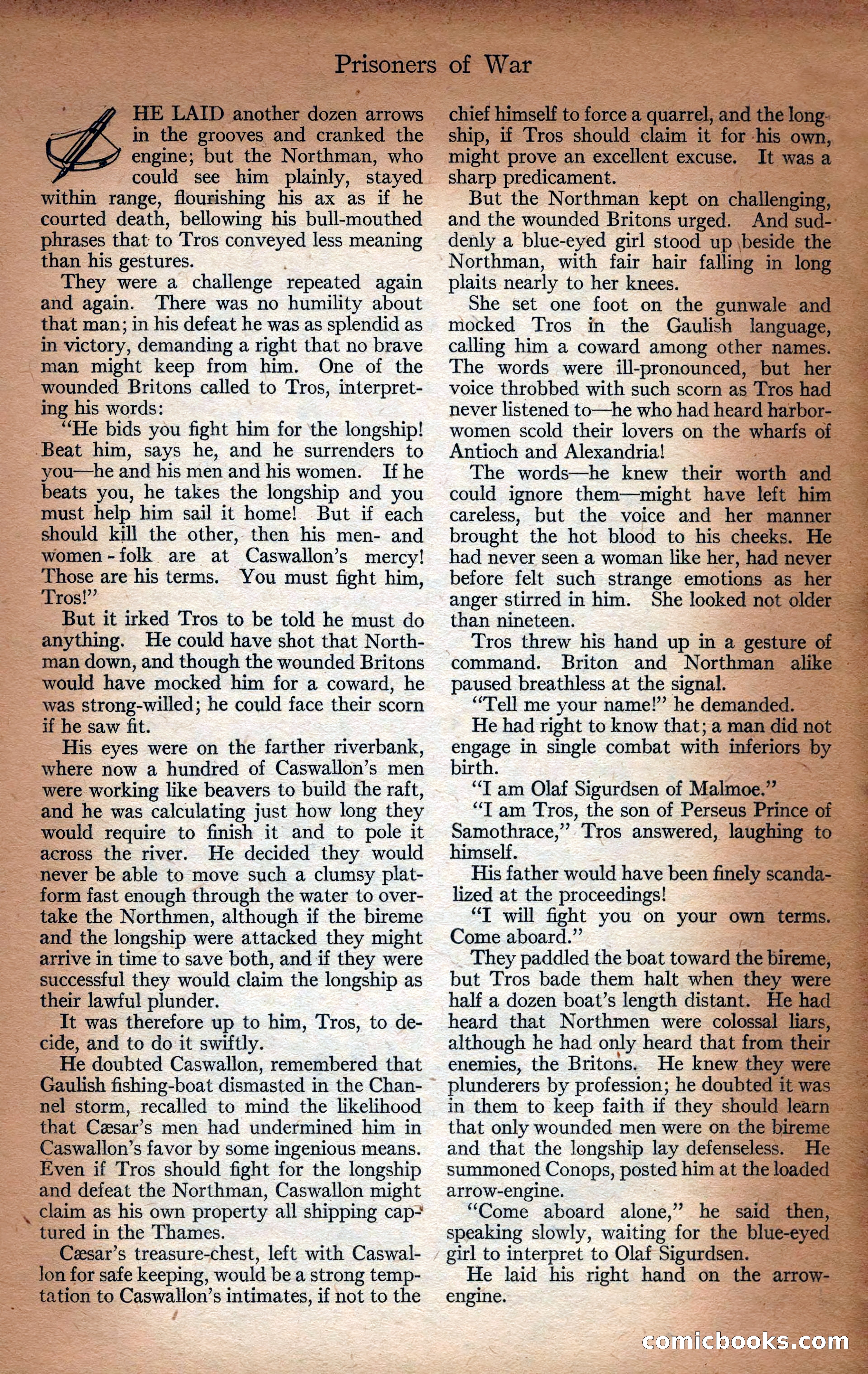
A restored page from Pulp Fiction, 1925. Page through the whole issue in the reader above.
📄 Transcribed text from this page (OCR, searchable)
Machine-transcribed from the original scan — historical spelling and the odd misread are preserved.
Ser ey Con Kz, pe OW si we oe SS ee: - i rp ¢ 4 Se . pe oe ee a= aon - + oo a Nites ine = Prisoners HE LAID another dozen arrows in the grooves and cranked the engine; but the Northman, who could see him plainly, stayed within range, flourishing his ax as if he courted death, bellowing his bull-mouthed phrases that to Tros conveyed less meaning than his gestures. They were a challenge repeated again and again. There was no humility about that man; in his defeat he was as splendid as in victory, demanding a right that no brave man might keep from him. One of the wounded Britons called to Tros, interpret- ing his words: “He bids you fight him for the longship! Beat him, says he, and he surrenders to you—he and his men and his women. If he beats you, he takes the longship and you must help him sail it home! But if each should kill the other, then his men- and women ~-folk are at Caswallon’s mercy! Those are his terms. You must fight him, Tros!”’ But it irked Tros to be told he must do anything. He could have shot that North- man down, and though the wounded Britons would have mocked him for a coward, he was strong-willed; he could face their scorn if he saw fit. His eyes were on the farther riverbank, where now a hundred of Caswallon’s men were working like beavers to build the rait, and he was calculating just how long they would require to finish it and to pole it across the river. He decided they would never be able to move such a clumsy plat- form fast enough through the water to over- take the Northmen, although if the bireme and the longship were attacked they might arrive in time to save both, and if they were successful they would claim the longship as their lawful plunder. It was therefore up to him, Tros, to de- cide, and to do it swiftly. He doubted Caswallon, remembered that Gaulish fishing-boat dismasted in the Chan- nel storm, recalled to mind the likelihood that Czsar’s men had undermined him in Caswallon’s favor by some ingenious means. Even if Tros should fight for the longship and defeat the Northman, Caswallon might _ Claim as his own property all shipping cap- tured in the Thames. Ceesar’s treasure-chest, left with Caswal- Jon for safe keeping, would be a strong temp- tation to Caswallon’s intimates, if not to the of War chief himself to force a quarrel, and the long: ship, if Tros should claim it for his own, might prove an excellent excuse. It was a sharp predicament. But the Northman kept on challenging, and the wounded Britons urged. And sud- denly a blue-eyed girl stood up \beside the Northman, with fair hair falling in long plaits nearly to her knees. She set one foot on the gunwale and mocked Tros in the Gaulish language, calling him a coward among other names. The words were ill-pronounced, but her voice throbbed with such scorn as Tros had never listened to—he who had heard harbor- women scold their lovers on the wharfs of Antioch and Alexandria! The words—he knew their worth and could ignore them—might have left him careless, but the voice and her manner brought the hot blood to his cheeks. He had never seen a woman like her, had never before felt such strange emotions as her anger stirred in him. She looked not older than nineteen. Tros threw his hand up in a gesture of command. Briton and Northman alike © paused breathless at the signal. “Tell me your name!” he demanded. He had right to know that; a man did not engage in single combat with inferiors by birth. “T am Olaf Sigurdsen of Malmoe.” “T am Tros, the son of Perseus Prince of Samothrace,’”’ Tros answered, laughing to himself. His father would have been finely scanda- lized at the proceedings! “IT will fight you on your own terms. Come aboard.” They paddled the boat toward the bireme, but Tros bade them halt when they were half a dozen boat’s length distant. He had heard that Northmen were colossal liars, although he had only heard that from their enemies, the Britons. He knew they were plunderers by profession; he doubted it was in them to keep faith if they should learn that only wounded men were on the bireme and that the longship lay defenseless. He summoned Conops, posted him at the loaded arrow-engine. “Come aboard alone,” he said then, speaking slowly, waiting for the blue-eyed girl to interpret to Olaf Sigurdsen. He laid his right hand on the arrow- engine. Eomicbooks.co a)