
Pulp Fiction, 1925 · page 59 of 196
Adventure Magazine Cover — page 59: what you’re looking at
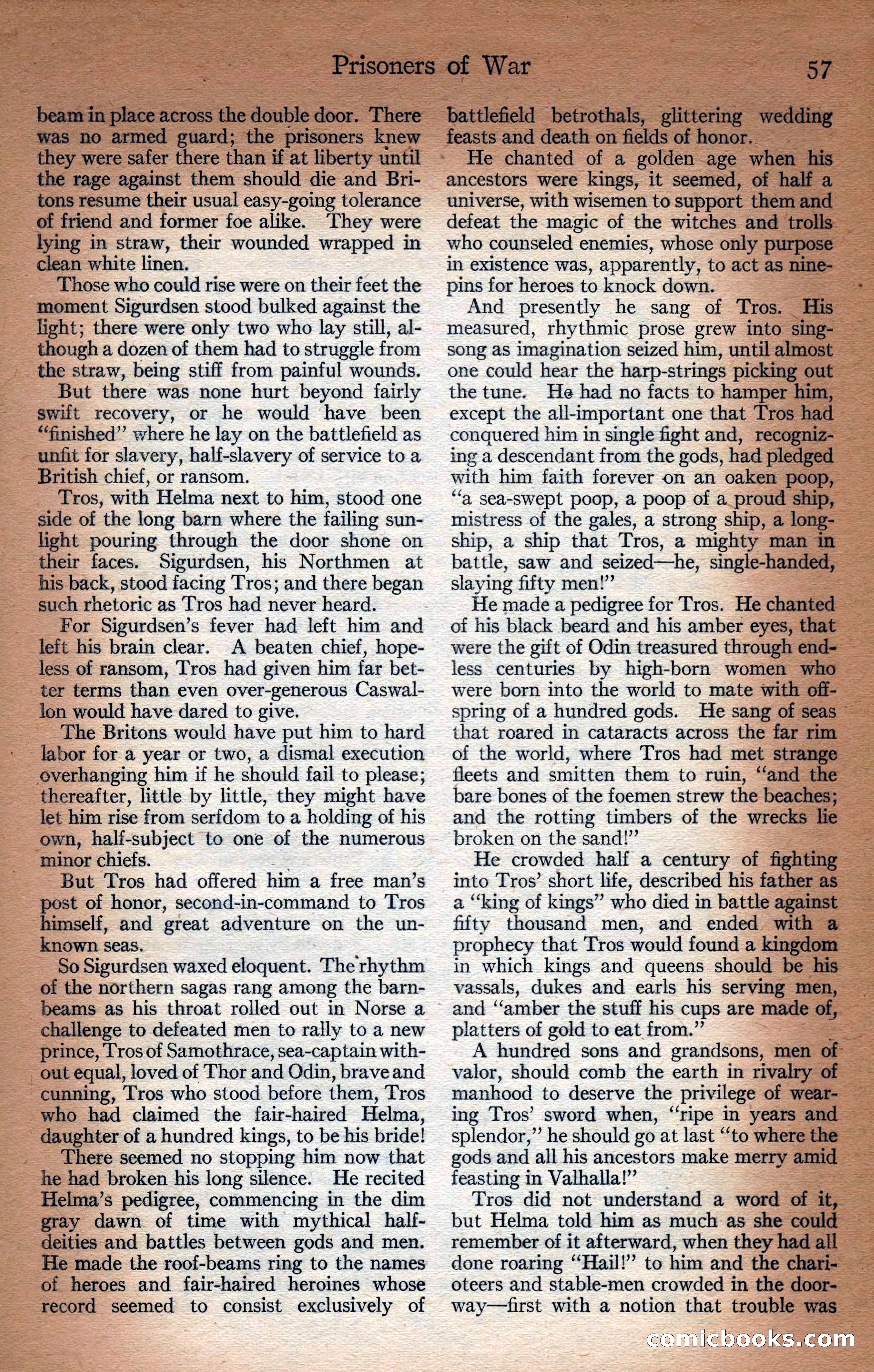
A restored page from Pulp Fiction, 1925. Page through the whole issue in the reader above.
📄 Transcribed text from this page (OCR, searchable)
Machine-transcribed from the original scan — historical spelling and the odd misread are preserved.
Prisoners of War — beam in place across the double door. There was no armed guard; the prisoners knew they were safer there than if at liberty until the rage against them should die and Bri- tons resume their usual easy-going tolerance of friend and former foe alike. ‘They were lying in straw, their wounded wrapped in clean white linen. Those who could rise were on their feet the moment Sigurdsen stood bulked against the light; there were only two who lay still, al- though a dozen of them had to struggle from the straw, being stiff from painful wounds. But there was none hurt beyond fairly swift recovery, or he would have been “finished’”’ where he lay on the battlefield as unfit for slavery, half-slavery of service to a British chief, or ransom. Tros, with Helma next to him, stood one side of the long barn where the failing sun- light pouring through the door shone on their faces. Sigurdsen, his Northmen at his back, stood facing Tros; and there began such rhetoric as Tros had never heard. For Sigurdsen’s fever had left him and leit his brain clear. A beaten chief, hope- less of ransom, Tros had given him far bet- ter terms than even over-generous Caswal- lon would have dared to give. The Britons would have put him to hard labor for a year or two, a dismal execution overhanging him if he should fail to please; thereafter, little by little, they might have let him rise from serfdom to a holding of his own, half-subject to one of the numerous minor chiefs. | But Tros had offered him a free man’s post of honor, second-in-command to Tros himself, and great adventure on the un- known seas. So Sigurdsen waxed eloquent. The rhythm of the northern sagas rang among the barn- beams as his throat rolled out in Norse a challenge to defeated men to rally to a new prince, Tros of Samothrace, sea-captain with- out equal, loved of Thor and Odin, brave and cunning, Tros who stood before them, Tros who had claimed the fair-haired Helma, daughter of a hundred kings, to be his bride! There seemed no stopping him now that he had broken his long silence. He recited Helma’s pedigree, commencing in the dim gray dawn of time with mythical half- deities and battles between gods and men. He made the roof-beams ring to the names oi heroes and fair-haired heroines whose record seemed to consist exclusively of o7 battlefield beGothals glittering wedding feasts and death on fields of honor. He chanted of a golden age when his ancestors were kings, it seemed, of half a universe, with wisemen to support them and defeat the magic of the witches and trolls who counseled enemies, whose only purpose in existence was, apparently, to act as nine- pins for heroes to knock down. And presently he sang of Tros. His measured, rhythmic prose grew into sing- song as imagination seized him, until almost one could hear the harp-strings picking out the tune. He had no facts to hamper him, except the all-important one that Tros had conquered him in single fight and, recogniz- ing a descendant from the gods, had pledged with him faith forever on an oaken poop, ‘a sea-swept poop, a poop of a proud ship, mistress of the gales, a strong ship, a long- ship, a ship that Tros, a mighty man im battle, saw and seized—he, single-handed, slaying fifty men!” He made a pedigree for Tros. He chanted of his black beard and his amber eyes, that were the gift of Odin treasured through end- less centuries by high-born women who were born into the world to mate with off- spring of a hundred gods. He sang of seas” that roared in cataracts across the far rim of the world, where Tros had met strange fleets and smitten them to ruin, “and the bare bones of the foemen strew the beaches; and the rotting timbers of the wrecks lie broken on the sand!” He crowded half a century of fighting into Tros’ short life, described his father as a “king of kings” who died in battle against fifty thousand men, and ended with a prophecy that Tros would found a kingdom in which kings and queens should be his vassals, dukes and earls his serving men, and “amber the stuff his cups are made of, platters of gold to eat from.” A hundred sons and grandsons, men of valor, should comb the earth in rivalry of manhood to deserve the privilege of wear- ing Tros’ sword when, “ripe in years and splendor,” he should go at last “to where the gods and all his ancestors make merry amid feasting in Valhalla!” Tros did not understand a word of it, but Helma told him as much as she could remember of it afterward, when they had all done roaring ‘‘Hail!’’ to him and the chari- oteers and stable-men crowded in the door- way—first with a notion that trouble was Gomicbooks.com