
Pulp Fiction, 1925 · page 71 of 196
Adventure Magazine Cover — page 71: what you’re looking at
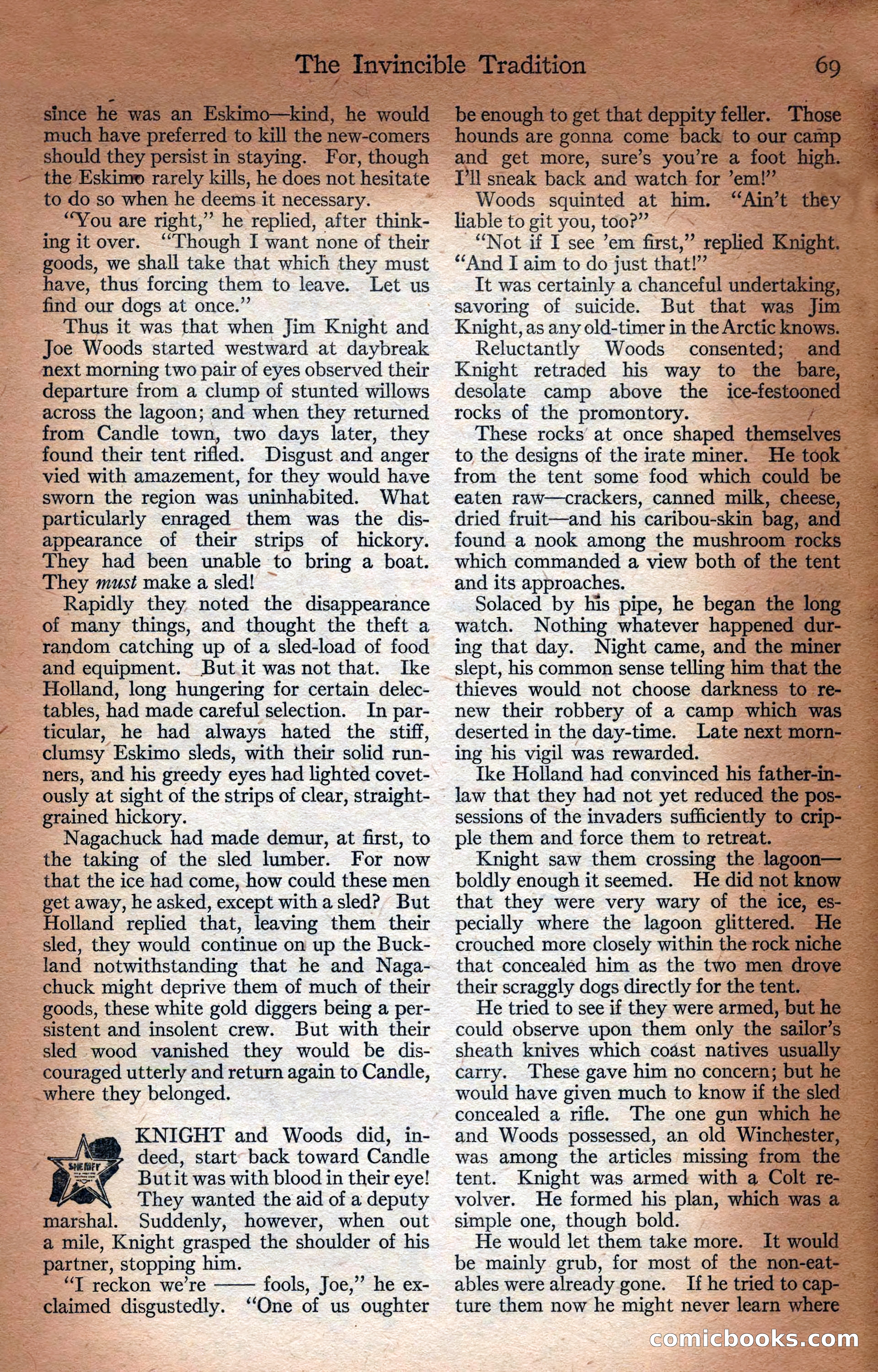
A restored page from Pulp Fiction, 1925. Page through the whole issue in the reader above.
📄 Transcribed text from this page (OCR, searchable)
Machine-transcribed from the original scan — historical spelling and the odd misread are preserved.
The Invincible Tradition 69 since he was an Eskimo—kind, he would much have preferred to kill the new-comers should they persist in staying. For, though - the Eskimo rarely kills, he does not hesitate to do so when he deems it necessary. “You are right,” he replied, after think- ing itover. “Though I want none of their goods, we shall take that which they must have, thus forcing them to leave. Let us find our dogs at once.” Thus it was that when Jim Knight and Joe Woods started westward at daybreak next morning two pair of eyes observed their departure from a clump of stunted willows across the lagoon; and when they returned from Candle town, two days later, they found their tent rifled. Disgust and anger vied with amazement, for they would have sworn the region was uninhabited. What particularly enraged them was the dis- appearance of their strips of hickory. They had been unable to bring a boat. They must make a sled! Rapidly they. noted the disappearance of many things, and thought the theft a random catching up of a sled-load of food and equipment. But it was not that. Ike Holland, long hungering for certain delec- tables, had made careful selection. In par- ticular, he had always hated the stiff, clumsy Eskimo sleds, with their solid run- ners, and his greedy eyes had lighted covet- ously at sight of the strips of clear, straight- grained hickory. Nagachuck had made demur, at first, to the taking of the sled lumber. For now that the ice had come, how could these men get away, he asked, except witha sled? But Holland replied that, leaving them their sled, they would continue on up the Buck- land notwithstanding that he and Naga- chuck might deprive them of much of their goods, these white gold diggers being a per- sistent and insolent crew. But with their sled wood vanished they would be dis- couraged utterly and return again to Candle, where they belonged. KNIGHT and Woods did, in- ney deed, start back toward Candle = Butit was with blood in their eye! ) They wanted the aid of a deputy marshal. Suddenly, however, when out a mile, Knight grasped the shoulder of his partner, stopping him. “T reckon we’re claimed disgustedly. fools, Joe,” he ex- “One of us oughter be enough to get that deppity feller. Those hounds are gonna come back to our camp and get more, sure’s you're a foot high. [ll sneak back and watch for ’em!” Woods squinted at him, “Ain’t they liable to git you, too?” “Not if I see ’em first,” replied Knight. *fAnd I aim to do just that!” It was certainly a chanceful undertaking, savoring of suicide. But that was Jim Knight, as any old-timer in the Arctic knows. Reluctantly Woods consented; and Knight retraced his way to the bare, desolate camp above the ice-festeaned rocks of the promontory. These rocks at once shaped chemeetd to the designs of the irate miner. He took from the tent some food which could be eaten raw—crackers, canned milk, cheese, dried fruit—and his caribou-skin bag, and found a nook among the mushroom rocks which commanded a view both of the tent and its approaches. Solaced by his pipe, he began the long watch. Nothing whatever happened dur- ing that day. Night came, and the miner slept, his common sense telling him that the thieves would not choose darkness to re- new their robbery of a camp which was deserted in the day-time. Late next morn- ing his vigil was rewarded. Ike Holland had convinced his fathet-in- law that they had not yet reduced the pos- sessions of the invaders sufficiently to crip- ple them and force them to retreat. Knight saw them crossing the lagoon— boldly enough it seemed. He did not know that they were very wary of the ice, es- pecially where the lagoon glittered. He crouched more closely within the rock niche that concealed him as the two men drove their scraggly dogs directly for the tent. He tried to see if they were armed, but he could observe upon them only the sailor’s sheath knives which coast natives usually carry. These gave him no concern; but he would have given much to know if the sled concealed a rifle. The one gun which he and Woods possessed, an old Winchester, was among the articles missing from the tent. Knight was armed with a Colt re- volver. He formed his plan, which was a simple one, though bold. He would let them take more. It would be mainly grub, for most of the non-eat- ables were already gone. If he tried to cap- ture them now he might never learn where eomicbooks.com * ey ae Me >; » ly PHONE te YSU pled