
Pulp Fiction, 1925 · page 74 of 196
Adventure Magazine Cover — page 74: what you’re looking at
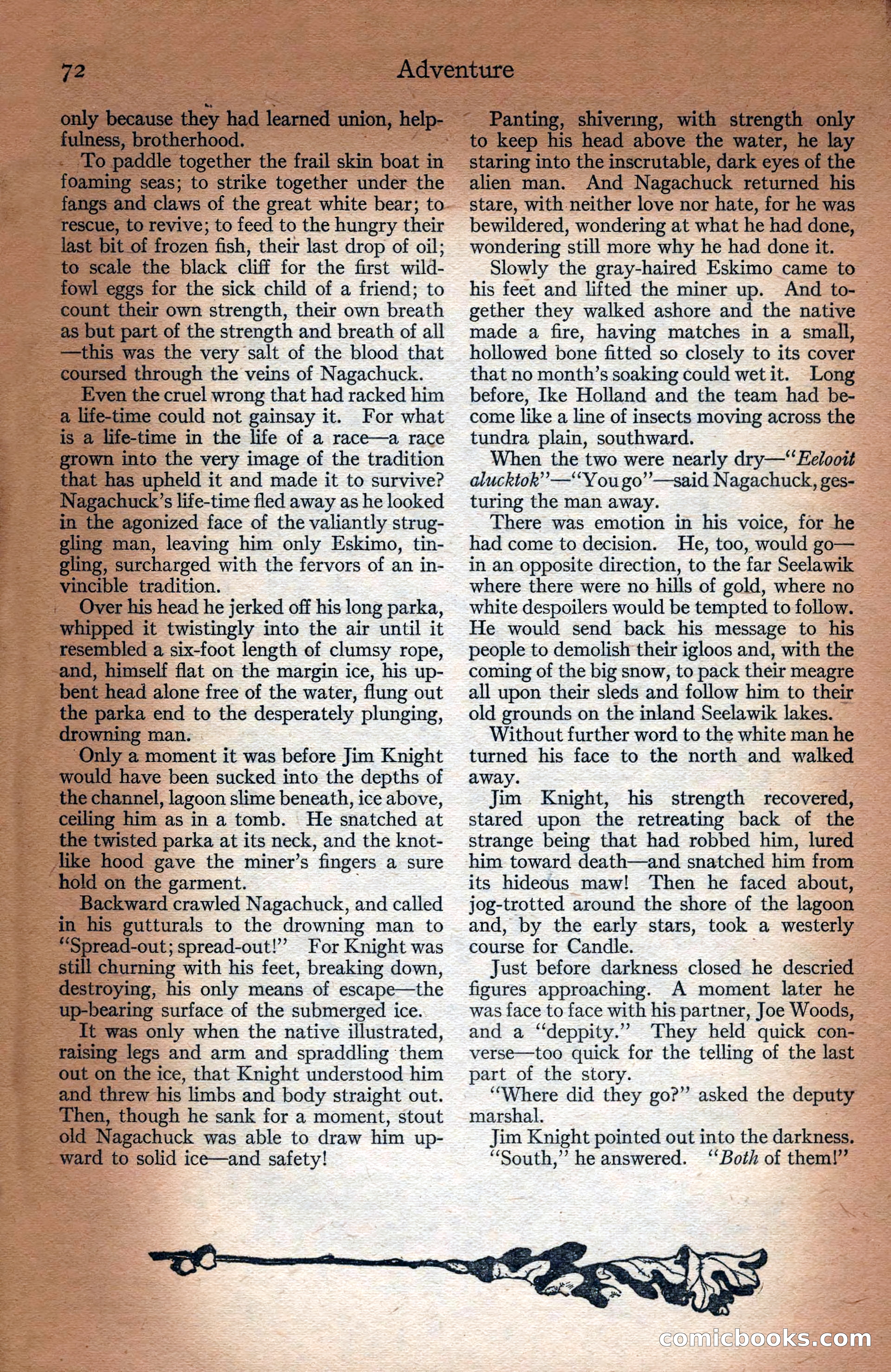
A restored page from Pulp Fiction, 1925. Page through the whole issue in the reader above.
📄 Transcribed text from this page (OCR, searchable)
Machine-transcribed from the original scan — historical spelling and the odd misread are preserved.
72 Adventure only because they had learned union, help- 7 fulness, brotherhood. ‘To paddle together the frail skin boat in foaming seas; to strike together under the fangs and claws of the great white bear; to rescue, to revive; to feed to the hungry their last bit of frozen fish, their last drop of oil; to scale the black cliff for the first wild- fowl eges for the sick child of a friend; to count their own strength, their own breath as but part of the strength and breath of all —this was the very salt of the blood that coursed through the veins of Nagachuck. Even the cruel wrong that had racked him a life-time could not gainsay it. For what is a life-time in the life of a race—a race "grown into the very image of the tradition that has upheld it and made it to survive? Nagachuck’s life-time fled away as he looked in the agonized face of the valiantly strug- gling man, leaving him only Eskimo, tin- gling, surcharged with the fervors of an in- vincible tradition. Over his head he jerked off his long parka, whipped it twistingly into the air until it resembled a six-foot length of clumsy rope, and, himself flat on the margin ice, his up- bent head alone free of the water, flung out the parka end to the desperately plunging, drowning man. Only a moment it was before Jim Knight would have been sucked into the depths of the channel, lagoon slime beneath, ice above, ceiling him as in a tomb. He snatched at the twisted parka at its neck, and the knot- like hood gave the miner’s ‘fingers a sure hold on the garment. Backward crawled Nagachuck, and called in his gutturals to the drowning man to “Spread-out; spread-out!”’ For Knight was still churning with his feet, breaking down, destroying, his only means of escape—the up-bearing surface of the submerged ice. It was only when the native illustrated, raising legs and arm and spraddling them Out on the ice, that Knight understood him and threw his limbs and body straight out. Then, though he sank for a moment, stout old Nagachuck was able to draw him up- ward to solid ice—and safety! Panting, shivering, with strength only to keep his head above the water, he lay staring into the inscrutable, dark eyes of the alien man. And Nagachuck returned his stare, with neither love nor hate, for he was bewildered, wondering at what he had done, wondering still more why he had done it. Slowly the gray-haired Eskimo came to his feet and lifted the miner up. And to- gether they walked ashore and the native made a fire, having matches in a small, hollowed bone fitted so closely to its cover that no month’s soaking could wetit. Long before, Ike Holland and the team had be- come like a line of insects moving across the tundra plain, southward. When the two were nearly dry—‘Eeloowt alucktok’’—Y ou go”’—said Nagachuck, ges- turing the man away. There was emotion in his voice, for he had come to decision. He, too, would go— in an opposite direction, to the far Seelawik where there were no hills of gold, where no white despoilers would be tempted to follow. He would send back his message to his people to demolish their igloos and, with the coming of the big snow, to pack their meagre all upon their sleds and follow him to their old grounds on the inland Seelawik lakes. Without further word to the white man he turned his face to the north and walked away Tim Knight, his strength recovered, stared upon the retreating back of the strange being that had robbed him, lured him toward death—and snatched him from its hideous maw! Then he faced about, jog-trotted around the shore of the lagoon and, by the early stars, took a westerly course for Candle. Just before darkness closed he descried figures approaching. A moment later he was face to face with his partner, Joe Woods, and a “‘deppity.” They held quick con- verse—too quick for the telling of the last part of the story. “Where did they go?” asked the deputy marshal. Jim Knight pointed out into the darkness. “South,” he answered. ‘Both of them!’ Gomichbooks.com