
Pulp Fiction, 1925 · page 8 of 196
Adventure Magazine Cover — page 8: what you’re looking at
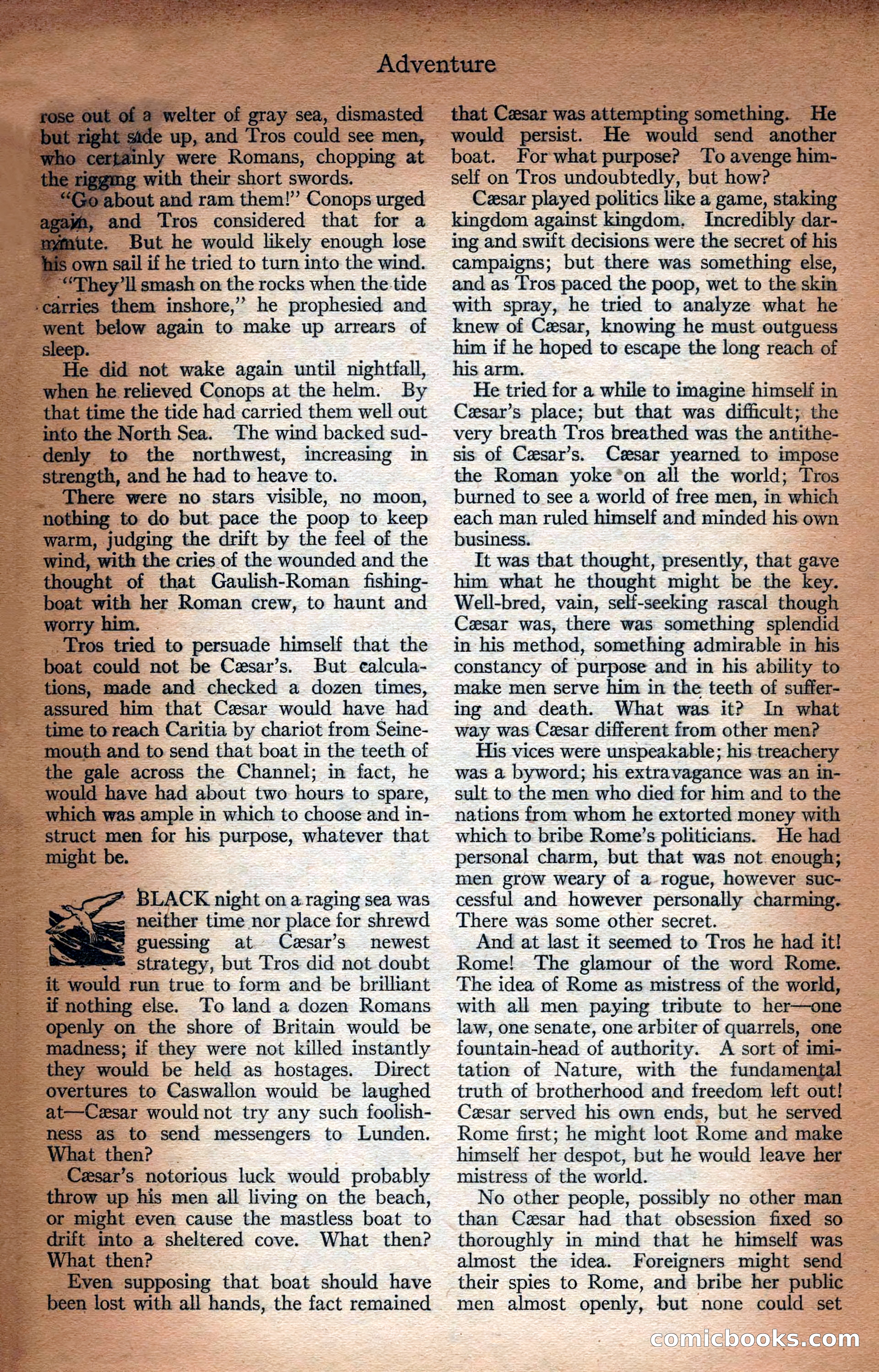
A restored page from Pulp Fiction, 1925. Page through the whole issue in the reader above.
📄 Transcribed text from this page (OCR, searchable)
Machine-transcribed from the original scan — historical spelling and the odd misread are preserved.
Adventure rose out of a welter of gray sea, dismasted “ide up, and Tros could see men, | ho rtainly were Romans, chopping at Geabe with their short swords. agama, and ‘ros considered that for a Ete * vute. But he would likely enough lose ‘his own sail if he tried to turn into the wind. ~ “They'll smash on the rocks when the-tide ‘carries them inshore,” he prophesied and “went below again to make up arrears of sleep. He did not wake again until nightfall, when he relieved Conops at the helm. By that time the tide had carried them well out - into the North Sea. The wind backed sud- -denly to the northwest, increasing in strength, and he had to heave to. _ There were no stars visible, no moon, nothing to do but pace the poop to keep Warm, judging the drift by the feel of the wind, with the cries of the wounded and the thought of that Gaulish-Roman fishing- boat with her Roman crew, to haunt and worry him. . "Tyos tried to persuade himself that the boat could not be Cesar’s. But calcula- tions, made and checked a dozen times, assured him that Cesar would have had _ time to reach Caritia by chariot from Seine- mouth and to send that boat in the teeth of the gale across the Channel; in fact, he would have had about two hours to spare, which was ample in which to choose and in- Struct men for his purpose, whatever that might be. BLACK night on a.raging sea was <= neither time nor place for shrewd Saumme> guessing at Cesar’s newest strategy, but Tros did not doubt it would run true to form and be brilliant if nothing else. To land a dozen Romans openly on the shore of Britain would be madness; if they were not killed instantly they would be held as hostages. Direct Overtures to Caswallon would be laughed at—Ceesar would not try any such foolish- ness as to send messengers to Lunden. What then? _ ‘Cexsar’s notorious luck would probably throw up his men all living on the beach, Or might even cause the mastless boat to - drift into a sheltered cove. What then? What then? _ yen supposing that boat should have been lost with all hands, the fact remained that Cesar was attempting something. He would persist. He would send another boat. For what purpose? To avenge him- self on Tros undoubtedly, but how? Cesar played politics like a game, staking kingdom against kingdom. Incredibly dar- ing and swift decisions were the secret of his campaigns; but there was something else, and as Tros paced the poop, wet to the skin with spray, he tried to analyze what he knew of Cesar, knowing he must outguess him if he hoped to escape the long reach of his arm. He tried for a while to imagine himself in Cesar’s place; but that was difficult; the very breath Tros breathed was the antithe- sis of Cesar’s. Cesar yearned to impose the Roman yoke’on all the world; Tros burned to see a world of free men, in which each man ruled himself and minded his own business. It was that thought, presently, that gave him what he thought might be the key. Well-bred, vain, self-seeking rascal though Cesar was, there was something splendid in his method, something admirable in his constancy of purpose and in his ability to make men serve him in the teeth of suffer- ing and death. What was it? In what way was Cesar different from other men? His vices were unspeakable; his treachery ~ was a byword; his extravagance was an in- sult to the men who died for him and to the nations from whom he extorted money with — which to bribe Rome’s politicians. He had personal charm, but that was not enough; men grow weary of a-rogue, however suc- cessful and however personally charming. There was some other secret. And at last it seemed to Tros he had it! Rome! The glamour of the word Rome. The idea of Rome as mistress of the world, with all men paying tribute to her—one law, one senate, one arbiter of quarrels, one fountain-head of authority. A sort of imi- tation of Nature, with the fundamental truth of brotherhood and freedom left out! Cesar served his own ends, but he served Rome first; he might loot Rome and make himself her despot, but he would leave her mistress of the world. No other people, possibly no other man than Cesar had that obsession fixed so thoroughly in mind that he himself was almost the idea. Foreigners might send their spies to Rome, and bribe her public men almost openly, but none could set Gomicbooks.com