
Pulp Fiction, 1925 · page 112 of 212
Adventure Magazine Cover, June 20, 1925 — page 112: what you’re looking at
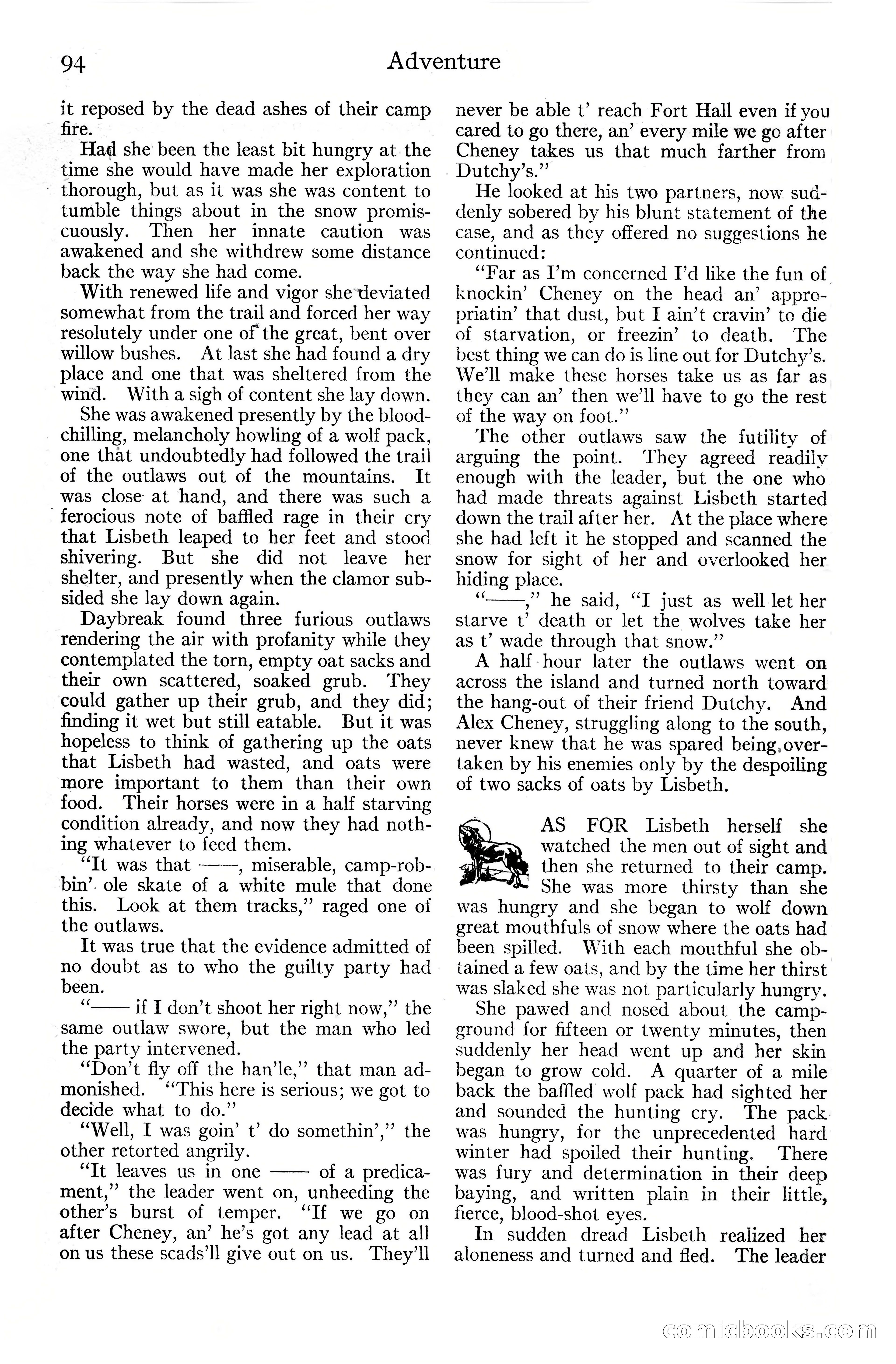
A restored page from Pulp Fiction, 1925. Page through the whole issue in the reader above.
📄 Transcribed text from this page (OCR, searchable)
Machine-transcribed from the original scan — historical spelling and the odd misread are preserved.
94 it reposed by the dead ashes of their camp fire. . Had she been the least bit hungry at the time she would have made her exploration ' thorough, but as it was she was content to tumble things about in the snow promis- cuously. Then her innate caution was awakened and she withdrew some distance back the way she had come. With renewed life and vigor she ‘deviated somewhat from the trail and forced her way resolutely under one of the great, bent over willow bushes. At last she had found a dry place and one that was sheltered from the wind. With a sigh of content she lay down. She was awakened presently by the blood- chilling, melancholy howling of a wolf pack, one that undoubtedly had followed the trail of the outlaws out of the mountains. It was close at hand, and there was such a ferocious note of baffled rage in their cry that Lisbeth leaped to her feet and stood shivering. But she did not leave her shelter, and presently when the clamor sub- sided she lay down again. Daybreak found three furious outlaws rendering the air with profanity while they contemplated the torn, empty oat sacks and their own scattered, soaked grub. They could gather up their grub, and they did; finding it wet but still eatable. But it was hopeless to think of gathering up the oats that Lisbeth had wasted, and oats were more important to them than their own food. Their horses were in a half starving condition already, and now they had noth- ing whatever to feed them. “It was that , miserable, camp-rob- bin’. ole skate of a white mule that done this. Look at them tracks,” raged one of the outlaws. It was true that the evidence admitted of no doubt as to who the guilty party had been. - if I don’t shoot her right now,” the © same outlaw swore, but the man who led the party intervened. “Don’t fly off the han’le,” that man ad- monished. ‘This here is serious; we got to decide what to do.” “Well, I was goin’ t’ do somethin’,” the other retorted angrily. “It leaves us in one of a predica- ment,” the leader went on, unheeding the other’s burst of temper. “If we go on after Cheney, an’ he’s got any lead at all on us these scads’ll give out on us. They’il Adventure never be able t’ reach Fort Hall even if you cared to go there, an’ every mile we go after Cheney takes us that much farther from Dutchy’s.”’ He looked at his two partners, now sud- denly sobered by his blunt statement of the case, and as they offered no suggestions he continued: ‘Far as I’m concerned I’d like the fun of knockin’ Cheney on the head an’ appro- priatin’ that dust, but I ain’t cravin’ to die of starvation, or freezin’ to death. The best thing we can do is line out for Dutchy’s. We'll make these horses take us as far as they can an’ then we'll have to go the rest of the way on foot.” The other outlaws saw the futility of arguing the point. They agreed readily enough with the leader, but the one who had made threats against Lisbeth started down the trail after her. At the place where she had left it he stopped and scanned the snow for sight of her and overlooked her hiding place. ‘““——.”? he said, “I just as well let her starve t’ death or let the wolves take her as t’ wade through that snow.” A half-hour later the outlaws went on across the island and turned north toward the hang-out of their friend Dutchy. And Alex Cheney, struggling along to the south, never knew that he was spared being, over- taken by his enemies only by the despoiling of two sacks of oats by Lisbeth. AS FOR Lisbeth herself she watched the men out of sight and then she returned to their camp. “ She was more thirsty than she was hungry and she began to wolf down great mouthfuls of snow where the oats had been spilled. With each mouthful she ob- tained a few oats, and by the time her thirst was slaked she was not particularly hungry. She pawed and nosed about the camp- ground for fifteen or twenty minutes, then suddenly her head went up and her skin began to grow cold. A quarter of a mile back the baffled wolf pack had sighted her and sounded the hunting cry. The pack. was hungry, for the unprecedented hard winter had spoiled their hunting. There was fury and determination in their deep baying, and written plain in their little, fierce, blood-shot eyes. In sudden dread Lisbeth realized her aloneness and turned and fled. The leader COMIGDIOOKSEEO