
Pulp Fiction, 1925 · page 172 of 212
Adventure Magazine Cover, June 20, 1925 — page 172: what you’re looking at
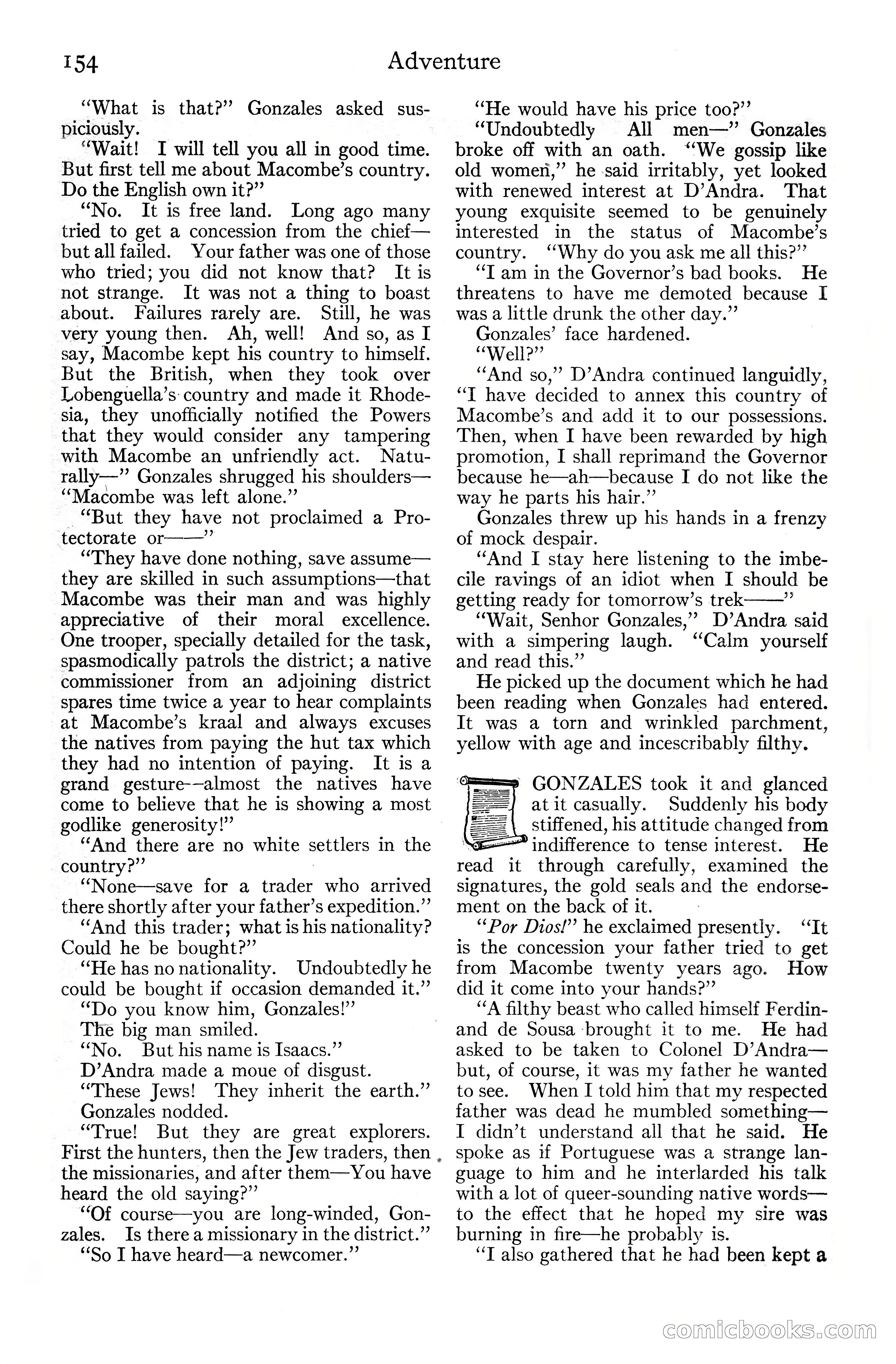
A restored page from Pulp Fiction, 1925. Page through the whole issue in the reader above.
📄 Transcribed text from this page (OCR, searchable)
Machine-transcribed from the original scan — historical spelling and the odd misread are preserved.
154 “What is that?” Gonzales asked sus- piciously. “Wait! I will tell you all in good time. But first tell me about Macombe’s country. Do the English own it?” “No. It is free land. Long ago many tried to get a concession from the chief— but all failed. Your father was one of those who tried; you did not know that? It is not strange. It was not a thing to boast about. Failures rarely are. Still, he was very young then. Ah, well! And so, as I say, Macombe kept his country to himself. But the British, when they took over Lobenguella’s: country and made it Rhode- sia, they unofficially notified the Powers that they would consider any tampering with Macombe an unfriendly act. Natu- rally—” Gonzales shrugged his shoulders— ‘Macombe was left alone.” “But they have not proclaimed a Pro- tectorate or——” ‘“‘They have done nothing, save assume— they are skilled in such assumptions—that Macombe was their man and was highly appreciative of their moral excellence. One trooper, specially detailed for the task, spasmodically patrols the district; a native commissioner from an adjoining district spares time twice a year to hear complaints at Macombe’s kraal and always excuses the natives from paying the hut tax which they had no intention of paying. It is a grand gesture-—almost the natives have come to believe that he is showing a most godlike generosity!” “And there are no white settlers in the country?” ‘“‘None—save for a nader who arrived there shortly after your father’s expedition.”’ ‘“‘And this trader; what is his nationality? Could he be bought?” “He has no nationality. Undoubtedly he could be bought if occasion demanded it.” “Do you know him, Gonzales!’ The big man smiled. “No. But his name is Isaacs.” D’Andra made a moue of disgust. “These Jews! They inherit the earth.” Gonzales nodded. “True! But they are great explorers. First the hunters, then the Jew traders, then , the missionaries, and after them—You have heard the old saying?” “Of course—you are long-winded, Gon- zales. Is there a missionary in the district.” “So I have heard—a newcomer.”’ Adventure “He would have his price too?”’ “Undoubtedly All men—” Gonzales broke off with an oath. “‘We gossip like old women,” he said irritably, yet looked with renewed interest at D’Andra. That young exquisite seemed to be genuinely interested in the status of Macombe’s country. “Why do you ask me all this?” “T am in the Governor’s bad books. He threatens to have me demoted because I was a little drunk the other day.” Gonzales’ face hardened. ‘“Well?”’ ‘And so,” D’Andra continued languidly, “I have decided to annex this country of Macombe’s and add it to our possessions. Then, when I have been rewarded by high promotion, I shall reprimand the Governor because he—ah—because I do not like the way he parts his hair.”’ Gonzales threw up his hands in a frenzy of mock despair. ‘“‘And I stay here listening to the imbe- cile ravings of an idiot when I should be getting ready for tomorrow’s trek ‘Wait, Senhor Gonzales,’’ D’Andra said with a simpering laugh. ‘‘Calm yourself and read this.” He picked up the document which he had been reading when Gonzales had entered. It was a torn and wrinkled parchment, yellow with age and incescribably filthy. === GONZALES took it and glanced at it casually. Suddenly his body stiffened, his attitude changed from indifference to tense interest. He read it through carefully, examined the signatures, the gold seals and the endorse- ment on the back of it. “Por Dios!” he exclaimed presently. “It is the concession your father tried to get from Macombe twenty years ago. How did it come into your hands?” ‘A filthy beast who called himself Ferdin- and de Sousa brought it to me. He had asked to be taken to Colonel D’Andra— but, of course, it was my father he wanted tosee. When I told him that my respected father was dead he mumbled something— I didn’t understand all that he said. He spoke as if Portuguese was a strange lan- guage to him and he interlarded his talk with a lot of queer-sounding native words— to the effect that he hoped my sire was burning in fire—he probably is. “T also gathered that he had been kept a | | | aa COMIGDIOOKSEEO