
Pulp Fiction, 1925 · page 175 of 212
Adventure Magazine Cover, June 20, 1925 — page 175: what you’re looking at
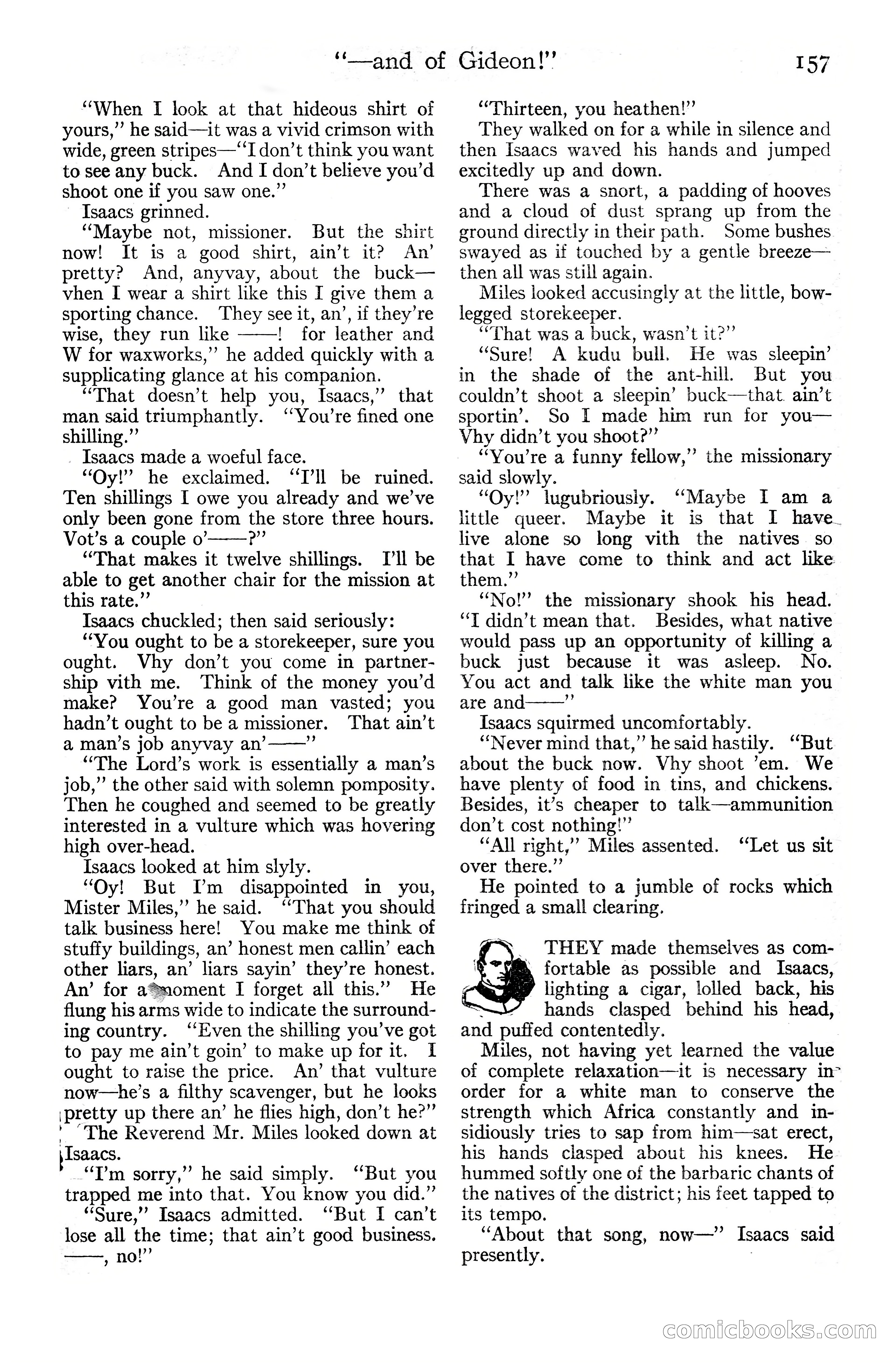
A restored page from Pulp Fiction, 1925. Page through the whole issue in the reader above.
📄 Transcribed text from this page (OCR, searchable)
Machine-transcribed from the original scan — historical spelling and the odd misread are preserved.
‘and of Gideon!”’ ‘When I look at that hideous shirt of yours,” he said—it was a vivid crimson with wide, green stripes—“I don’t think you want to see any buck. And I don’t believe you’d shoot one if you saw one.” - Isaacs grinned. “Maybe not, missioner. But the shirt now! It is a good shirt, ain’t it? An’ pretty? And, anyvay, about the buck— vhen I wear a shirt like this I give them a sporting chance. ‘They see it, an’, if they’re wise, they run like ! for leather and W for waxworks,” he added quickly with a supplicating glance at his companion. “That doesn’t help you, Isaacs,” that man said triumphantly. ‘You're fined one shilling.” Isaacs made a woeful face. “Oy!” he exclaimed. “I’ll be ruined. Ten shillings I owe you already and we’ve only been gone from the store three hours. Vot’s a couple o’ P” “That makes it twelve shillings. Tl be able to get another chair for the mission at this rate.”’ Isaacs chuckled; then said seriously: ‘You ought to be a storekeeper, sure you ought. Vhy don’t you come in partner- ship vith me. Think of the money you’d make? You’re a good man vasted; you hadn’t ought to be a missioner. That ain’t a man’s job anyvay an’——” “The Lord’s work is essentially a man’s job,” the other said with solemn pomposity. Then he coughed and seemed to be greatly interested in a vulture which was hovering high over-head. Isaacs looked at him slyly. “Oy! But I’m disappointed in you, Mister Miles,”’ he said. ‘That you should talk business here! You make me think of stuffy buildings, an’ honest men callin’ each other liars, an’ liars sayin’ they’re honest. An’ for a®moment I forget all this.” He flung his arms wide to indicate the surround- ing country. ‘Even the shilling you’ve got to pay me ain’t goin’ to make up for it. I ought to raise the price. An’ that vulture now—he’s a filthy scavenger, but he looks \pretty up there an’ he flies high, don’t he?”’ ' “The Reverend Mr. Miles looked down at Isaacs. “I’m sorry,” he said simply. “But you trapped me into that. You know you did.” “Sure,” Isaacs admitted. “But I can’t lose all the time; that ain’t good business. no!”’ 157 ‘Thirteen, you heathen!’ They walked on for a while in silence and then Isaacs waved his hands and jumped excitedly up and down. There was a snort, a padding of hooves and a cloud of dust sprang up from the ground directly in their path. Some bushes swayed as if touched by a gentle breeze— then all was still again. . Miles looked accusingly at the little, bow- legged storekeeper. “That was a buck, wasn’t it?” “Sure! A kudu bull. He was sleepin’ in the shade of the ant-hill. But you couldn’t shoot a sleepin’ buck—that. ain’t sportin’. So I made him run for you— Vhy didn’t you shoot?” “You're a funny fellow,” the missionary said slowly. “Oy!” lugubriously. “Maybe I am a little queer. Maybe it is that I have_ live alone so long vith the natives. so that I have come to think and act like them.” “No!” the missionary shook his head. “T didn’t mean that. Besides, what native would pass up an opportunity of killing a buck just because it was asleep. No. You act and talk like the white man you are and——’”’ Isaacs squirmed uncomfortably. “Never mind that,” he said hastily. “But about the buck now. Vhy shoot ’em. We have plenty of food in tins, and chickens. Besides, it’s cheaper to talk—ammunition don’t cost nothing!” “All right,” Miles assented. over there.”’ He pointed to a jumble of rocks which fringed a small clearing. “Let us sit THEY made themselves as com- @ fortable as possible and Isaacs, “ey lighting a cigar, lolled back, his hands clasped behind his head, and puffed contentedly. Miles, not having yet learned the value of complete relaxation—it is necessary in- order for a white man to conserve the strength which Africa constantly and in- sidiously tries to sap from him—sat erect, his hands clasped about his knees. He hummed softly one of the barbaric chants of the natives of the district; his feet tapped to its tempo. “About that song, now—” Isaacs said presently. COMIGDIOOKSEEO