
Pulp Fiction, 1925 · page 206 of 212
Adventure Magazine Cover, June 20, 1925 — page 206: what you’re looking at
A restored page from Pulp Fiction, 1925. Page through the whole issue in the reader above.
📄 Transcribed text from this page (OCR, searchable)
Machine-transcribed from the original scan — historical spelling and the odd misread are preserved.
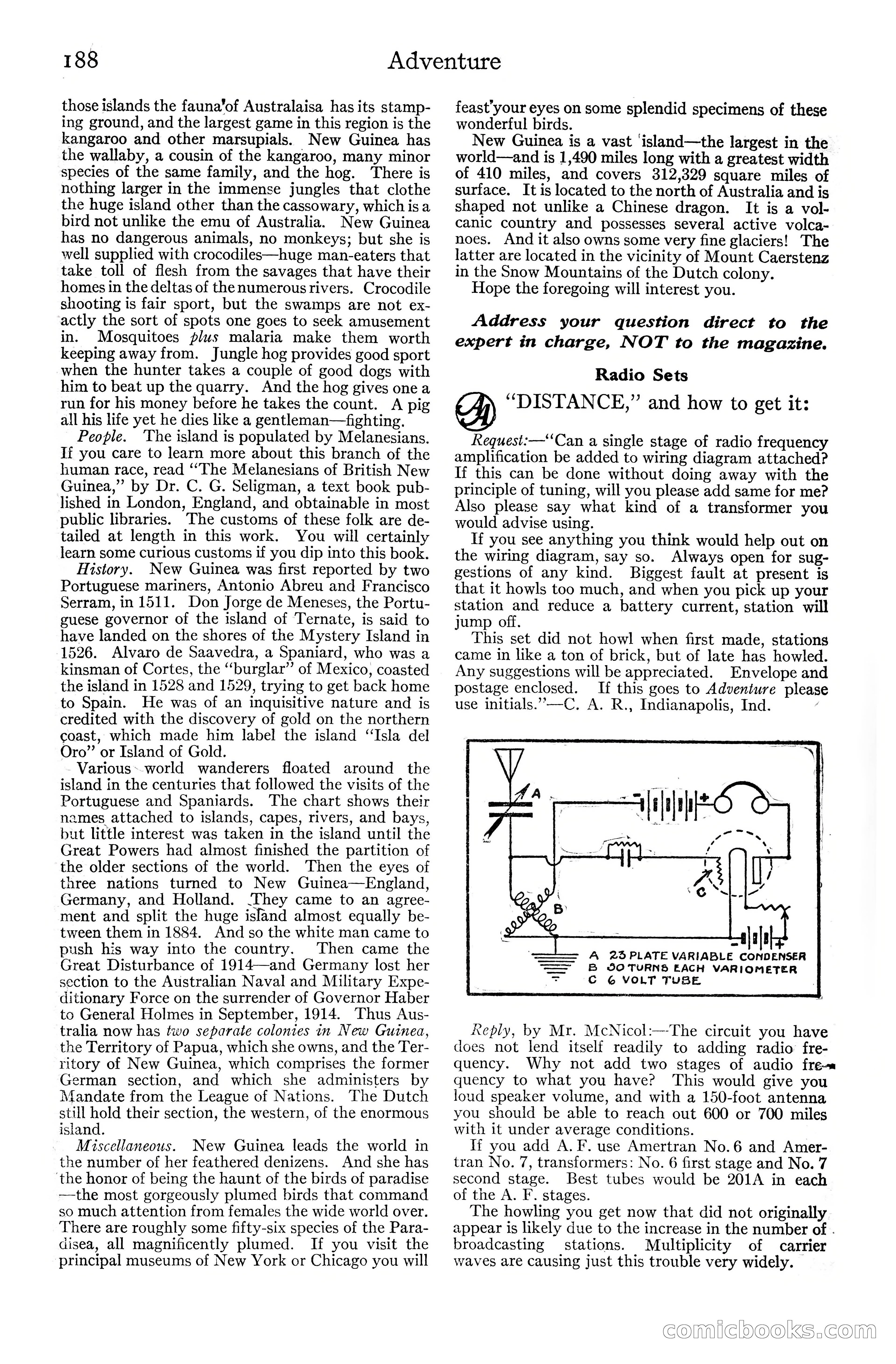
I 88 those islands the fauna’of Australaisa has its stamp- ing ground, and the largest game in this region is the kangaroo and other marsupials. New Guinea has the wallaby, a cousin of the kangaroo, many minor species of the same family, and the hog. There is nothing larger in the immense jungles that clothe the huge island other than the cassowary, which is a bird not unlike the emu of Australia. New Guinea has no dangerous animals, no monkeys; but she is well supplied with crocodiles—huge man-eaters that take toll of flesh from the savages that have their homes in the deltas of thenumerous rivers. Crocodile shooting is fair sport, but the swamps are not ex- actly the sort of spots one goes to seek amusement in. Mosquitoes plus malaria make them worth keeping away from. Jungle hog provides good sport when the hunter takes a couple of good dogs with him to beat up the quarry. And the hog gives one a run for his money before he takes the count. A pig all his life yet he dies like a gentleman—fighting. People. The island is populated by Melanesians. If you care to learn more about this branch of the human race, read “‘“The Melanesians of British New Guinea,” by Dr. C. G. Seligman, a text book pub- lished in London, England, and obtainable in most public libraries. The customs of these folk are de- tailed at length in this work. You will certainly learn some curious customs if you dip into this book. History. New Guinea was first reported by two Portuguese mariners, Antonio Abreu and Francisco Serram, in 1511. Don Jorge de Meneses, the Portu- guese governor of the island of Ternate, is said to have landed on the shores of the Mystery Island in 1526. Alvaro de Saavedra, a Spaniard, who was a kinsman of Cortes, the “burglar” of Mexico, coasted the island in 1528 and 1529, trying to get back home to Spain. He was of an inquisitive nature and is credited with the discovery of gold on the northern coast, which made him label the island ‘‘Isla del Oro” or Island of Gold. Various~world wanderers floated around the island in the centuries that followed the visits of the Portuguese and Spaniards. The chart shows their names attached to islands, capes, rivers, and bays, but little interest was taken in the island until the Great Powers had almost finished the partition of the older sections of the world. Then the eyes of three nations turned to New Guinea—England, Germany, and Holland. ‘They came to an agree- ment and split the huge island almost equally be- tween them in 1884. And so the white man came to push his way into the country. Then came the Great Disturbance of 1914—and Germany lost her section to the Australian Naval and Military Expe- ditionary Force on the surrender of Governor Haber to General Holmes in September, 1914. Thus Aus- tralia now has two separate colonies in New Guinea, the Territory of Papua, which she owns, and the Ter- ritory of New Guinea, which comprises the former German section, and which she administers by Mandate from the League of Nations. The Dutch still hold their section, the western, of the enormous island. Miscellaneous. New Guinea leads the world in the number of her feathered denizens. And she has ‘the honor of being the haunt of the birds of paradise —the most gorgeously plumed birds that command so much attention from females the wide world over. There are roughly some fifty-six species of the Para- disea, all magnificently plumed. If you visit the principal museums of New York or Chicago you will Adventure feast’your eyes on some splendid specimens of these wonderful birds. New Guinea is a vast ‘island—the largest in the world—and is 1,490 miles long with a greatest width of 410 miles, and covers 312,329 square miles of surface. It is located to the north of Australia and is shaped not unlike a Chinese dragon. It is a vol- canic country and possesses several active volca- noes. And it also owns some very fine glaciers! The latter are located in the vicinity of Mount Caerstenz in the Snow Mountains of the Dutch colony. Hope the foregoing will interest you. Address your question direct to the expert in charge, NOT to the magazine. Radio Sets 4) “DISTANCE,” and how to get it: Request: —Can a single stage of radio frequency amplification be added to wiring diagram attached? If this can be done without doing away with the principle of tuning, will you please add same for me? Also please say what kind of a transformer you would advise using. If you see anything you think would help out on the wiring diagram, say so. Always open for sug- gestions of any kind. Biggest fault at present is that it howls too much, and when you pick up your station and reduce a battery current, station will jump off. This set did not howl when first made, stations came in like a ton of brick, but of late has howled. Any suggestions will be appreciated. Envelope and postage enclosed. If this goes to Adventure please use initials.’”’—C, A. R., Indianapolis, Ind. : A 23 PLATE VARIABLE CONDENSER B JO TURNS EACH VARIOMETER C 6 VOLT TUBE Reply, by Mr. McNicol:—The circuit you have does not lend itself readily to adding radio: fre- quency. Why not add two stages of audio fre quency to what you have? This would give you loud speaker volume, and with a 150-foot antenna you should be able to reach out 600 or 700 miles with it under average conditions. If you add A. F. use Amertran No.6 and Amer- tran No. 7, transformers: No. 6 first stage and No. 7 second stage. Best tubes would be 201A in each of the A. F. stages. The howling you get now that did not originally appear is likely due to the increase in the number of . broadcasting stations. Multiplicity of carrier waves are causing just this trouble very widely. COMIGDIOOKSEEO