
Pulp Fiction, 1925 · page 50 of 212
Adventure Magazine Cover, June 20, 1925 — page 50: what you’re looking at
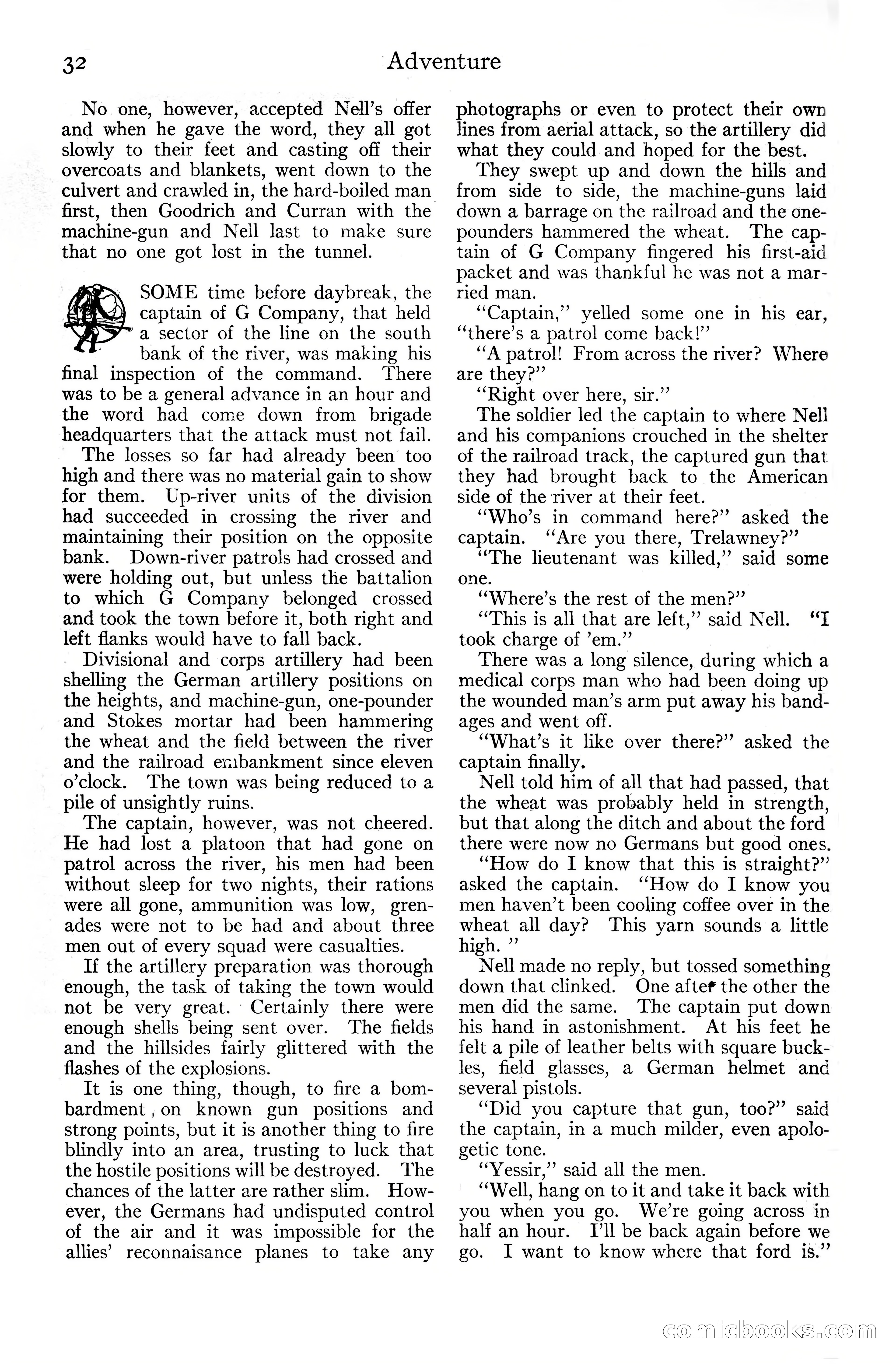
A restored page from Pulp Fiction, 1925. Page through the whole issue in the reader above.
📄 Transcribed text from this page (OCR, searchable)
Machine-transcribed from the original scan — historical spelling and the odd misread are preserved.
a2 Adventure No one, however, accepted Nell’s offer and when he gave the word, they all got slowly to their feet and casting off their overcoats and blankets, went down to the culvert and crawled in, the hard-boiled man first, then Goodrich and Curran with the machine-gun and Nell last to make sure that no one got lost in the tunnel. a€ ; \r SOME time before daybreak, the 42} captain of G Company, that held ~ a sector of the line on the south bank of the river, was making his final inspection of the command. There was to be a general advance in an hour and the word had come down from brigade headquarters that the attack must not fail. _ The losses so far had already been too high and there was no material gain to show for them. Up-river units of the division had succeeded in crossing the river and maintaining their position on the opposite bank. Down-river patrols had crossed and were holding out, but unless the battalion to which G Company belonged crossed and took the town before it, both right and left flanks would have to fall back. Divisional and corps artillery had been shelling the German artillery positions on the heights, and machine-gun, one-pounder and Stokes mortar had been hammering the wheat and the field between the river and the railroad ersbankment since eleven o’clock. The town was being reduced to a pile of unsightly ruins. The captain, however, was not cheered. He had lost a platoon that had gone on patrol across the river, his men had been without sleep for two nights, their rations were all gone, ammunition was low, gren- ades were not to be had and about three men out of every squad were casualties. If the artillery preparation was thorough enough, the task of taking the town would not be very great. Certainly there were enough shells being sent over. The fields and the hillsides fairly glittered with the flashes of the explosions. It is one thing, though, to fire a bom- bardment ,on known gun positions and strong points, but it is another thing to fire blindly into an area, trusting to luck that the hostile positions will be destroyed. ‘The chances of the latter are rather slim. How- ever, the Germans had undisputed control of the air and it was impossible for the allies’ reconnaisance planes to take any photographs or even to protect their own lines from aerial attack, so the artillery did what they could and hoped for the best. They swept up and down the hills and from side to side, the machine-guns laid down a barrage on the railroad and the one- pounders hammered the wheat. The cap- tain of G Company fingered his first-aid packet and was thankful he was not a mar- ried man. “Captain,” yelled some one in his ear, “‘there’s a patrol come back!” ‘““A patrol! From across the river? Where are they?” “Right over here, sir.” The soldier led the captain to where Nell and his companions crouched in the shelter of the railroad track, the captured gun that they had brought back to the American side of the river at their feet. ‘‘Who’s in command here?” asked the captain. ‘Are you there, Trelawney?” “The lieutenant was killed,’ said some one. ““Where’s the rest of the men?” “This is all that are left,” said Nell. “TI took charge of ’em.”’ There was a long silence, during which a medical corps man who had been doing up the wounded man’s arm put away his band- ages and went off. ‘“What’s it like over there?” asked the captain finally. Nell told him of all that had passed, that the wheat was probably held in strength, but that along the ditch and about the ford there were now no Germans but good ones. “How do I know that this is straight?” asked the captain. ‘How do I know you men haven’t been cooling coffee over in the wheat all day? This yarn sounds a little high. ” Nell made no reply, but tossed something down that clinked. One afte the other the men did the same. The captain put down his hand in astonishment. At his feet he felt a pile of leather belts with square buck- les, field glasses, a German helmet and several pistols. “Did you capture that gun, too?” said the captain, in a much milder, even apolo- getic tone. “Yessir,” said all the men. ‘Well, hang on to it and take it back with you when you go. We’re going across in half an hour. Ill be back again before we go. I want to know where that ford is.” COMIGDIOOKSEEO