
Pulp Fiction, 1925 · page 98 of 212
Adventure Magazine Cover, June 20, 1925 — page 98: what you’re looking at
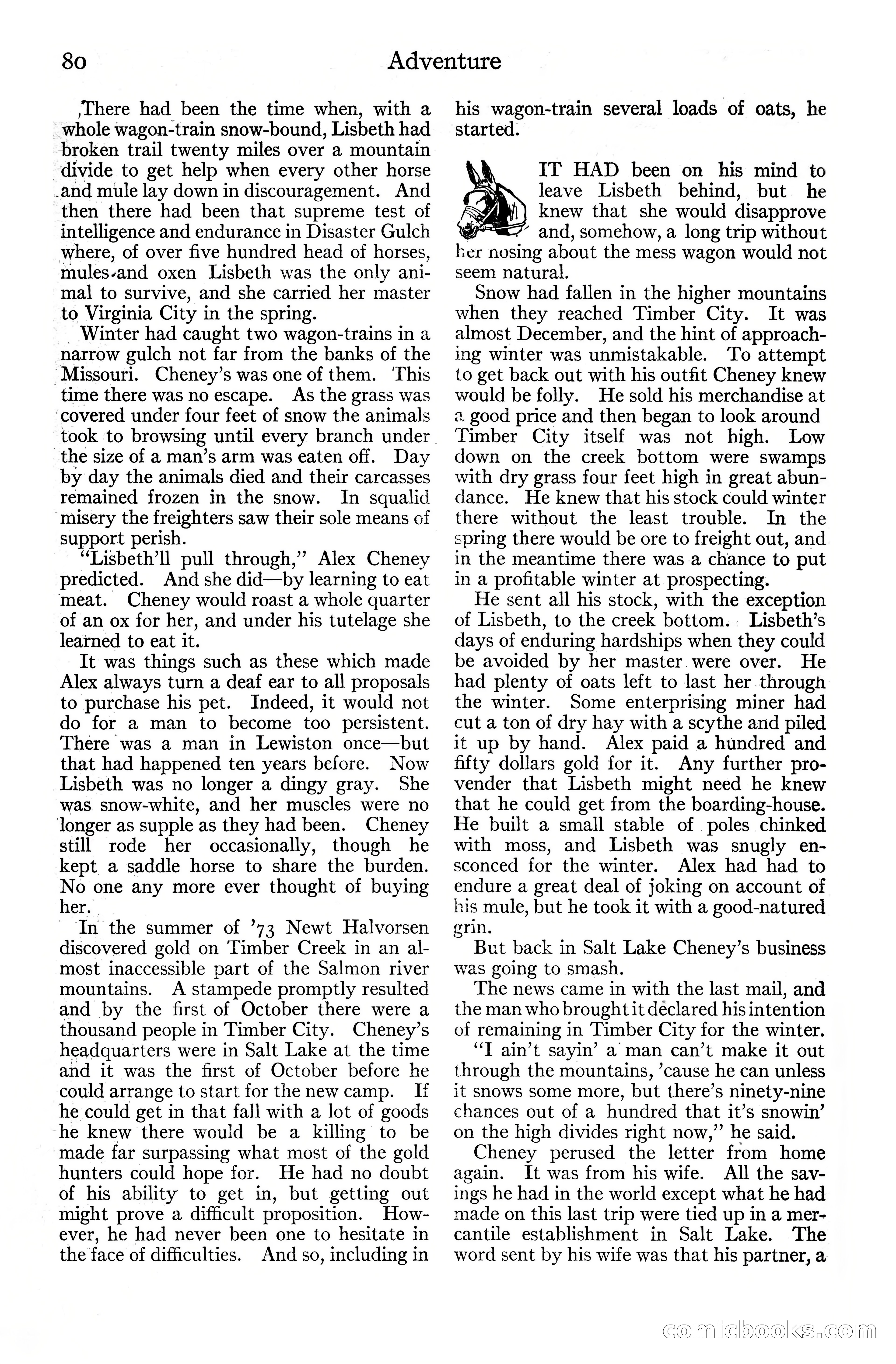
A restored page from Pulp Fiction, 1925. Page through the whole issue in the reader above.
📄 Transcribed text from this page (OCR, searchable)
Machine-transcribed from the original scan — historical spelling and the odd misread are preserved.
80 There had been the time when, with a whole wagon-train snow-bound, Lisbeth had broken trail twenty miles over a mountain ‘divide to get help when every other horse .and mule lay down in discouragement. And then there had been that supreme test of intelligence and endurance in Disaster Gulch where, of over five hundred head of horses, mules-and oxen Lisbeth was the only ani- mal to survive, and she carried her master to Virginia City in the spring. _ Winter had caught two wagon-trains in a narrow gulch not far from the banks of the ‘Missouri. Cheney’s was one of them. ‘This time there was no escape. As the grass was ‘covered under four feet of snow the animals took to browsing until every branch under | the size of a man’s arm was eaten off. Day by day the animals died and their carcasses remained frozen in the snow. In squalid ‘misery the freighters saw their sole means of support perish. “Lisbeth’ll pull through,’ Alex Cheney predicted. And she did—by learning to eat meat. Cheney would roast a whole quarter of an ox for her, and under his tutelage she learned to eat it. It was things such as these which made Alex always turn a deaf ear to all proposals to purchase his pet. Indeed, it would not do for a man to become too persistent. There was a man in Lewiston once—but that had happened ten years before. Now Lisbeth was no longer a dingy gray. She was snow-white, and her muscles were no longer as supple as they had been. Cheney still rode her occasionally, though he kept a saddle horse to share the burden. No one any more ever thought of buying her. - In the summer of ’73 Newt Halvorsen discovered gold on Timber Creek in an al- most inaccessible part of the Salmon river mountains. A stampede promptly resulted and by the first of October there were a thousand people in Timber City. Cheney’s headquarters were in Salt Lake at the time and it was the first of October before he could arrange to start for the new camp. Ii he could get in that fall with a lot of goods he knew there would be a killing to be made far surpassing what most of the gold hunters could hope for. He had no doubt of his ability to get in, but getting out might prove a difficult proposition. How- ever, he had never been one to hesitate in the face of difficulties. And so, including in Adventure his wagon-train several loads of oats, he started. IT HAD been on his mind to leave Lisbeth behind, but he knew that she would disapprove and, somehow, a long trip without her nosing about the mess wagon would not seem natural. Snow had fallen in the higher mountains when they reached Timber City. It was almost December, and the hint of approach- ing winter was unmistakable. To attempt to get back out with his outfit Cheney knew would be folly. He sold his merchandise at a good price and then began to look around Timber City itself was not high. Low down on the creek bottom were swamps with dry grass four feet high in great abun- dance. He knew that his stock could winter there without the least trouble. In the spring there would be ore to freight out, and in the meantime there was a chance to put in a profitable winter at prospecting. He sent all his stock, with the exception of Lisbeth, to the creek bottom. Lisbeth’s days of enduring hardships when they could be avoided by her master were over. He had plenty of oats left to last her through the winter. Some enterprising miner had cut a ton of dry hay with a scythe and piled it up by hand. Alex paid a hundred and fifty dollars gold for it. Any further pro- vender that Lisbeth might need he knew that he could get from the boarding-house. He built a small stable of poles chinked with moss, and Lisbeth was snugly en- sconced for the winter. Alex had had to endure a great deal of joking on account of his mule, but he took it with a good-natured grin. But back in Salt Lake Cheney’s business was going to smash. The news came in with the last mail, and the man who brought it declared his intention of remaining in ‘Timber City for the winter. “T ain’t sayin’ a man can’t make it out through the mountains, ’cause he can unless it snows some more, but there’s ninety-nine chances out of a hundred that it’s snowin’ on the high divides right now,” he said. Cheney perused the letter from home again. It was from his wife. All the sav- ings he had in the world except what he had made on this last trip were tied up in a mer- cantile establishment in Salt Lake. The word sent by his wife was that his partner, a COMmiclboookks.CO