
Pulp Fiction, 1913 · page 119 of 192
Ainslee's Magazine, February 1913 — page 119: what you’re looking at
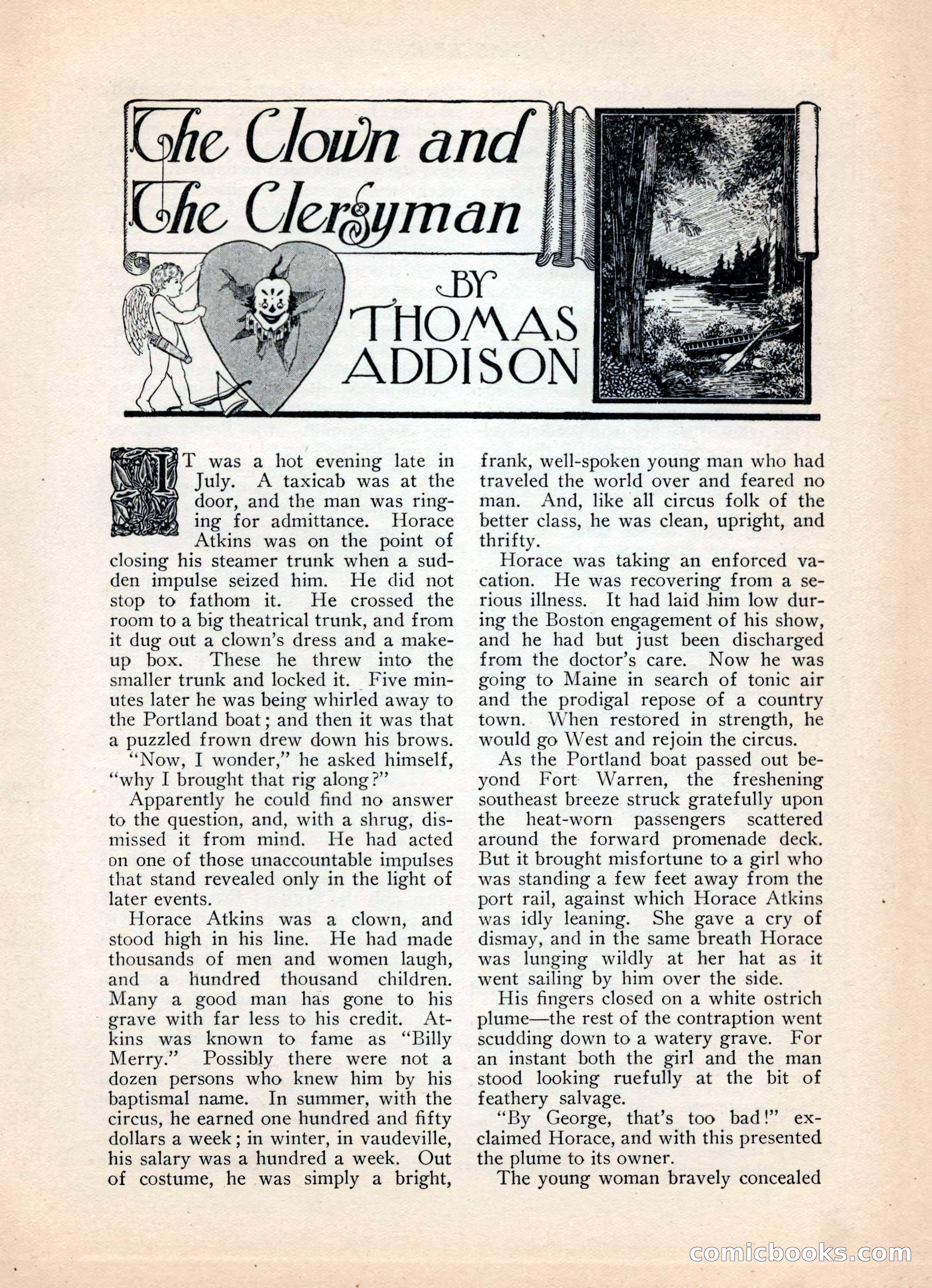
A restored page from Pulp Fiction, 1913. Page through the whole issue in the reader above.
📄 Transcribed text from this page (OCR, searchable)
Machine-transcribed from the original scan — historical spelling and the odd misread are preserved.
#T was a hot evening late in July. A taxicab was at the door, and the man was ring- ing for admittance. Horace Atkins was on the point of closing his steamer trunk when a sud- den impulse seized him. He did not stop to fathom it. He crossed the room to a big theatrical trunk, and from it dug out a clown’s dress and a make- up box. These he threw into the smaller trunk and locked it. Five min- utes later he was being whirled away to the Portland boat; and then it was that a puzzled frown drew down his brows. “Now, I wonder,” he asked himself, “why I brought that rig along?” Apparently he could find no answer to the question, and, with a shrug, dis- missed it from mind. He had acted on one of those unaccountable impulses that stand revealed only in the light of later events. Horace Atkins was a clown, and stood high in his line. He had made thousands of men and women laugh, and a hundred thousand children. Many a good man has gone to his grave with far less to his credit. At- kins was known to fame as “Billy Merry.” Possibly there were not a dozen persons who knew him by his baptismal name. In summer, with the circus, he earned one hundred and fifty dollars a week; in winter, in vaudeville, his salary was a hundred a week. Out of costume, he was simply a bright, e Clergyman |} frank, well-spoken young man who had traveled the world over and feared no man. And, like all circus folk of the better class, he was clean, upright, and thrifty. Horace was taking an enforced va- cation. He was recovering from a se- rious illness. It had laid him low dur- ing the Boston engagement of his show, and he had but just been discharged from the doctor’s care. Now he was going to Maine in search of tonic air and the prodigal repose of a country town. When restored in strength, he would go West and rejoin the circus. As the Portland boat passed out be- yond Fort Warren, the freshening southeast breeze struck gratefully upon the heat-worn passengers scattered around the forward promenade deck. But it brought misfortune to a girl who was standing a few feet away from the port rail, against which Horace Atkins was idly leaning. She gave a cry of dismay, and in the same breath Horace was lunging wildly at her hat as it went sailing by him over the side. His fingers closed on a white ostrich plume—the rest of the contraption went scudding down to a watery grave. For an instant both the girl and the man stood looking ruefully at the bit of feathery salvage. “By George, that’s too bad!” ex- claimed Horace, and with this presented the plume to its owner. The young woman bravely concealed DNOOLK