
Pulp Fiction, 1913 · page 14 of 192
Ainslee's Magazine, February 1913 — page 14: what you’re looking at
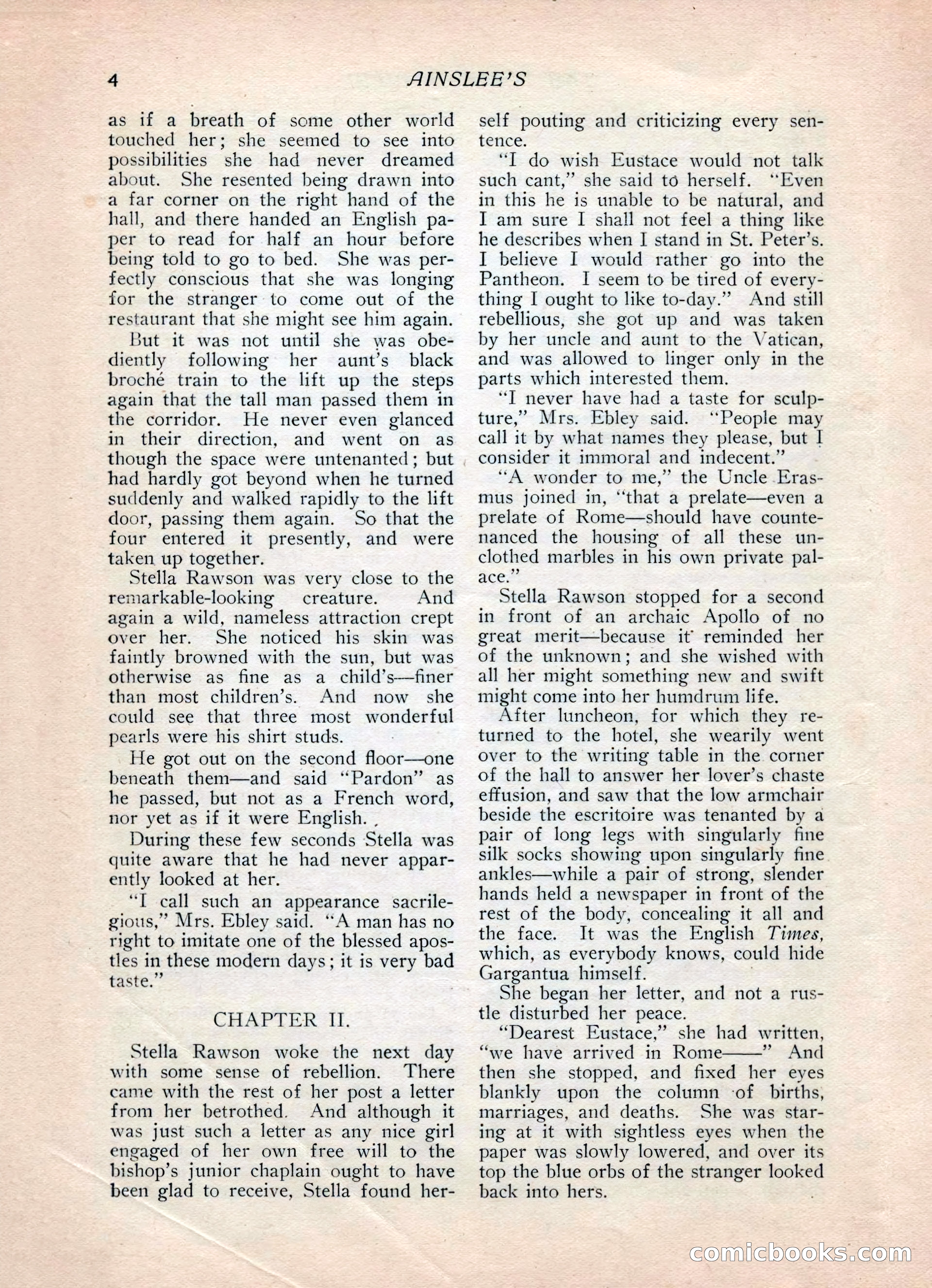
A restored page from Pulp Fiction, 1913. Page through the whole issue in the reader above.
📄 Transcribed text from this page (OCR, searchable)
Machine-transcribed from the original scan — historical spelling and the odd misread are preserved.
4 AINSLEE’S as if a breath of some other world touched her; she seemed to see into possibilities she had never dreamed about. She resented being drawn into a far corner on the right hand of the hall, and there handed an English pa- per to read for half an hour before being told to go to bed. She was per- fectly conscious that she was longing for the stranger to come out of the restaurant that she might see him again. But it was not until she was obe- diently following her aunt’s black broché train to the lift up the steps again that the tall man passed them in the corridor. He never even glanced in their direction, and went on as though the space were untenanted; but had hardly got beyond when he turned suddenly and walked rapidly to the lft door, passing them again. So that the four entered it presently, and were taken up together. Stella Rawson was very close to the remarkable-looking creature. And again a wild, nameless attraction crept over her. She noticed his skin was faintly browned with the sun, but was otherwise as fine as a _ child’s—finer than most children’s. And now she could see that three most wonderful pearls were his shirt studs. He got out on the second floor—one beneath them—and said “Pardon” as he passed, but not as a French word, nor yet as if it were English. , During these few seconds Stella was quite aware that he had never appar- ently looked at her. “Tl call such an appearance sacrile- gious,” Mrs. Ebley said. ‘A man has no right to imitate one of the blessed apos- tles in these modern days; it is very bad taste.” CHAPTER II. Stella Rawson woke the next day with some sense of rebellion. There came with the rest of her post a letter from her betrothed. And although it was just such a letter as any nice girl engaged of her own free will to the bishop’s junior chaplain ought to have been glad to receive, Stella found her- self pouting and criticizing every sen- tence. “I do wish Eustace would not talk such cant,” she said to herself. “Even in this he is unable to be natural, and I am sure I shall not feel a thing like he describes when I stand in St. Peter’s. I believe I would rather go into the Pantheon. I seem to be tired of every- thing I ought to like to-day.” And still rebellious, she got up and was taken by her uncle and aunt to the Vatican, and was allowed to linger only in the parts which interested them. ‘“T never have had a taste for sculp- ture,’ Mrs. Ebley said. ‘People may call it by what names they please, but | consider it immoral and indecent.” “A wonder to me,” the Uncle -Eras- mus joined in, “that a prelate—even a prelate of Rome—should have counte- nanced the housing of all these un- clothed marbles in his own private pal- aces Stella Rawson stopped for a second in front of an archaic Apollo of no great merit—because it’ reminded her of the unknown; and she wished with all her might something new and swift might come into her humdrum life. After luncheon, for which they re- turned to the hotel, she wearily went over to the writing table in the corner of the hall to answer her lover’s chaste effusion, and saw that the low armchair beside the escritoire was tenanted by a pair of long legs with singularly fine silk socks showing upon singularly fine ankles—while a pair of strong, slender hands held a newspaper in front of the rest of the body, concealing it all and the face. It was the English Times, which, as everybody knows, could hide Gargantua himself. : She began her letter, and not a rus- tle disturbed her peace. “Dearest Eustace,” she had written, “we have arrived in Rome ” And then she stopped, and fixed her eyes blankly upon the column ‘of births, marriages, and deaths. She was star- ing at it with sightless eyes when the paper was slowly lowered, and over its top the blue orbs of the stranger looked back into hers. : (C@ OOK iGO