
Pulp Fiction, 1913 · page 148 of 192
Ainslee's Magazine, February 1913 — page 148: what you’re looking at
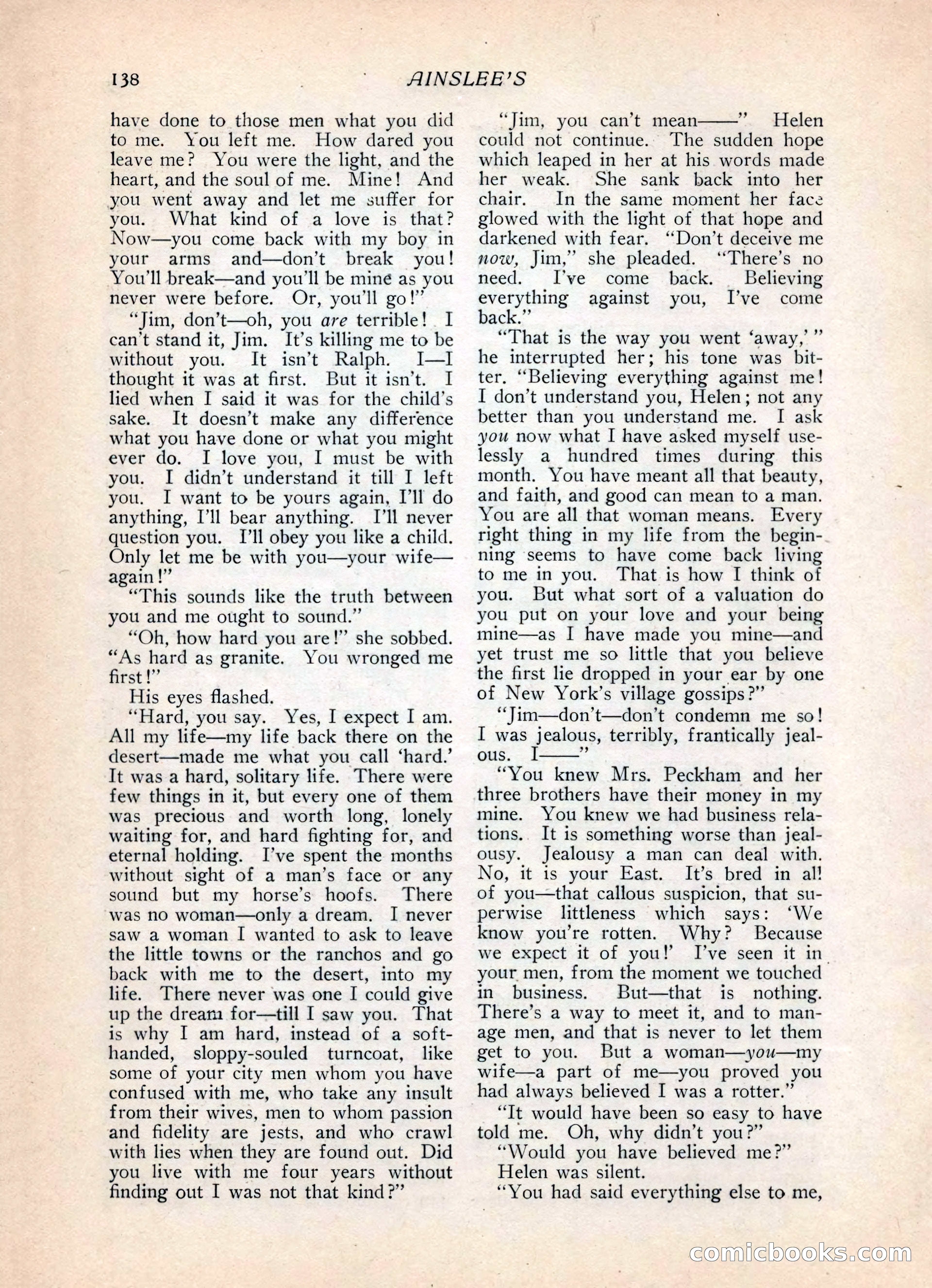
A restored page from Pulp Fiction, 1913. Page through the whole issue in the reader above.
📄 Transcribed text from this page (OCR, searchable)
Machine-transcribed from the original scan — historical spelling and the odd misread are preserved.
138 have done to those men what you did to me. You left me. How dared you leave me? You were the light, and the heart, and the soul of me. Mine! And you went away and let me suffer for you. What kind of a love is that? Now—you come back with my boy in your arms and—don’t break you! You'll break—and you'll be miné as you never were before. Or, you'll go!” “Jim, don’t—oh, you are terrible! I can't stand it, Jim. It’s killing me to be without you. It isn’t Ralph. I—I thought it was at first. But it isn’t. I lied when I said it was for the child’s sake. It doesn’t make any difference what you have done or what you might ever do. I love you, I must be with you. I didn’t understand it till I left you. I want to be yours again, I'll do anything, I’!l bear anything. I'll never question you. I'll obey you like a child. Only let me be with you—your wife— again!” “This sounds like the truth between you and me ought to sound.” “Oh, how hard you are!” she sobbed. “As hard as granite. You wronged me first!” His eyes flashed. “Hard, you say. Yes, I expect I am. All my life—my life back there on the desert—made me what you call ‘hard.’ It was a hard, solitary life. There were few things in it, but every one of them was precious and worth long, lonely waiting for, and hard fighting for, and eternal holding. I’ve spent the months without sight of a man’s face or any sound but my horse’s hoofs. There was no woman—only a dream. I never saw a woman I wanted to ask to leave the little towns or the ranchos and go back with me to the desert, into my life. There never was one I could give up the dream for—till I saw you. That is why I am hard, instead of a soft- handed, sloppy-souled turncoat, like some of your city men whom you have confused with me, who take any insult from their wives, men to whom passion and fidelity are jests, and who crawl with lies when they are found out. Did you live with me four years without finding out I was not that kind?” AINSLEE’S “Jim, you can’t mean Helen could not continue. The sudden hope which leaped in her at his words made her weak. She sank back into her chair. In the same moment her face glowed with the light of that hope and darkened with fear. ‘Don’t deceive me now, Jim,” she pleaded. ‘‘There’s no need. I’ve come back. _ Believing everything against you, I’ve come back.” “That is the way you went ‘away,’ ” he interrupted her; his tone was bit- ter. “Believing everything against me! I don’t understand you, Helen; not any better than you understand me. I ask you now what I have asked myself use- lessly a hundred times during this month. You have meant all that beauty, and faith, and good can mean to a man. You are all that woman means. Every right thing in my life from the begin- ning seems to have come back living to me in you. That is how I think of you. But what sort of a valuation do you put on your love and your being mine—as I have made you mine—and yet trust me so little that you believe the first lie dropped in your ear by one of New York’s village gossips?” “‘Jim—don’t—don’t condemn me so! I was jealous, terribly, frantically jeal- ous. I[ = “You knew Mrs. Peckham and her three brothers have their money in my mine. You knew we had business rela- tions.. It is something worse than jeal- ousy. Jealousy a man can deal with. No, it is your East. It’s bred in al! of you—that callous suspicion, that su- perwise littleness which says: ‘We know you're rotten. Why? Because we expect it of you!’ your men, from the moment we touched in business. But—that is nothing. There’s a way to meet it, and to man- age men, and that is never to let them get to you. But a woman—you—my wife—a part of me—you proved you had always believed I was a rotter.” “It would have been so easy to have told me. Oh, why didn’t you?” “Would you have believed me?” Helen was silent. “You had said everything else to me, (C@ AMUC DOOLK I’ve seen it in. (C@