
Pulp Fiction, 1913 · page 163 of 192
Ainslee's Magazine, February 1913 — page 163: what you’re looking at
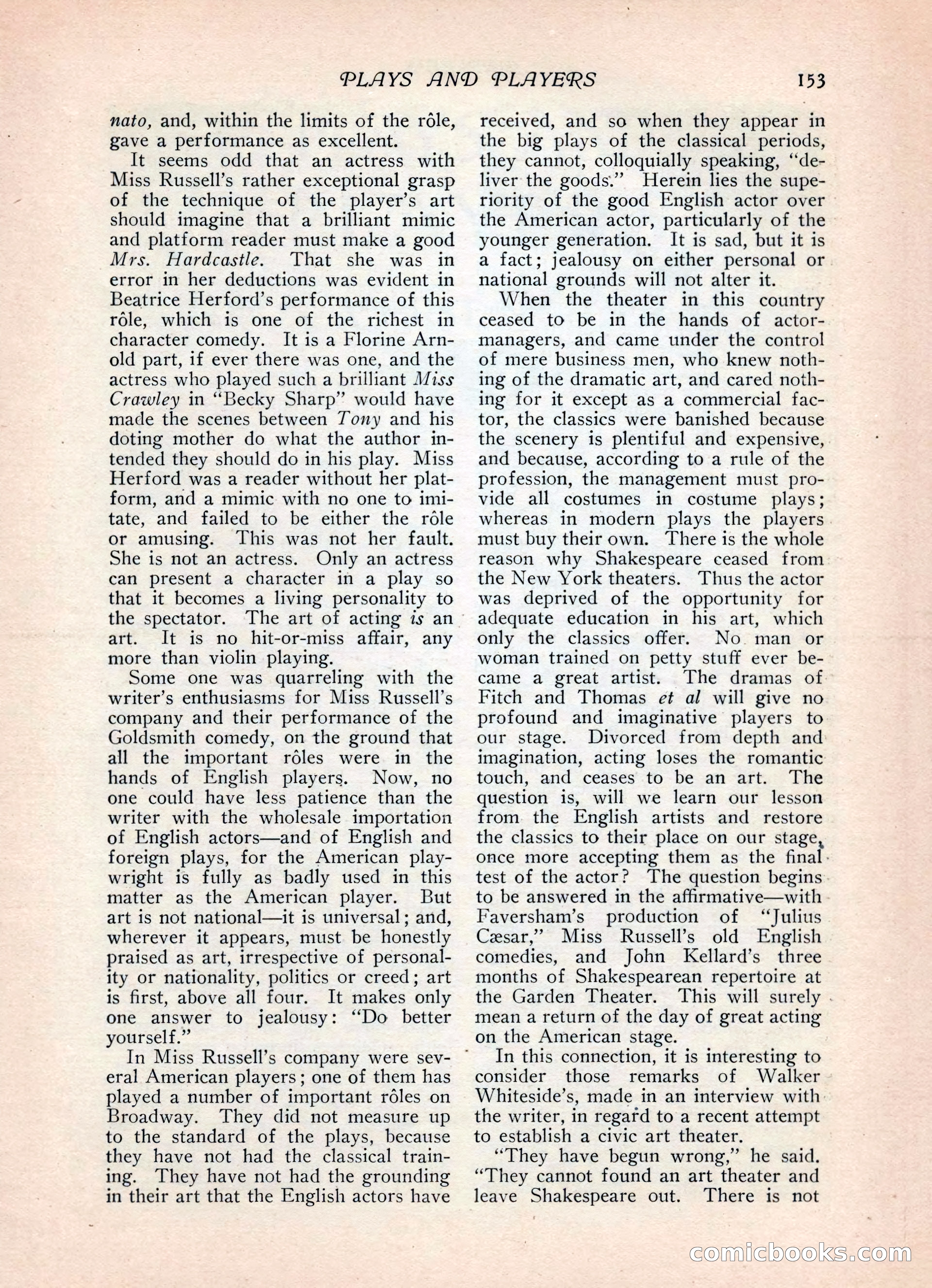
A restored page from Pulp Fiction, 1913. Page through the whole issue in the reader above.
📄 Transcribed text from this page (OCR, searchable)
Machine-transcribed from the original scan — historical spelling and the odd misread are preserved.
PLAYS AND PLAYERS nato, and, within the limits of the role, gave a performance as excellent. It seems odd that an actress with Miss Russell’s rather exceptional grasp of the technique of the player’s art should imagine that a brilliant mimic and platform reader must make a good Mrs. Hardcastle. That she was in error in her deductions was evident in Beatrice Herford’s performance of this role, which is one of the richest in character comedy. It is a Florine Arn- old part, if ever there was one, and the actress who played such a brilliant Miss Crawley in “Becky Sharp” would have made the scenes between Tony and his doting mother do what the author in- tended they should do in his play. Miss Herford was a reader without her plat- form, and a mimic with no one to imi- tate, and failed to be either the role or amusing. This was not her fault. She is not an actress. Only an actress can present a character in a play so that it becomes a living personality to the spectator. The art of acting is an art. It is no hit-or-miss affair, any more than violin playing. Some one was quarreling with the writer’s enthusiasms for Miss Russell’s company and their performance of the Goldsmith comedy, on the ground that all the important rdles were in the hands of English players. Now, no one could have less patience than the writer with the wholesale importation of English actors—and of English and foreign plays, for the American play- wright is fully as badly used in this matter as the American player. But art is not national—it is universal; and, wherever it appears, must be honestly praised as art, irrespective of personal- ity or nationality, politics or creed; art is first, above all four. It makes only one answer to jealousy: “Do better yourself.” In Miss Russell’s company were sev- — eral American players; one of them has played a number of important roles on Broadway. They did not measure up to the standard of the plays, because they have not had the classical train- ing. They have not had the grounding in their art that the English actors have 153 received, and so when they appear in the big plays of the classical periods, they cannot, colloquially speaking, “de- liver the goods.” Herein lies the supe- riority of the good English actor over the American actor, particularly of the younger generation. It is sad, but it is a fact; jealousy on either personal or national grounds will not alter it. When the theater in this country ceased to be in the hands of actor- managers, and came under the control of mere business men, who knew noth- ing of the dramatic art, and cared noth- ing for it except as a commercial fac- tor, the classics were banished because the scenery is plentiful and expensive, and because, according to a rule of the profession, the management must pro- vide all costumes in costume plays; whereas in modern plays the players must buy theirown. There is the whole reason why Shakespeare ceased from the New York theaters. Thus the actor was deprived of the opportunity for adequate education in his art, which only the classics offer. No man or woman trained on petty stuff ever be- came a great artist. The dramas of Fitch and Thomas e¢ al will give no profound and imaginative players to our stage. Divorced from depth and imagination, acting loses the romantic touch, and ceases to be an art. The question is, will we learn our lesson from the English artists and restore the classics to their place on our stage, once more accepting them as the final- test of the actor? The question begins to be answered in the affirmative—with Faversham’s production of “Julius Cesar,” Miss Russell’s old English comedies, and John Kellard’s three months of Shakespearean repertoire at the Garden Theater. mean a return of the day of great acting on the American stage. In this connection, it is interesting to consider those remarks of Walker Whiteside’s, made in an interview with the writer, in regard to a recent attempt to establish a civic art theater. “They have begun wrong,” he said. “They cannot found an art theater and leave Shakespeare out. There is not This will surely . (C@ im COMMUC DOOLK