
Pulp Fiction, 1913 · page 165 of 192
Ainslee's Magazine, February 1913 — page 165: what you’re looking at
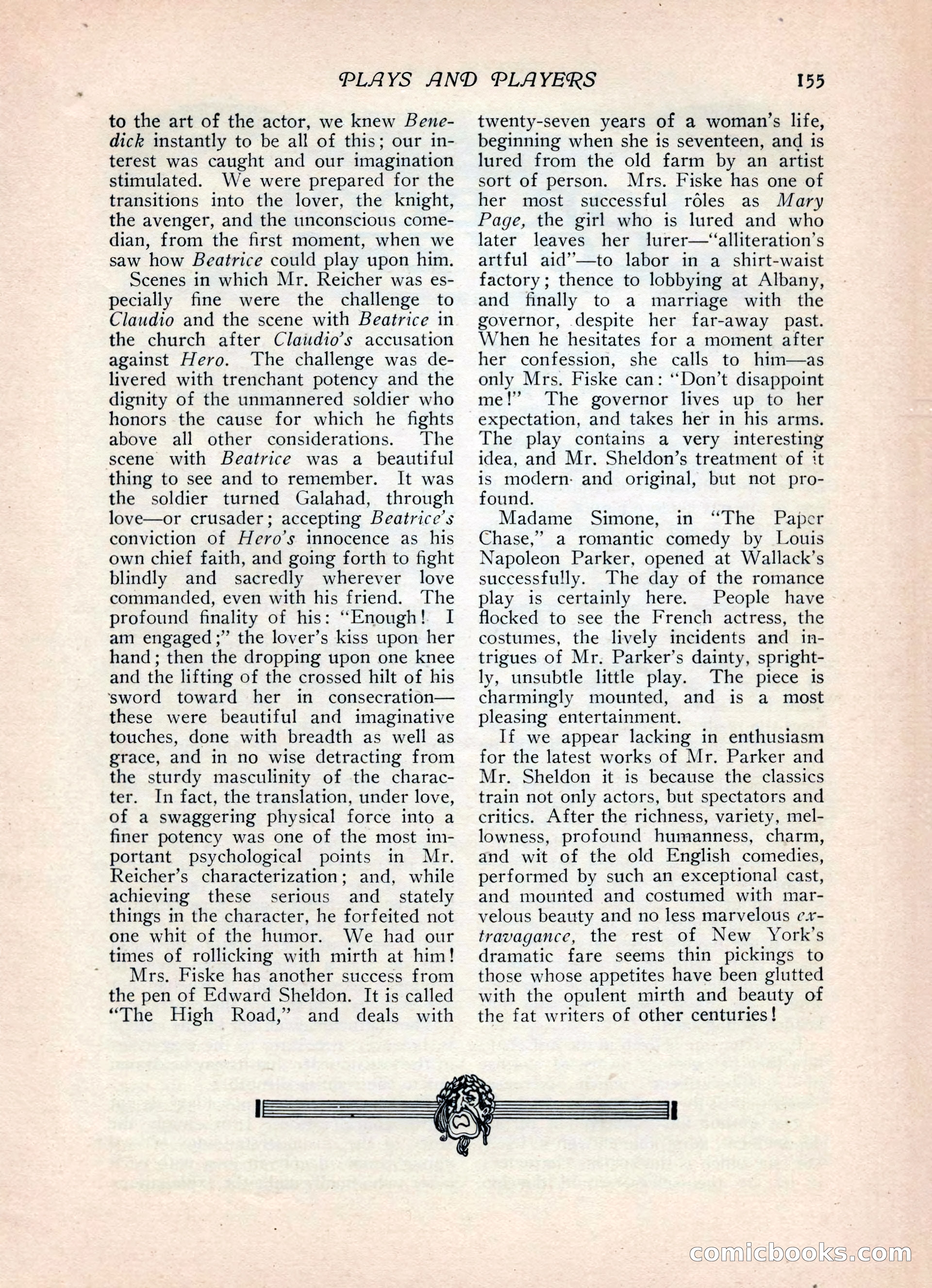
A restored page from Pulp Fiction, 1913. Page through the whole issue in the reader above.
📄 Transcribed text from this page (OCR, searchable)
Machine-transcribed from the original scan — historical spelling and the odd misread are preserved.
PLAYS AND PLAYERS to the art of the actor, we knew Bene- dick instantly to be all of this; our in- terest was caught and our imagination stimulated. We were prepared for the transitions into the lover, the knight, the avenger, and the unconscious come- dian, from the first moment, when we saw how Beatrice could play upon him. Scenes in which Mr. Reicher was es- pecially fine were the challenge to Claudio and the scene with Beatrice in the church after Claudio’s accusation against Hero. The challenge was de- livered with trenchant potency and the dignity of the unmannered soldier who honors the cause for which he fights above all other considerations. The scene with Beatrice was a_ beautiful thing to see and to remember. It was the soldier turned Galahad, through love—or crusader; accepting Beatrice’s conviction of Hero’s innocence as his own chief faith, and going forth to fight blindly and sacredly wherever love commanded, even with his friend. The profound finality of his: “Enough! I am engaged ;” the lover’s kiss upon her hand; then the dropping upon one knee and the lifting of the crossed hilt of his sword toward her in consecration— these were beautiful and imaginative touches, done with breadth as well as grace, and in no wise detracting from the sturdy masculinity of the charac- ter. In fact, the translation, under love, of a swaggering physical force into a finer potency was one of the most 1m- portant psychological points in Mr. Reicher’s characterization; and, while achieving these serious and _ stately things in the character, he forfeited not one whit of the humor. We had our times of rollicking with mirth at him! ' Mrs, Fiske has another success from the pen of Edward Sheldon. It is called “The High Road,’ and deals with 155 twenty-seven years of a woman’s life, beginning when she is seventeen, and is lured from the old farm by an artist sort of person. Mrs. Fiske has one of her most successful rdles as Mary Page, the girl who is lured and who later leaves her lurer—“alliteration’s artful aid’”—to labor in a shirt-waist factory; thence to lobbying at Albany, and finally to a marriage with the governor, despite her far-away past. When he hesitates for a moment after her confession, she calls to him—as only Mrs. Fiske can: “Don’t disappoint me!” The governor lives up to her expectation, and takes her in his arms. The play contains a very interesting idea, and Mr. Sheldon’s treatment of it is modern: and original, but not pro- found. Madame Simone, in “The Paper Chase,” a romantic comedy by Louis Napoleon Parker, opened at Wallack’s successfully. The day of the romance play is certainly here. People have flocked to see the French actress, the costumes, the lively incidents and in- trigues of Mr. Parker’s dainty, spright- ly, unsubtle little play. The piece is charmingly mounted, and is a most pleasing entertainment. If we appear lacking in enthusiasm for the latest works of Mr. Parker and Mr. Sheldon it is because the classics train not only actors, but spectators and critics. After the richness, variety, mel- lowness, profound humanness, charm, and wit of the old English comedies, performed by such an exceptional cast, and mounted and costumed with mar- velous beauty and no less marvelous e+- travagance, the rest of New York’s dramatic fare seems thin pickings to those whose appetites have been glutted with the opulent mirth and beauty of the fat writers of other centuries! (C@ VOOLK (C@)