
Pulp Fiction, 1913 · page 23 of 192
Ainslee's Magazine, February 1913 — page 23: what you’re looking at
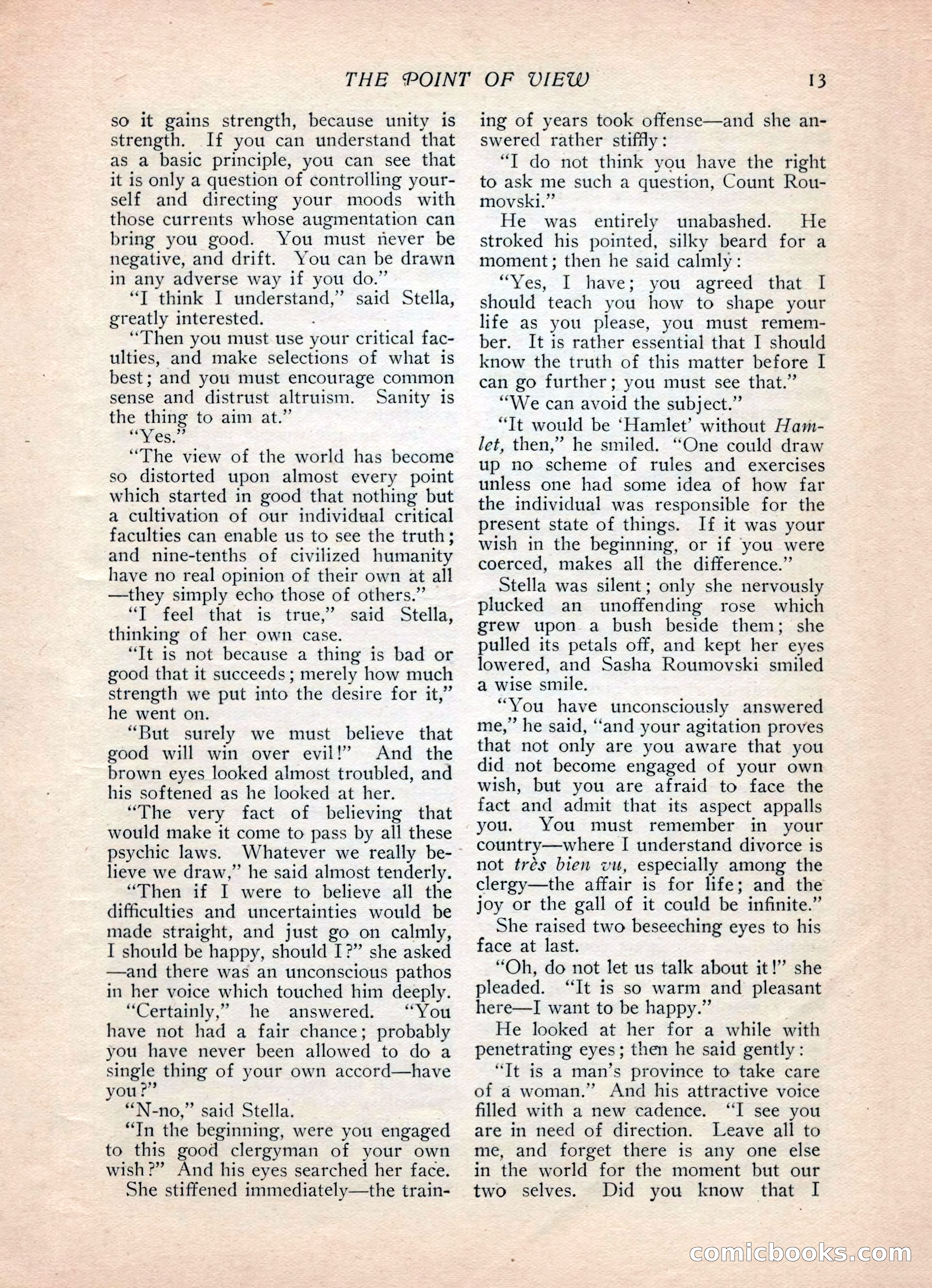
A restored page from Pulp Fiction, 1913. Page through the whole issue in the reader above.
📄 Transcribed text from this page (OCR, searchable)
Machine-transcribed from the original scan — historical spelling and the odd misread are preserved.
THE POINT OF VIEW so it gains strength, because unity is strength. If you can understand that as a basic principle, you can see that it is only a question of controlling your- self and directing your moods with those currents whose augmentation can bring you good. You must never be negative, and drift. You can be drawn in any adverse way if you do.” “T think I understand,” said Stella, greatly interested. ‘Then you must use your critical fac- ulties, and make selections of what is best; and you must encourage common sense and distrust altruism. Sanity is the thing to aim at.” eyes,” “The view of the world has become so distorted upon almost every point which started in good that nothing but a cultivation of our individual critical faculties can enable us to see the truth; and nine-tenths of civilized humanity have no real opinion of their own at all —they simply echo those of others.” “I féel that is true,” said - Stella, thinking of her own case. “It is not because a thing is bad or good that it succeeds ; merely how much strength we put into the desire for it,” he went on. “But surely we must believe that good will win over evil!’ And the brown eyes looked almost troubled, and his softened as he looked at her. “The very fact of believing that would make it come to pass by all these psychic laws. Whatever we really be- lieve we draw,” he said almost tenderly. “Then if I were to believe all the difficulties and uncertainties would be made straight, and just go on calmly, I should be happy, should I?” she asked —and there was an unconscious pathos in her voice which touched him deeply. “Certainly,” he answered. “You have not had a fair chance; probably you have never been allowed to do a single thing of your own accord—have you?” “N-no,” said Stella. “In the beginning, were you engaged to this good clergyman of your own wish?” And his eyes searched her face. She stiffened immediately—the train- 13 ing of years took offense—and she an- swered rather stiffly: “I do not think you have the right to ask me such a question, Count Rou- movski.”’ He was entirely unabashed. He stroked his pointed, silky beard for a moment; then he said calmly: “Yes, I have; you agreed that I should teach you how to shape your life as you please, you must remem- ber. It is rather essential that I should know the truth of this matter before I can go further; you must see that.” “We can avoid the subject.” “It would be ‘Hamlet’ without Ham- let, then,” he smiled. “One could draw up no scheme of rules and exercises unless one had some idea of how far the individual was responsible for the present state of things. If it was your wish in the beginning, or if you were coerced, makes all the difference.” Stella was silent; only she nervously plucked an unoffending rose which grew upon a bush beside them; she pulled its petals off, and kept her eyes lowered, and Sasha Roumovski smiled a wise smile. “You have unconsciously answered me,” he said, ‘and your agitation proves that not only are you aware that you did not become engaged of your own wish, but you are afraid to face the fact and admit that its aspect appalls you. You must remember in your country—where I understand divorce is not trés bien vu, especially among the clergy—the affair is for life; and the joy or the gall of it could be infinite.” She raised two beseeching eyes to his face at last. “Oh, do not let us talk about it!” she pleaded. “It is so warm and pleasant here—I want to be happy.” He looked at her for a while with penetrating eyes; then he said gently: “It is a man’s province to take care of a woman.” And his attractive voice filled with a new cadence. “I see you are in need of direction. Leave all to me, and forget there is any one else in the world for the moment but our two selves. Did you know that I COMMUCE IOOK (E@)