
Pulp Fiction, 1913 · page 59 of 192
Ainslee's Magazine, February 1913 — page 59: what you’re looking at
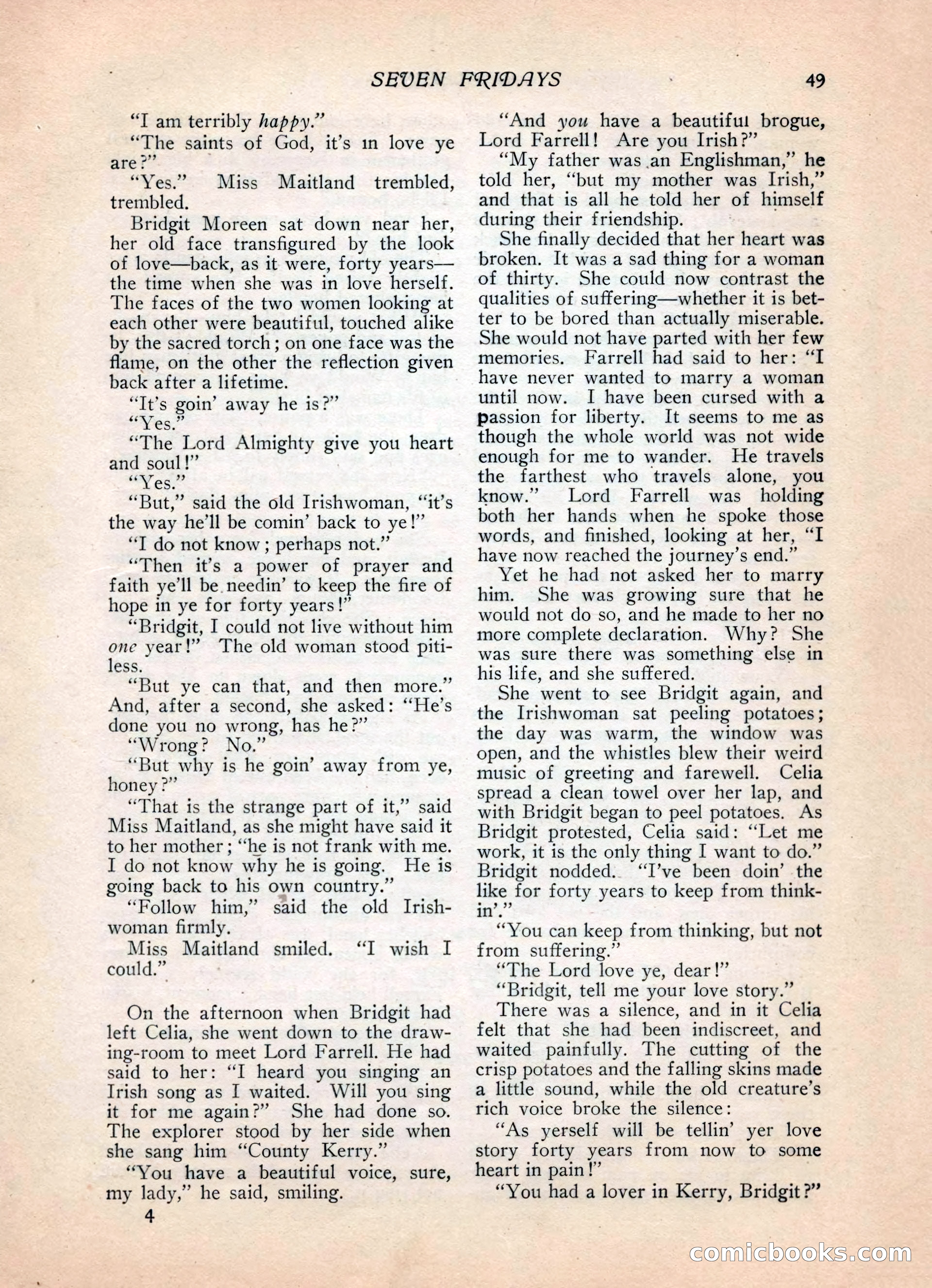
A restored page from Pulp Fiction, 1913. Page through the whole issue in the reader above.
📄 Transcribed text from this page (OCR, searchable)
Machine-transcribed from the original scan — historical spelling and the odd misread are preserved.
SEVEN FRIDAYS “T am terribly happy.” “The saints of God, it’s in love ye are?” alter trembled. Bridgit Moreen sat down near her, her old face transfigured by the look of love—back, as it were, forty years— the time when she was in love herself. The faces of the two women looking at each other were beautiful, touched alike by the sacred torch; on one face was the flame, on the other the reflection given back after a lifetime. “It’s goin’ away he is?” ees” “The Lord Almighty give you heart and soul!” Oy ag 7 “But,” said the old Irishwoman, the way he'll be comin’ back to ye!” “T do not know; perhaps not.” “Then it’s a power of prayer and faith ye'll be. needin’ to keep the fire of hope in ye for forty years!” “Bridgit, I could not live without him one year!” The old woman stood piti- less. “But ye can that, and then more.” And, after a second, she asked: “‘He’s done you no wrong, has he?” “Wrong? No,” “But why is he goin’ away from ye, honey ?” “That is the strange part of it,” said Miss Maitland, as she might have said it to her mother; “he is not frank with me. I do not know why he is going. He is going back to his own country.” “Follow him,” said the old Irish- woman firmly. Miss Maitland smiled. could.” Miss Maitland trembled, ce it’s “T wish I On the afternoon when Bridgit had left Celia, she went down to the draw- ing-room to meet Lord Farrell. He had said to her: “I heard you singing an Irish song as I waited. Will you sing it for me again?’ She had done so. The explorer stood by her side when she sang him “County Kerry.” “You have a beautiful voice, sure, my lady,” he said, smiling. 49 “And you have a beautiful brogue, Lord Farrell! Are you Irish?” “My father was an Englishman,” he told her, “but my mother was Irish,” and that is all he told her of himself during their friendship. She finally decided that her heart was broken. It was a sad thing for a woman of thirty. She could now contrast the qualities of suffering—whether it is bet- ter to be bored than actually miserable. She would not have parted with her few memories. Farrell had said to her: “I have never wanted to marry a woman until now. I have been cursed with a passion for liberty. It seems to me as though the whole world was not wide enough for me to wander. He travels the farthest who travels alone, you know.” Lord Farrell was _ holding both her hands when he spoke those words, and finished, looking at her, “I have now reached the journey’s end.” Yet he had not asked her to marry him. She was growing sure that he would not do so, and he made to her no more complete declaration. Why? She was sure there was something else in his life, and she suffered. She went to see Bridgit again, and the Irishwoman sat peeling potatoes; the day was warm, the window was open, and the whistles blew their weird music of greeting and farewell. Celia spread a clean towel over her lap, and with Bridgit began to peel potatoes. As Bridgit protested, Celia said: “Let me work, it is the only thing I want to do.” Bridgit nodded. “I’ve been doin’ the like for forty years to keep from think- — “You can keep from thinking, but not from suffering.” “The Lord love ye, dear!” “Bridgit, tell me your love story.” There was a silence, and in it Celia felt that she had been indiscreet, and waited painfully. The cutting of the crisp potatoes and the falling skins made a little sound, while the old creature’s rich voice broke the silence: “As yerself will be tellin’ yer love story forty years from now to some heart in pain!” “You had a lover in Kerry, Bridgit ?” COLMUCE OOK (C@)