
Pulp Fiction, 1913 · page 88 of 192
Ainslee's Magazine, February 1913 — page 88: what you’re looking at
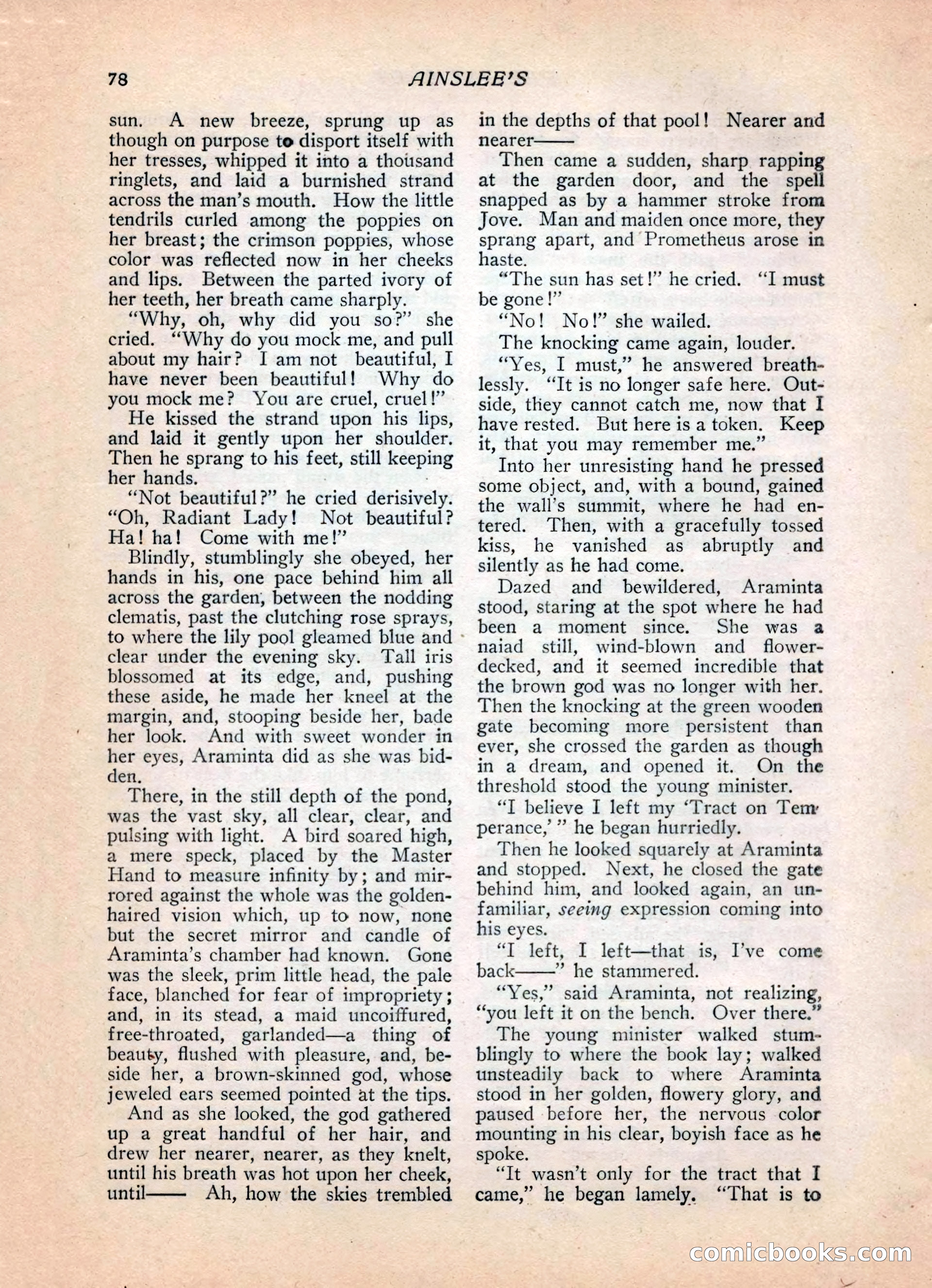
A restored page from Pulp Fiction, 1913. Page through the whole issue in the reader above.
📄 Transcribed text from this page (OCR, searchable)
Machine-transcribed from the original scan — historical spelling and the odd misread are preserved.
78 sun. A new breeze, sprung up as though on purpose te disport itself with her tresses, whipped it into a thottsand ringlets, and laid a burnished strand across the man’s mouth. How the little tendrils curled among the poppies on her breast; the crimson poppies, whose color was reflected now in her cheeks and lips. Between the parted ivory of her teeth, her breath came sharply. “Why, oh, why did you so?” she cried. ‘‘Why do you mock me, and pull about my hair? I am not beautiful, I have never been beautiful! Why do you mock me? You are cruel, cruel!” He kissed the strand upon his lips, and laid it gently upon her shoulder. Then he sprang to his feet, still keeping her hands. : “Not beautiful?” he cried derisively. “Oh, Radiant Lady! Not beautiful? Ha! ha! Come with me!” Blindly, stumblingly she obeyed, her hands in his, one pace behind him all across the garden, between the nodding clematis, past the clutching rose sprays, to where the lily pool gleamed blue and - clear under the evening sky. Tall iris blossomed at its edge, and, pushing these aside, he made her kneel at the margin, and, stooping beside her, bade her look. And with sweet wonder in her eyes, Araminta did as she was bid- den. There, in the still depth of the pond, was the vast sky, all clear, clear, and pulsing with light. A bird soared high, a mere speck, placed by the Master Hand to measure infinity by; and mir- rored against the whole was the golden- haired vision which, up to now, none but the secret mirror and candle of Araminta’s chamber had known. Gone was the sleek, prim little head, the pale face, blanched for fear of impropriety ; and, in its stead, a maid uncoiffured, free-throated, garlanded—a thing of beauty, flushed with pleasure, and, be- side her, a brown-skinned god, whose jeweled ears seemed pointed at the tips. And as she looked, the god gathered up a great handful of her hair, and drew her nearer, nearer, as they knelt, until his breath was hot upon her cheek, until Ah, how the skies trembled AINSLEE’S in the depths of that pool! Nearer and nearer 3 Then came a sudden, sharp rapping at the garden door, and the spell snapped as by a hammer stroke from Jove. Man and maiden once more, they sprang apart, and Prometheus arose in haste. “The sun has set!” he cried. ‘“‘I must be gone!” “No! No!” she wailed. The knocking came again, louder. “Yes, I must,” he answered breath- lessly. “It is no longer safe here. Out- side, they cannot catch me, now that I have rested. But here isatoken. Keep it, that you may remember me.” Into her unresisting hand he pressed some object, and, with a bound, gained the wall’s summit, where he had en- tered. Then, with a gracefully tossed kiss, he vanished as abruptly and silently as he had come. Dazed and _ bewildered, Araminta stood, staring at the spot where he had been a moment since. She was a naiad still, wind-blown and _ flower- decked, and it seemed incredible that the brown god was no longer with her. Then the knocking at the green wooden gate becoming more persistent than ever, she crossed the garden as though in a dream, and opened it. On the threshold stood the young minister. “T believe I left my ‘Tract on Tem: perance, ” he began hurriedly. Then he looked squarely at Araminta and stopped. Next, he closed the gate behind him, and looked again, an un- familiar, seeing expression coming into his eyes. “IT left, I left—that is, I’ve come back ” he stammered. “Yes,” said Araminta, not realizing, “vou left it on the bench. Over there.” The young minister walked stum- blingly to where the book lay; walked unsteadily back to where Araminta stood in her golden, flowery glory, and paused before her, the nervous color mounting in his clear, boyish face as he spoke. “It wasn’t only for the tract that I came,” he began lamely. “That is to COMEGE 0)(0(0)|< (EO)