
Pulp Fiction, 1913 · page 90 of 192
Ainslee's Magazine, February 1913 — page 90: what you’re looking at
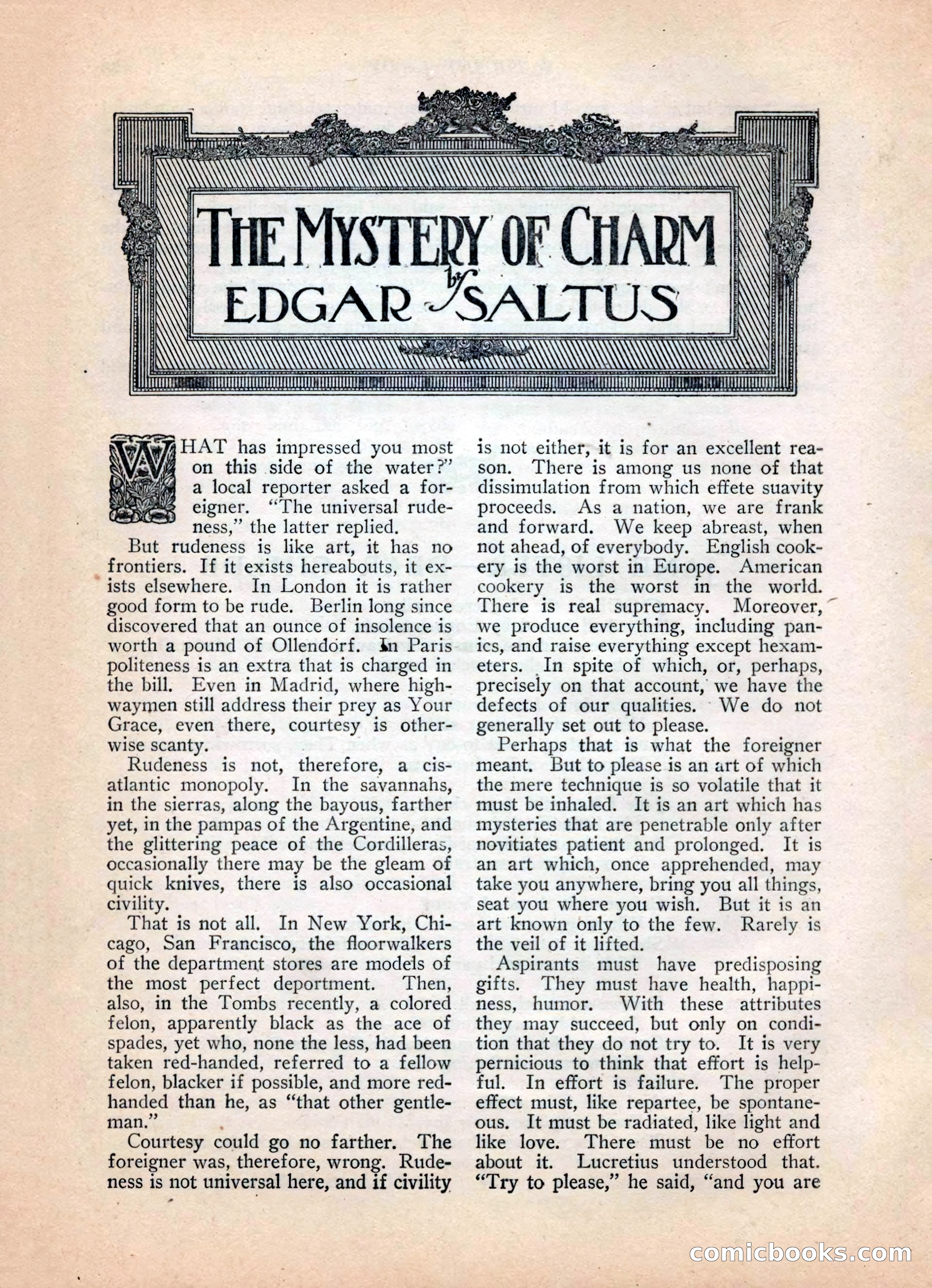
A restored page from Pulp Fiction, 1913. Page through the whole issue in the reader above.
📄 Transcribed text from this page (OCR, searchable)
Machine-transcribed from the original scan — historical spelling and the odd misread are preserved.
eer rrevy AHTAT has impressed you most 4 on this side of the water?” a local reporter asked a for- eigner. “The universal rude- ness,’ the latter replied. But rudeness is like art, it has no _ frontiers. If it exists hereabouts, it ex- ists elsewhere. In London it is rather good form to be rude. Berlin long since discovered that an ounce of insolence is worth a pound of Ollendorf. 4n Paris politeness is an extra that is charged in the bill, Even in Madrid, where high- waymen still address their prey as Your Grace, even there, courtesy is other- wise scanty. Rudeness is not, therefore, a cis- atlantic monopoly. In the savannahs, in the sierras, along the bayous, farther yet, in the pampas of the Argentine, and the glittering peace of the Cordilleras, occasionally there may be the gleam of quick knives, there is also occasional civility. That is not all. In New York, Chi- cago, San Francisco, the floorwalkers of the department stores are models of the most perfect deportment. Then, also, in the Tombs recently, a colored felon, apparently black as the ace of spades, yet who, none the less, had been taken red-handed, referred to a fellow felon, blacker if possible, and more red- handed than he, as “that other gentle- man,’ Courtesy could go no farther. The foreigner was, therefore, wrong. Rude- ness is not universal here, and if civility - is not either, it is for an excellent rea- son. There is among us none of that dissimulation from which effete suavity proceeds. As a nation, we are frank and forward. We keep abreast, when not ahead, of everybody. English cook- ery is the worst in Europe. “American cookery is the worst in the world. There is real supremacy. we produce everything, including pan- ics, and raise everything except hexam- eters. In spite of which, or, perhaps, precisely on that account, we have the defects of our qualities. We do not generally set out to please. Perhaps that is what the foreigner meant. But to please is an art of which the mere technique is so volatile that it must be inhaled. It is an art which has mysteries that are penetrable only after novitiates patient and prolonged. It is an art which, once apprehended, may take you anywhere, bring you all things, seat you where you wish. But it is an art known only to the few. Rarely is the veil of it lifted. Aspirants must have predisposing gifts. They must have health, happi- ness, humor. With these attributes they may succeed, but only on condi- tion that they do not try to. It is very pernicious to think that effort is help- ful. In effort is failure. The proper effect must, like repartee, be spontane- ous. It must be radiated, like light and like love. There must be no effort about it. Lucretius understood that. “Try to please,” he said, “and you are Moreover, ~ EOPNICLOOOL< €O