
Pulp Fiction, 1913 · page 97 of 192
Ainslee's Magazine, February 1913 — page 97: what you’re looking at
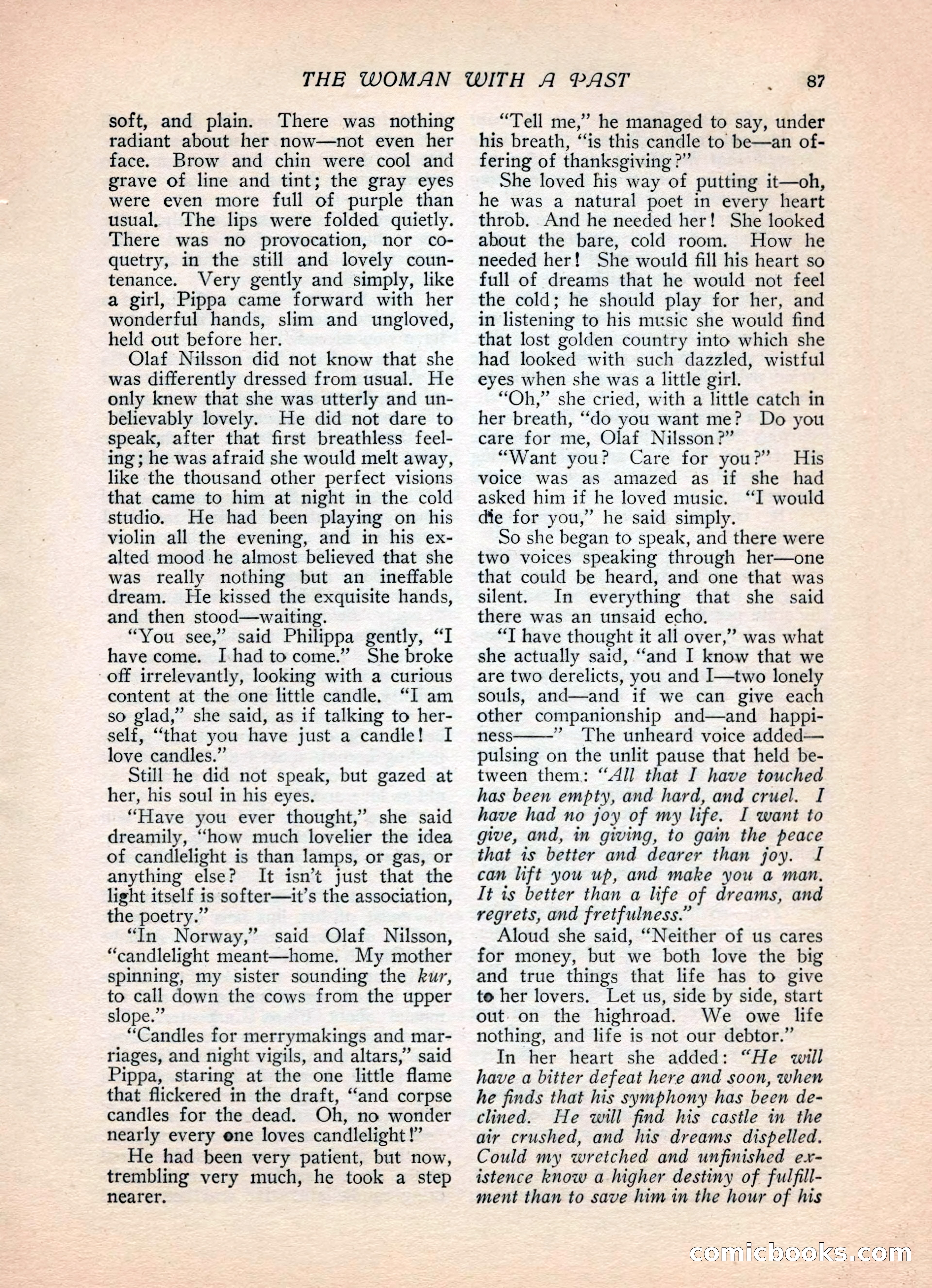
A restored page from Pulp Fiction, 1913. Page through the whole issue in the reader above.
📄 Transcribed text from this page (OCR, searchable)
Machine-transcribed from the original scan — historical spelling and the odd misread are preserved.
THE WOMAN WITH A PAST soft, and plain. There was nothing radiant about her now—not even her face. Brow and chin were cool and grave of line and tint; the gray eyes were even more full of purple than usual, The lips were folded quietly. There was no provocation, nor co- quetry, in the still and lovely coun- tenance. Very gently and simply, like a girl, Pippa came forward with her wonderful hands, slim and ungloved, held out before her. Olaf Nilsson did not know that she was differently dressed from usual. He only knew that she was utterly and un- believably lovely. He did not dare to speak, after that first breathless feel- ing; he was afraid she would melt away, like the thousand other perfect visions that came to him at night in the cold studio. He had been playing on his violin all the evening, and in his ex- alted mood he almost believed that she was really nothing but an ineffable dream. He kissed the exquisite hands, and then stood—waiting. “You see,’ said Philippa gently, “I have come. J had to come.” She broke off irrelevantly, looking with a curious content at the one little candle. “I am so glad,” she said, as if talking to her- self, “that you have just a candle! I love candles.” Still he did not speak, but gazed at her, his soul in his eyes. “Have you ever thought,” she said dreamily, “how much lovelier the idea of candlelight is than lamps, or gas, or anything else? It isn’t just that the light itself is softer—it’s the association, the poetry.” “In Norway,” said Olaf Nilsson, “candlelight meant—home. My mother spinning, my sister sounding the kur, to call down the cows from the upper slope.” “Candles for merrymakings and mar- riages, and night vigils, and altars,” said Pippa, staring at the one little flame that flickered in the draft, “and corpse candles for the dead. Oh, no wonder nearly every one loves candlelight!” He had been very patient, but now, trembling very much, he took a step nearer. 87 “Tell me,” he managed to say, under his breath, “is this candle to be—an of- fering of thanksgiving?” She loved his way of putting it—oh, he was a natural poet in every heart throb. And he needed her! She looked about the bare, cold room. How he needed her! She would fill his heart so full of dreams that he would not feel the cold; he should play for her, and in listening to his music she would find that lost golden country into which she had looked with such dazzled, wistful eyes when she was a little girl. “Oh,” she cried, with a little catch in her breath, “do you want me? Do you care for me, Olaf Nilsson?” “Want you? Care for you?” His voice was as amazed as if she had asked him if he loved music. “I would die for you,” he said simply. So she began to speak, and there were two voices speaking through her—one that could be heard, and one that was silent. In everything that she said there was an unsaid echo. “T have thought it all over,” was what she actually said, “and I know that we are two derelicts, you and I—two lonely souls, and—and if we can give each other companionship and—and _ happi- ness ” The unheard voice added— pulsing on the unlit pause that held be- tween them: “All that I have touched has been empty, and hard, and cruel. I have had no joy of my life. I want to give, and, in giving, to gain the peace that is better and dearer than joy. I can lift you up, and make you a man, It is better than a life of dreams, and regrets, and fretfulness.” Aloud she said, “Neither of us cares for money, but we both love the big and true things that life has to give to her lovers. Let us, side by side, start out. on the highroad. We owe life nothing, and life is not our debtor.” In her heart she added: “He will have a bitter defeat here and soon, when he finds that his symphony has been de- clined. He will find his castle in the air crushed, and his dreams dispelled. Could my wretched and unfinished ex- istence know a higher destiny of fulfill- ment than to save him in the hour of his CONMUC OOO) K< CO