
Pulp Fiction, 1928 · page 11 of 100
Amazing Stories, Vol. 3, No. 2 — page 11: what you’re looking at
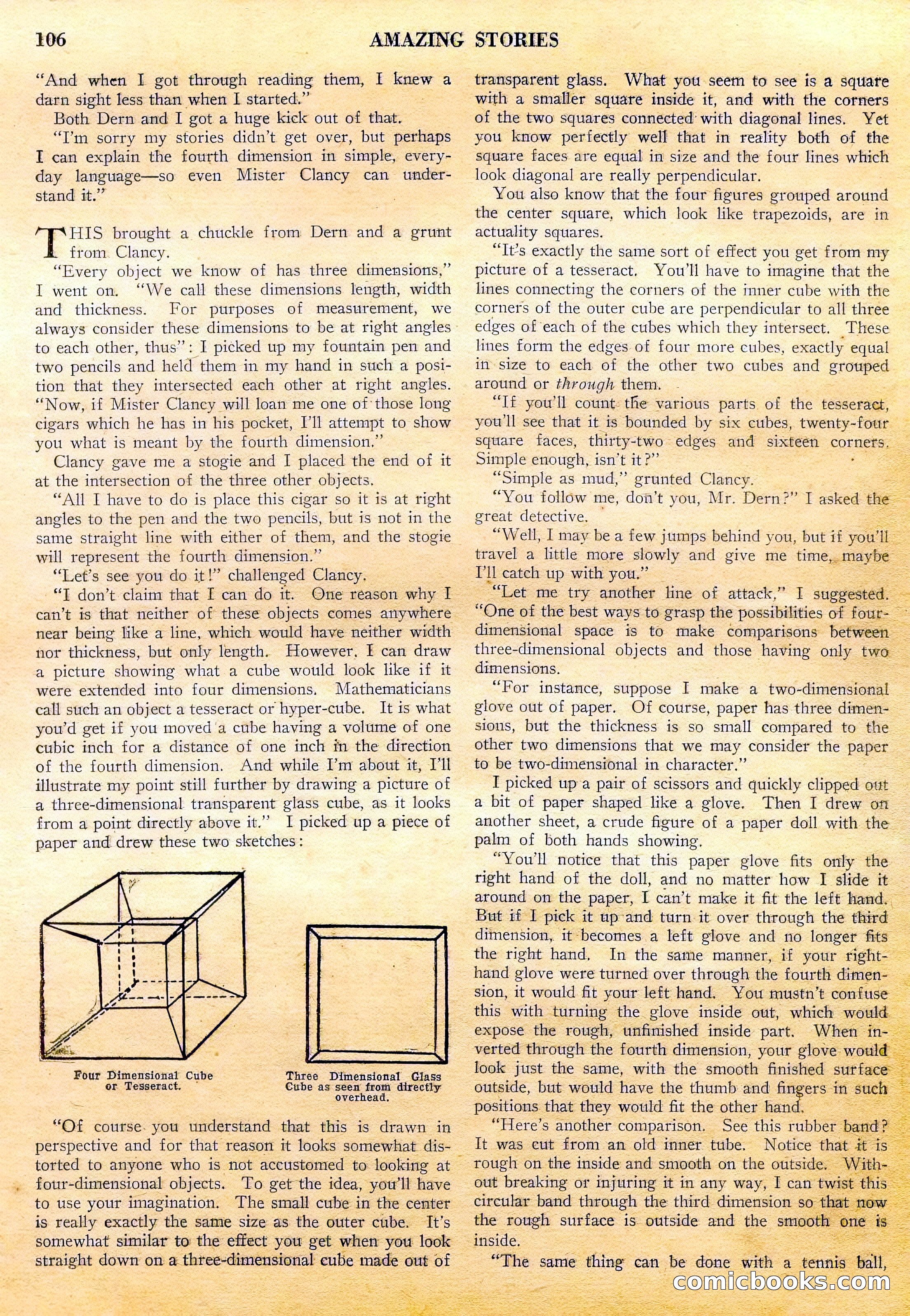
A restored page from Pulp Fiction, 1928. Page through the whole issue in the reader above.
📄 Transcribed text from this page (OCR, searchable)
Machine-transcribed from the original scan — historical spelling and the odd misread are preserved.
106 “And when I got through reading them, I knew a darn sight less than when I started.” Both Dern and I got a huge kick out of that. “Tm sorry my stories didn’t get over, but perhaps I can explain the fourth dimension in simple, every- day language—so even Mister Clancy can wnder- stand it.” HIS brought a chuckle from Dern and a grunt from. Clancy. “Every object we know of has three dimensions,” IT went on. “We call these dimensions length, width and thickness. For purposes of measurement, we always consider these dimensions to be at right angles to each other, thus”: I picked up my fountain pen and two pencils and held them in my hand in such a posi- tion that they intersected each other at right angles. “Now, if Mister Clancy will loan me one of those long cigars which he has in his pocket, I'll attempt to show you what is meant by the fourth dimension,” Clancy gave me a stogie and I placed the end of it at the intersection of the three other objects. “All I have to do is place this cigar so it is at right angles to the pen and the two pencils, but is not in the same straight line with either of them, and the stogie will represent the fourth dimension.” “Let’s see you do it!” challenged Clancy, “T don’t claim that E can do it. One reason why I can’t is that neither of these objects comes attywhere near being like a line, which would have neither width nor thickness, but only length. However. I can draw a picture showing what a cube would look like if it were extended into four dimensions. Mathematicians call such an object a tesseract or hyper-cube. It is what you'd get if you moved ‘a cube having a volume of one cubic inch for a distance of one inch in the direction of the fourth dimension. And while I’m about it, I'll illustrate my point still further by drawing a picture of a three-dimensional transparent glass cube, as it looks from a point directly above it.” I picked up a piece of paper and drew these two sketches: Three Dimensional Glass Four Dimensional Cube or Tesseract, Cube as seen’ from directly: overhead. “Of course. you understand that this is drawn in perspective and for that reason it looks somewhat dis- torted to anyone who is not accustomed to looking at four-dimensional objects. To get the idea, you'll have to use your imagination. The small cube in the center is really exactly the same size as the outer cube. It’s somewhat similar to the effect you get when you look straight down on a three-dimensional cube made out of expose the rough, unfinished inside part. AMAZING STORIES transparent glass. What you seem to see is a squate with a smaller square inside it, and with the corners of the two squares connected’ with diagonal lines. Yet you know perfectly well that in reality both of the square faces are equal in size and the four lines which look diagonal are really perpendicular. You also know that the four figures grouped around the center square, which look like trapezoids, are in actuality squares. “Tt’s exactly the same sort of effect you get from my picture of a tesseract. You'll have to imagine that the lines connecting the corners of the inner cube with the corners of the outer cube are perpendicular to all three edges of each of the cubes which they intersect. _These lines form the edges of four more cubes, exactly equal in size to each of the other two cubes and grouped around or through them. “Tf you'll count: the various parts of the tesseract, you'll see that it is bounded by six cubes, twenty-four — square faces, thirty -two edges and sixteen corners. — Simple enough, isn’t it?” ‘ “Simple as mud,” grunted Clancy. “You follow me, don’t you, Mr. Dern?” I asked the great detective, — “Well, I may be a few jumps behind you, but if you'll. travel a little more slowly and give me ime gle [ll catch up with you.’ “Let me try another line of attack,” I suggested “One of the best ways to grasp the possibilities of four. dimensional space is to make comparisons between three-dimensional objects and those having only Ere dimensions, : “For instance, suppose I make a two-dimensional glove out of paper. Of course, paper has three dimen- sions, but the thickness is so small compared to the other two dimensions that we may consider the paper to be two-dimensional in character.” I picked up a pair of scissors and quickly clipped out a bit of paper shaped like a glove. Then I drew on another sheet, a crude figute of a paper doll with the palm of both hands showing. “You'll notice that this paper glove fits only the right hand of the doll, and no matter how I slide it — around on the paper, I can’t make it fit the left hand. — But +f I pick it up and turn it over through the third — dimension, it becomes a left glove and no longer fits the right hand, In the same manner, if your right hand glove were turned over through the fourth dimen. sion, it would fit your left hand. You mustn’t confus this with turning the glove inside out, which would When in verted through the fourth dimension, your glove woul look just the same, with the smooth finished sutface outside, but would have the thumb and fingers. in suct positions that they would fit the other hand. “Here’s another comparison. See this Tubbee bi It was eut from an old inner tube. Notice that it rough on the inside and smooth on the outside. a out breaking or injuring it in any way, I can t circular band through the third dimension so the the rough surface is outside and the stii00 inside, = “The same e thing can be done we a ten “comicbooks