
Pulp Fiction, 1928 · page 29 of 100
Amazing Stories, Vol. 3, No. 2 — page 29: what you’re looking at
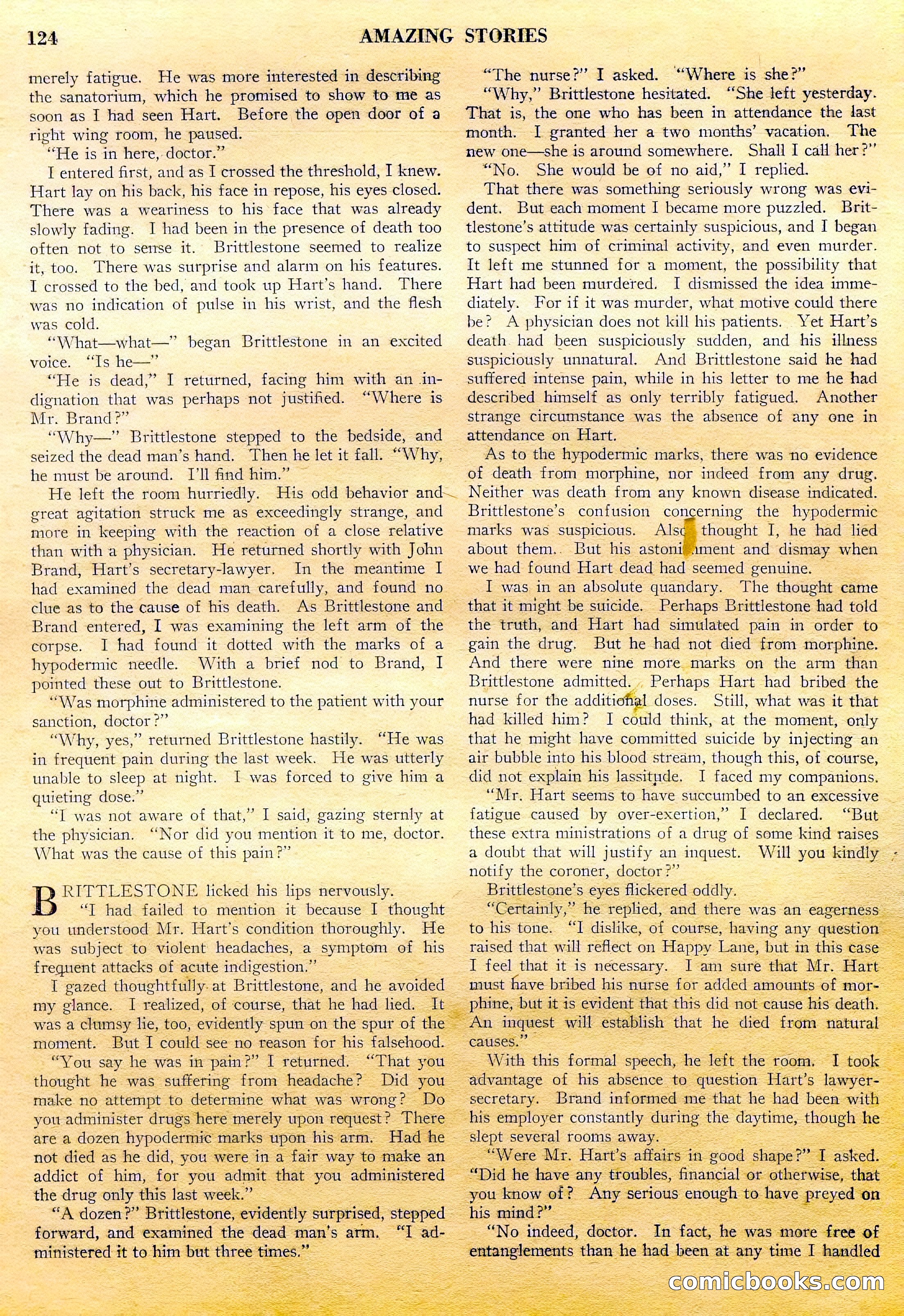
A restored page from Pulp Fiction, 1928. Page through the whole issue in the reader above.
📄 Transcribed text from this page (OCR, searchable)
Machine-transcribed from the original scan — historical spelling and the odd misread are preserved.
124 merely fatigue. He was more interested in describing the sanatorium, which he promised to show to me as soon as 1 had seen Hart. Before the open door of a right wing room, he paused. “He is in here, doctor.” I entered first, and as I crossed the threshold, I knew. Hart lay on his back, his face in repose, his eyes closed. There was a weariness to his face that was already slowly fading. I had been in the presence of death too often not to semse it. Brittlestone seemed to realize it, too. There was surprise and alarm on his features. I crossed to the bed, and took up Hart’s hand. There was no indication of pulse in his wrist, and the flesh was cold. “What—what—” voice. “Is he—” “He is dead,” I returned, facing him with an in- dignation that was perhaps not justified. “Where is Mr. Brand?” “Why—” Brittlestone stepped to the bedside, and seized the dead man’s hand. Then he let it fall. “Why, he must be around. I'll find him.” ~ He left the room hurriedly. great agitation struck me as exceedingly strange, and more in keeping with the reaction of a close relative than with a physician. He returned shortly with John Brand, Hart’s secretary-lawyer. In the meantime I had examined the dead man carefully, and found no clue as to the cause of his death. Brand entered, I was examining the left arm of the corpse. I had found it dotted with the marks of a hypodermic needle. With a brief nod to Brand, I pointed these out to Brittlestone. “Was morphine administered to the patient with your sanction, doctor?” “Why, yes,” returned Brittlestone hastily. “He was in frequent pain during the last week. He was utterly unable to sleep at night. I was forced to give him a quieting dose.” “T was not aware of that,’ I said, gazing sternly at the physician. “Nor did you mention it to me, doctor. What was the cause of this pain?” began Brittlestone in an excited B RITTLESTONE licked his lips nervously. “T had failed to mention it because I thought you understood Mr. Hart's condition thoroughly. He was subject to violent headaches, a symptom of his frequent attacks of acute indigestion,” See I gazed thoughtfully. at Brittlestone, and he avc my glance. I realized, of course, that he had lied was a clumsy lie, too, evidently spun on the spur of the moment. But I could see no reason for his’ falsehoo “You say bes was in pain ?” aE returned, | His odd behavior and— As Brittlestone and — AMAZING STORIES “The nurse?” I asked. “Where is she?” “Why,” Brittlestone hesitated. “She left yesterday. That is, the one who has been in attendance the last month. I granted her a two months’ vacation. The new one—she is around somewhere. Shall I call her?” “No. She would be of no aid,” I replied. That there was something seriously wrong was evi- dent. But each moment I became more puzzled. Brit- tlestone’s attitude was certainly suspicious, and I began to suspect him of crimimal activity, and even murder. It left me stunned for a moment, the possibility that Hart had been murdered. I dismissed the idea imme- diately. For if it was murder, what motive could there be? A physician does not kill his patients. Yet Hart’s death had been suspiciously sudden, and his illness suspiciously unnatural. And Brittlestone said he had suffered intense pain, while in his letter to me he had described himself as only terribly fatigued. Another strange circumstance was the absence of any one in attendance on Hart. : As to the hypodermic marks, there was no evidence of death from morphine, nor indeed from any drug. Neither was death from any known disease indicated. Brittlestone’s confusion concerning the hypodermic marks was suspicious. Als¢ thought I, he had lied about them.. But his astoni!ament and dismay when we had found Hart dead had seemed genuine. : I was in an absolute quandary. The thought came that it might be suicide. Perhaps Brittlestone had told — the truth, and Hart had simulated pain in order to : gain the drug. But he had not died from morphine. And there were nine more marks on the arm than | Brittlestone admitted. Perhaps Hart had bribed the nurse for the additietfe doses. Still, what was it that had killed him? I could think, at the moment, only that he might have committed suicide by injecting an — air bubble into his blood stream, though this, of course, did not explain his lassitude. I faced my companions. “Mr. fatigue caused by over-exertion,’ I declared. “But these extra ministrations of a drug of some kind raises a doubt that will justify an inquest. notify the coroner, doctor?” Brittlestone’s eyes flickered oddly. ws “Certainly,” he replied, and there was an eag to his tone. “I dislike, a course, having any, oe I feel that it is necessary. 1 am sure | maust have bribed his nurse f Will you kindly . Hart seems to have succumbed to an excessive _