
Pulp Fiction, 1928 · page 31 of 100
Amazing Stories, Vol. 3, No. 2 — page 31: what you’re looking at
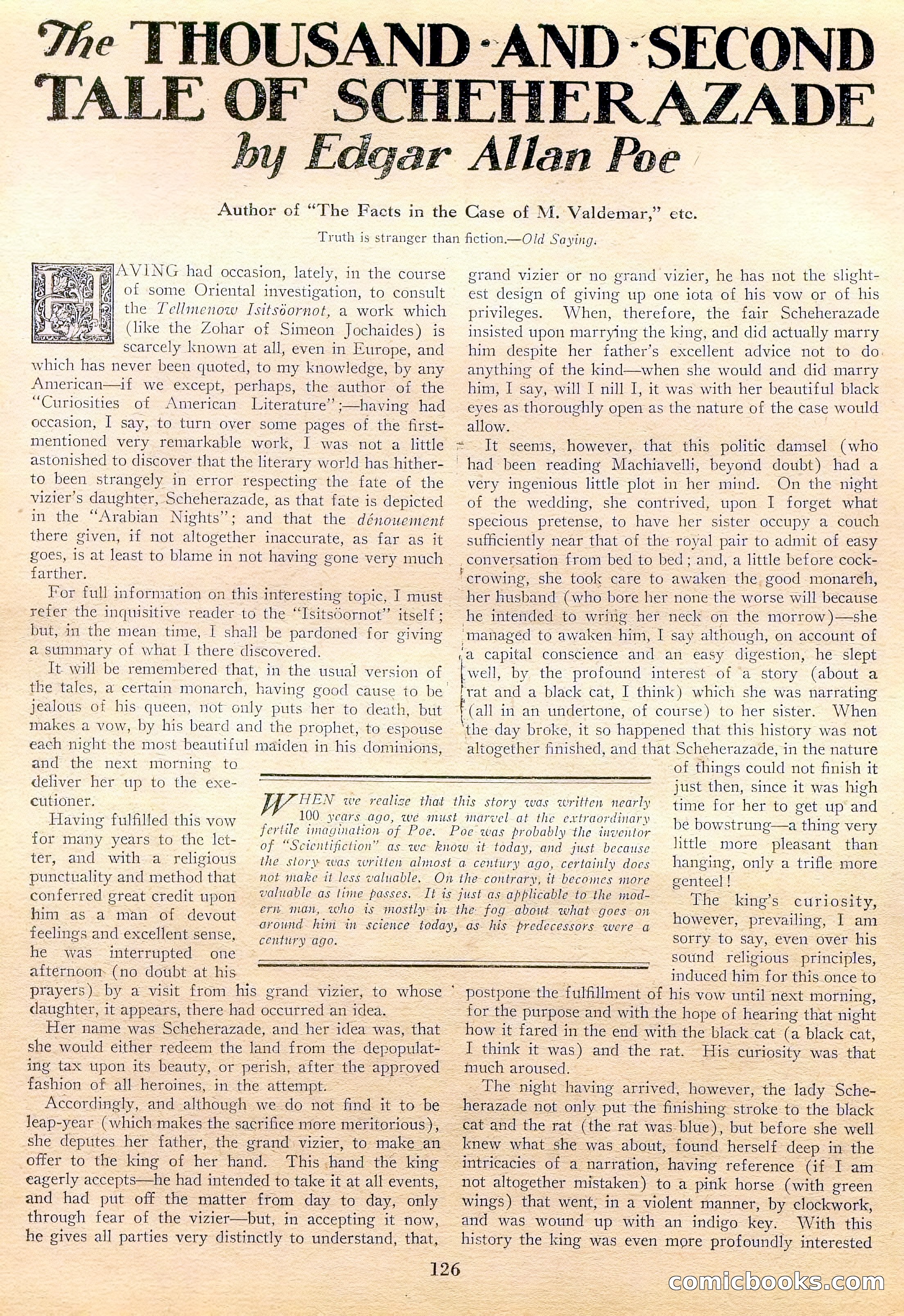
A restored page from Pulp Fiction, 1928. Page through the whole issue in the reader above.
📄 Transcribed text from this page (OCR, searchable)
Machine-transcribed from the original scan — historical spelling and the odd misread are preserved.
The THOUSAND -AND ‘SECOND TALE OF SCHEHERAZADE by Edgar Allan Poe Author of “The Facts in the Case of M. Valdemar,” ete. Truth is stranger than fiction—Old Saying: AVING had occasion, lately, in the course 4) of some Oriental investigation, to consult the Tellmenow Isitsoornot, a work which (like the Zohar of Simeon Jochaides) is scarcely known at all, even in Europe, and which has never been quoted, to my knowledge, by any American—if we except, perhaps, the author of the “Curiosities of American Literature’ ;—having had occasion, I say, to turn over some pages of the first- mentioned very remarkable work, I was not a_little astonished to discover that the literary world has hither- to been strangely in error respecting the fate of the vizier’s daughter, Scheherazade, as that fate is depicted in the “Arabian Nights’; and that the dénowement there given, if not altogether inaccurate, as far ag it goes, is at least to blame in not having gone very much farther. For full information on this interesting topic, I must refer the inquisitive reader to the “IsitsGornot” itself ; but, in the mean time, I shall be pardoned for giving a summary of what I there discovered. It will be remembered that, in the usual version of the tales, a certain monarch, having good cause to be’ jealous of his queen, not only puts her to death, but makes a vow, by his beard and the prophet, to espouse each night the most beautiful maiden in his dominions, and the next morning to grand vizier or no grand vizier, he has not the slight- est design of giving up one iota of his vow or of his privileges. When, therefore, the fair Scheherazade insisted upon marrying the king, and did actually marry him despite her father’s excellent advice not to do anything of the kind—when she would and did marry him, I say, will I nill 1, it was with her beautiful black eyes as thoroughly open as the nature of the case would allow. = It seems, however, that this politic damsel (who ‘had been reading Machiavelli, beyond doubt) had a very ingenious little plot in her mind. On the night of the wedding, she contrived, upon I forget what specious pretense, to have her sister occupy a couch sufficiently near that of the royal pair to admit of easy conversation from bed to bed; and, a little before cock- ' crowing, she took care to awaken the good monarch, her husband (who bore her none the worse will because he intended to wring her neck on the morrow )—she ‘managed to awaken him, I say although, on account of (a capital conscience and an easy digestion, he slept well, by the profound interest of a story (about a frat and a black cat, I think) which she was narrating E Call in an undertone, of course) to her sister. When ‘the day broke, it so happened that this history was not altogether finished, and that Scheherazade, in the nature of things could not finish it deliver her up to the exe- just then, since it was high cutioner. Having fulfilled this vow for many years to the let- ter, and with a religious punctuality and method that conferred great credit upon him as a man of devout feelings and excellent sense, ZHEN we realise that this story was written nearly 100. years ago, we must marvel at the extraordinary fertile imagiiation of Poe. Poe was probably the inventor of “Scientifiction” as we know it today, and just because ihe story was written almost a century ago, certainly docs not make it less valuable, On the contrary, it becomes more valuable as lime passes, It is just as applicable to the mod- erm man, who is mostly in the fog about what goes on around him a science today, as his predecessors were a century ago. time for her to get up and be bowstrung—a thing very little more pleasant than hanging, only a trifle more genteel ! The king’s curiosity, however, prevailing, I am sorry to say, even over his he was interrupted one afternoon (no doubt at his prayers) by a visit from his grand vizier, to whose ° daughter, it appears, there had occurred an idea. Her name was Scheherazade, and her idea was, that she would either redeem the land from the depopulat- ing tax upon its beauty, or perish, after the approved fashion of all heroines, in the attempt. Accordingly, and although we do not find it to be leap-year (which makes the sacrifice more meritorious), she deputes her father, the grand vizier, to make an offer to the king of her hand. This hand the king eagerly accepts—he had intended to take it at all events, and had put off the matter from day to day, only through fear of the vizier—but, in accepting it now, he gives all parties very distinctly to understand, that, 126 sound religious principles, induced him for this once to postpone the fulfillment of his vow until next morning, for the purpose and with the hope of hearing that night how it fared in the end with the black cat (a black cat, I think it was) and the rat. His curiosity was that much aroused. _ = _ The night having arrived, however, the lady Sche- hherazade not only put the finishing stroke to the black cat and the rat (the rat was blue), but before she well knew what she was about, found herself deep in the intricacies of a narration, having reference (if I am not altogether mistaken) to a pink horse (with green wings) that went, in a violent manner, by clockworls, and was wound up with an indigo key. With this history the king was even more profoundly interested CONIC OOKS.COM