
Pulp Fiction, 1928 · page 36 of 100
Amazing Stories, Vol. 3, No. 2 — page 36: what you’re looking at
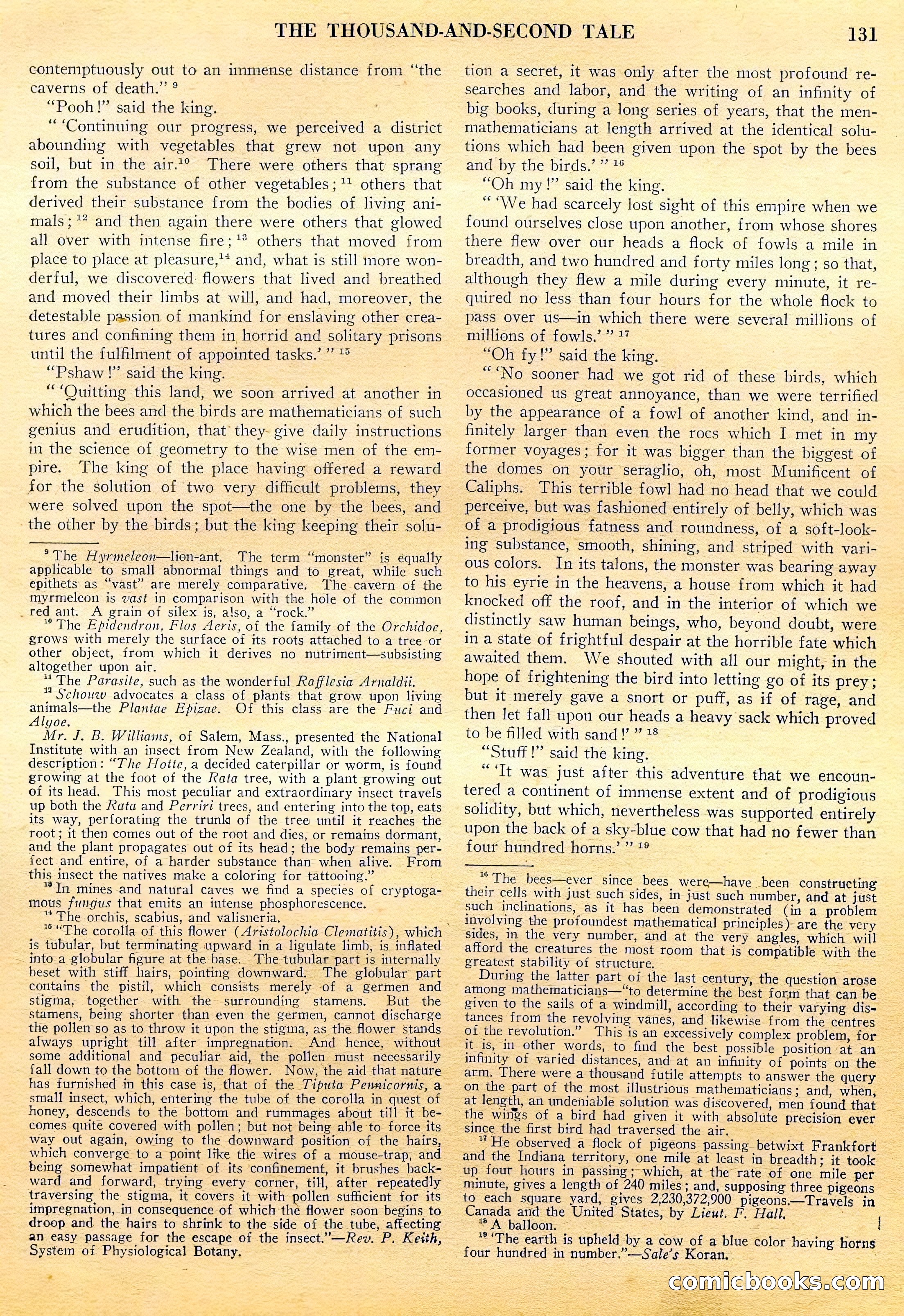
A restored page from Pulp Fiction, 1928. Page through the whole issue in the reader above.
📄 Transcribed text from this page (OCR, searchable)
Machine-transcribed from the original scan — historical spelling and the odd misread are preserved.
THE THOUSAND-AND-SECOND TALE contemptuously out to an immense distance from “the caverns of death.” ® “Pooh!” said the king. ““Continuing our progress, we perceived a district abounding with vegetables that grew not upon any soil, but in the air.*° There were others that sprang from the substance of other vegetables; 1! others that derived their substance from the bodies of living ani- mals; ** and then again there were others that glowed all over with intense fire;‘* others that moved from place to place at pleasure,’* and, what is still more won- derful, we discovered: flowers that lived and breathed and moved their limbs at will, and had, moreover, the detestable passion of mankind for enslaving other crea- tures and confining them in horrid and solitary prisons until the fulfilment of appointed tasks.’ ”” * “Pshaw !”’ said the king. ““Quitting this land, we soon arrived at another in which the bees and the birds are mathematicians of such genius and erudition, that they- give daily instructions in the science of geometry to the wise men of the em- pire. The king of the place having offered a reward for the solution of two very difficult problems, they were solved upon the spot—the one by the bees, and the other by the birds; but the king keeping their solu- * The Hyrmeleon—lion-ant. The term “monster” js équally applicable to small abnormal things and to great, while such epithets as “vast” are merely comparative. The cavern of the myrmeleon is vast in comparison with the hole of the common _Ted ant. A grain of silex is, also, a “rock.” ° The Epidendron, Flos Aeris, of the family of the Orchidoce, grows with merely the surface of its roots attached to a tree or other object, from which it derives no nutriment—subsisting altogether upon air. “ The Parasite, such as the wonderful Rafflesia Arnaldii, “4 Schouw advocates a class of plants that grow upon living animals—the Planiae Epizae. Of this class are the Fuci and Algoe. Mr. J. B. Williams, of Salem, Mass., presented the National Institute with an insect from New Zealand, with the following description: “The Hotte, a decided caterpillar or worm, is found growing at the foot of the Rata tree, with a plant growing out of its head. This most peculiar and extraordinary insect travels up both the /tata and Perriri trees, and entering into the top, eats its way, perforating the trunk of the tree until it reaches the root; it then comes out of the root and dies, or remains dormant, and the plant propagates out of its head; the body remains per- fect and entire, of a harder substance than when alive. From this insect the natives make a coloring for tattooing.” “Tn mines and natural caves we find a species of cryptoga- mous fungus that emits an intense phosphorescence. ” The orchis, scabius, and valisneria, * «The corolla of this flower (Aristolochia Clematitis), which — is tubular, but terminating upward in a ligulate limb, is inflated into a globular figure at the base. The tubular part is internally beset with stiff hairs, pointing downward. The globular part contains the pistil, which consists merely of a germen and stigma, together with the surrounding stamens. But the stamens, being shorter than even the germen, cannot discharge the pollen so as to throw it upon the stigma, as the flower stands always upright till after impregnation. And hence, without some additional and peculiar aid, the pollen must necessarily fall down to the bottom of the flower. Now, the aid that nature has furnished in this case is, that of the Tiputa Pennicornis, a small insect, which, entering the tube of the corolla in quest of honey, descends to the bottom and rummages about till it be- comes quite covered with pollen; but not being able to force its way out again, owing to the downward position of the hairs, which converge to a point like the wires of a mouse-trap, and being somewhat impatient of its ‘confinement, it brushes back- ward and forward, trying every corner, till, after repeatedly traversing the stigma, it covers it with pollen sufficient for its impregnation, in consequence of which the flower soon begins to droop and the hairs to shrink to the side of the tube, affecting an easy passage for the escape of the insect.’—Rev. P. Keith, System of Physiological Botany. * 131 tion a secret, it was only after the most profound re- searches and labor, and the writing of an infinity of big books, during a long series of years, that the men- mathematicians at length arrived at the identical solu- tions which had been given upon the spot by the bees and by the birds.’ ” 1° “Oh my!” said the king. ““We had scarcely lost sight of this empire when we found ourselves close upon another, from whose shores there flew over our heads a flock of fowls a mile in breadth, and two hundred and forty miles long; so that, although they flew a mile during every minute, it re- quired no less than four hours for the whole flock to pass over us—in which there were several millions of millions of fowls.’ ” 17 “Oh fy!” said the king. ““No sooner had we got rid of these birds, which occasioned us great annoyance, than we were terrified by the appearance of a fowl of another kind, and in- finitely larger than even the rocs which I met in my former voyages; for it was bigger than the biggest of the domes on your seraglio, oh, most Munificent of Caliphs. This terrible fowl had no head that we could perceive, but was fashioned entirely of belly, which was of a prodigious fatness and roundness, of a soft-look- ing substance, smooth, shining, and striped with vari- ous colors. In its talons, the monster was bearing away to his eyrie in the heavens, a house from which it had knocked off the roof, and in the interior of which we distinctly saw human beings, who, beyond doubt, were in a state of frightful despair at the horrible fate which awaited them. We shouted with all our might, in the hope of frightening the bird into letting go of its prey; but it merely gave a snort or puff, as if of tage, and then let fall upon our heads a heavy sack which proved to be filled with sand!’ ’”’ 38 “Stuff !”’ said the king. “Tt was just after this adventure that we encoun- tered a continent of immense extent and of prodigious solidity, but which, nevertheless was supported entirely upon the back of a sky-blue cow that had no fewer than four hundred horns.’ ” 1° “The bees—ever since bees were—have been constructing their cells with just such sides, in just such number, and at just such inclinations, as it has been demonstrated (in a problem involving the profoundest mathematical principles) are the very sides, in the very number, and at the very angles, which will afford the creatures the most room that is compatible with the greatest stability of structure. During the latter part of the last century, the question arose among mathematicians—“to determine the best form that can be given to the sails of a windmill, according to their varying dis- tances from the revolving vanes, and likewise from the centres of the revolution.” This is an excessively complex problem, for it is, in other words, to find the best possible position at an infinity of varied distances, and at an infinity of points on the arm. There were a thousand futile attempts to answer the query on the part of the most illustrious mathematicians; and, when, at length, an undeniable solution was discovered, men found that the wings of a bird had given it with absolute precision eyer - since the first bird had traversed the air : : * He observed a flock of pigeons passing betwixt Frankfort and the Indiana territory, one mile at least in breadth; it took up four hours in passing;-which, at the rate of one mile per minute, gives a length of 240 miles; and, supposing three pigeons to each square yard, gives 2;230,372,900 pigeons.—Travels in Canada and the United States, by Lieut. FP’. Hall, ; ®'A balloon. Sas i * ‘The earth is upheld by a cow of a blue color having horns four hundred in number,’—Sale’s Koran. Son ~ GConmicbooks.con Sa sae Spies