
Pulp Fiction, 1928 · page 45 of 100
Amazing Stories, Vol. 3, No. 2 — page 45: what you’re looking at
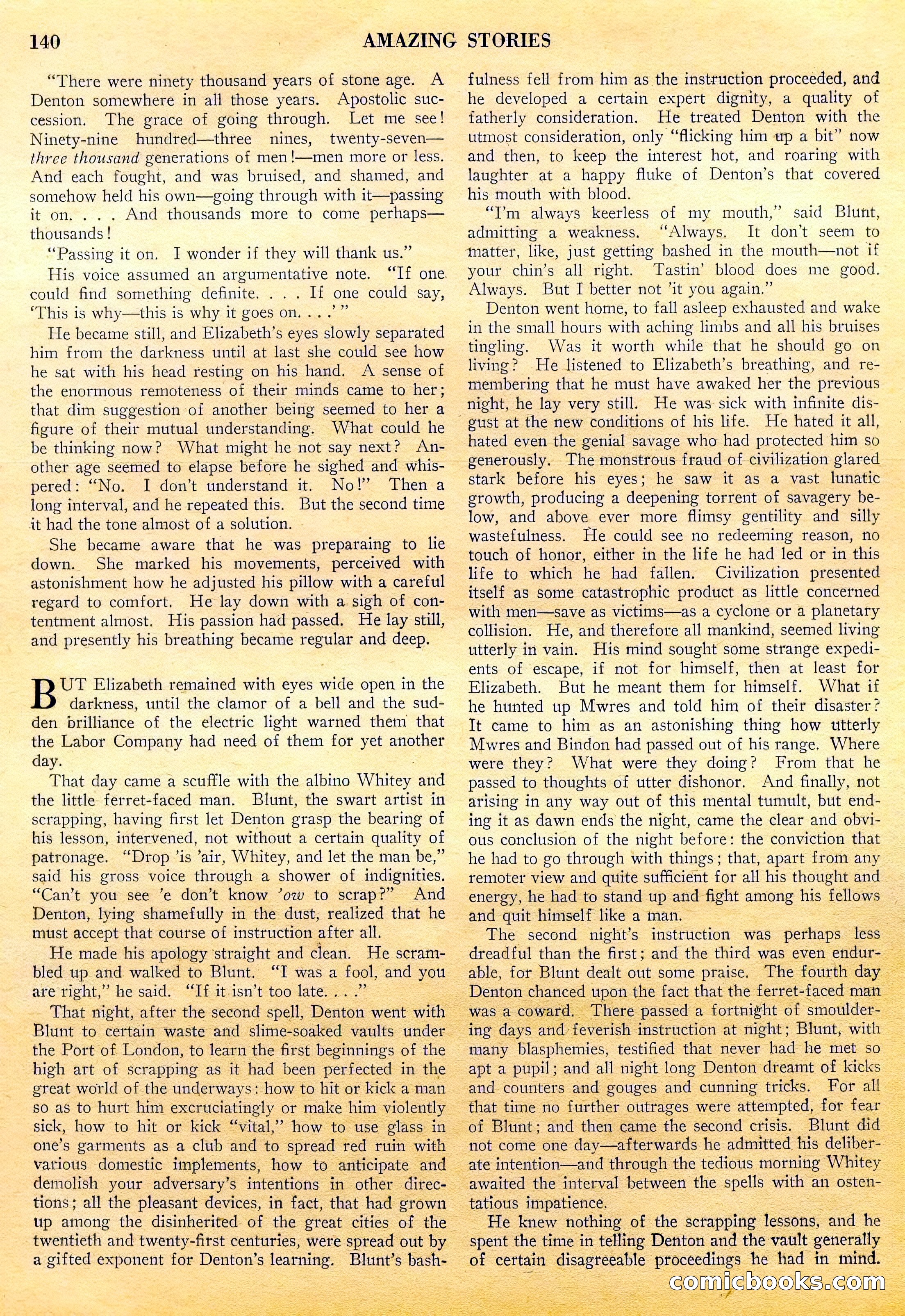
A restored page from Pulp Fiction, 1928. Page through the whole issue in the reader above.
📄 Transcribed text from this page (OCR, searchable)
Machine-transcribed from the original scan — historical spelling and the odd misread are preserved.
140 “There were ninety thousand years of stone age. A Denton somewhere in all those years. Apostolic suc- cession. The grace of going through. Let me see! Ninety-nine hundred—three nines, twenty-seven— three thousand generations of men!—men more or less. And each fought, and was bruised, and shamed, and somehow held his own—going through with it—passing it on... . And thousands more to come perhaps— thousands ! “Passing it on. His voice assumed an argumentative note. could find something definite. ... If one could say, ‘This is why—this is why it goes on... .”” He became still, and Elizabeth’s eyes slowly separated him from the darkness until at last she could see how he sat with his head resting on his hand. A sense of the enormous remoteness of their minds came to her; that dim suggestion of another being seemed to her a figure of their mutual understanding. What could he be thinking now? What might he not say next? An- other age seemed to elapse before he sighed and whis- pered: “No. I don’t understand it. No!’ Then a long interval, and he repeated this. But the second time it had the tone almost of a solution. She became aware that he was preparaing to lie down. She marked his movements, perceived with astonishment how he adjusted his pillow with a careful regard to comfort. He lay down with a sigh of con- tentment almost. His passion had passed. He lay still, and presently his breathing became regular and deep. I wonder if they will thank us.” UT Elizabeth remained with eyes wide open in the darkness, until the clamor of a bell and the sud- den brilliance of the electric light warned them that the Labor Company had need of them for yet another day. That day came a scuffle with the albino Whitey and the little ferret-faced man. Blunt, the swart artist in scrapping, having first let Denton grasp the bearing of his lesson, intervened, not without a certain quality of patronage. “Drop ’is ’air, Whitey, and let the man be,” said his gross voice through a shower of indignities. “Can't you see ’e don’t know ’ow to scrap?” And Denton, lying shamefully in the dust, realized that he must accept that course of instruction after all. He made his apology ‘straight and clean. He scram- bled up and walked to Blunt. “I was a fool, and you are right,” he said. “If it.isn’t too late... .” That night, after the second spell, Dentoi went with 1 2 ing days and feverish instruction at might; Blunt, with — Blunt to certain waste and slime-soaked vaults under the Port of London, to learn the first beginnings of the high art of scrapping as it had been perfected in the great world of the underways: how to hit or kick a man so as to hurt him excruciatingly or make him violently sick, how to hit or kick “vital,” how to use glass 1. one’s garments as a club and to spread red ruin with various domestic implements, how to anticipate and | demolish your adversary’s intentions in other ditec- tions; all the pleasant devices, in fact, that had grown up atnong the disinherited of the great cities of the twentieth “and twenty-first centuries, were spread out by a gifted exponent for Denton’s learning. Blunt’s bash- “Tf one gust at the new conditions of his life. awaited the interval between the spells with an osten- — of certain -disagtecable proceedings he had in mind. AMAZING STORIES fulness fell from him as the instruction proceeded, and he developed a certain expert dignity, a quality of fatherly consideration. He treated Denton with the utmost consideration, only “flicking him up a bit” now and then, to keep the interest hot, and roaring with laughter at a happy fluke of Denton’s that covered his mouth with blood. “T’m always keerless of my mouth,” said Blunt, admitting a weakness. “Always. It don’t seem to Matter, like, just getting bashed in the mouth—not if your chin’s all right. Tastin’ blood does me good. Always. But I better not ‘it you again.” Denton went home, to fall asleep exhausted and wake in the small hours with aching limbs and all his bruises tingling. Was it worth while that he should go on living? He listened to Elizabeth’s breathing, and re- membering that he must have awaked her the previous night, he lay very still. He was sick with infinite dis- He hated it all, hated even the genial savage who had protected him so generously. The monstrous fraud of civilization glared stark before his eyes; he saw it as a vast lunatic growth, producing a deepening torrent of savagery be- low, and above ever more flimsy gentility and silly wastefulness. He could see no redeeming reason, no touch of honor, either in the life he had led or in this life to which he had fallen. Civilization presented itself as some catastrophic product as little concerned with men—save as victims—as a cyclone or a planetary collision. He, and therefore all mankind, seemed living utterly in vain. His mind sought some strange expedi- ents of escape, if not for himself, then at least for Elizabeth. But he meant them for himself. What if he hunted up Mwres and told him of their disaster? Tt came to him as an astonishing thing how utterly Mwres and Bindon had passed out of his range. Where were they? What were they doing? From that he passed to thoughts of utter dishonor. And finally, not arising in any way out of this mental tumult, but end- ing it as dawn ends the night, came the clear and obvi- ous conclusion of the night before: the conviction that he had to go through with things; that, apart from any remoter view and qutite sufficient for all his thought and energy, he had to stand up and fight among his felons : and quit himself like a man. — The second night’s instruction was sefhians less dreadful than the first; and the third was even endur- able, for Blunt dealt out some praise. The fourth day Denton chanced upon the fact that the ferret-faced man There passed a fortnight of smoulder- = many blasphemies, testified that never had he met so apt a pupil; and all night long Denton dreamt of kicks and counters and gouges and cunning tricks. For all — that time no further outrages were attempted, for fear of Blunt; and then came the second crisis. Blunt did not come one day—afterwards he admitted his deliber- ate intention—and through the tedious morning Whitey tatious impatience. Ss He knew nothing of the setappine oe and he spent the time in telling Denton and the vault generally COMCIOOLKS: com 7