
Pulp Fiction, 1928 · page 6 of 100
Amazing Stories, Vol. 3, No. 2 — page 6: what you’re looking at
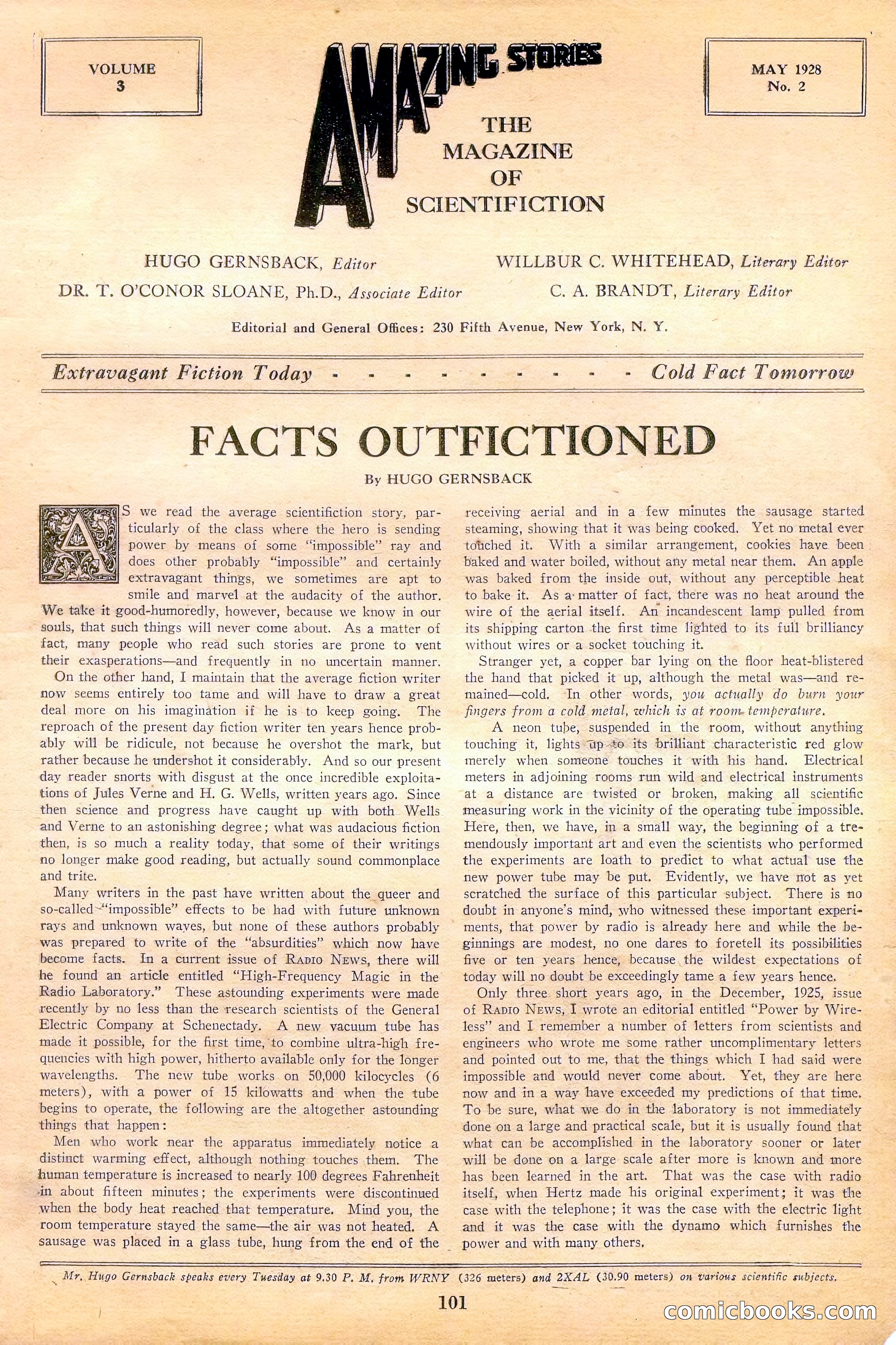
A restored page from Pulp Fiction, 1928. Page through the whole issue in the reader above.
📄 Transcribed text from this page (OCR, searchable)
Machine-transcribed from the original scan — historical spelling and the odd misread are preserved.
VOLUME HUGO GERNSBACK, Editor DR. T. O’CONOR SLOANE, Ph.D., Associate Editor MAY 1928 No. 2 THE MAGAZINE OF SCIENTIFICTION WILLBUR C. WHITEHEAD, Literary Editor C, A. BRANDT, Literary Editor Editorial and General Offices: 230 Fifth Avenue, New York, N. Y. Extravagant Fiction Today - - - - Cold Fact Tomorrow FACTS OUTFICTIONED By HUGO GERNSBACK Mq|S we read the average scientifiction story, par- ticularly of the class where the hero is sending power by means of some “impossible” ray and does other probably “impossible” and certainly extravagant things, we sometimes are apt to smile and marvel at the audacity of the author. We take it good-humoredly, however, because we know in our souls, that such things will neyer come about. As a matter of fact, many people who read such stories are prone to vent their exasperations—and frequently in no uncertain manner. On the other hand, I maintain that the average fiction writer now seems entirely too tame and will have to draw a great deal more on his imagination if he is to keep going. The reproach of the present day fiction writer ten years hence prob- ably will be ridicule, not because he overshot the mark, but rather because he undershot it considerably, And so our present day reader snorts with disgust at the once incredible exploita- tions of Jules Verne and H. G. Wells, written years ago. Since then science and progress have caught up with both Wells and Verne to an astonishing degree; what was audacious fiction then, is so much a reality today, that some of their writings no longer make good reading, but actually sound commonplace and trite. Many writers in the past have written about the queer and so-called~“impossible” effects to be had with future unknown rays and unknown waves, but none of these authors probably was prepared to write of the “absurdities” which now have become facts. Im a current issue of Rapio News, there will he found an article entitled “High-Frequency Magic in the’ Radio Laboratory.” These astounding experiments were made recently by no less than the research scientists of the General Electric Company at Schenectady. A new vacuum ttbe has made it possible, for the first time, to combine ultra-high fre- quencies with high power, hitherto available only for the longer wavelengths. The new tube works on 50,000 kilocycles (6 meters), with a power of 15 kilowatts and when the tube begins to operate, the following are the altogether astounding things that happen: 2 Men who work near the apparatus immediately notice a distinct warming effect, although nothing touches them. The - human temperature is increased to nearly 100 degrees Fahrenheit in about fifteen minutes; the experiments were discontinued when the body heat reached that temperature. Mind you, the room temperature stayed the same—the air was not heated. A sausage was placed in a glass tube, hung from the end of the _ — receiving aerial and in a few minutes the sausage started steaming, showing that it was being cooked. Yet no metal ever touched it. With a similar arrangement, cookies have been baked and water boiled, without atiy metal near them. An apple was baked from the inside out, without any perceptible heat to bake it. As a-matter of fact, there was no heat around the wire of the aerial itself. An incandescent lamp pulled from its shipping carton the first time lighted to its full brilliancy without wires or a socket touching it. Stranger yet, a copper bar lying on the floor heat-blistered the hand that picked it up, although the metal was—and re- mained—cold, In other words, you actually do burn your fingers from a cold metal, which is at room. temperature, A neon tube, suspended in the room, without anything touching it, lights apo its brilliant characteristic red glow merely when someone touches it with his hand. Electrical meters in adjoining rooms run wild and electrical instruments at a distance are twisted or broken, making all scientific measuring work in the vicinity of the operating tube impossible, Here, then, we have, in a small way, the beginning of a tre- mendously important art and even the scientists who performed the experiments are loath to predict to what actual use the new power tube may be put. Evidently, we have not as yet scratched the surface of this particular subject. There is no doubt in anyone’s mind, who witnessed these important experi- ments, that power by radio is already here and while the be- ginnings are modest, no one dares to foretell its possibilities five or ten years hence, because.the wildest expectations of today will no doubt be exceedingly tame a few years hence, Only three. short years ago, in the December, 1925, issue of Rapro News, I wrote an editorial entitled “Power by Wire- less’ and I remember a number of letters from scientists and engineers who wrote me some rather uncomplimentary letters and pointed out to me, that the things which I had said were impossible and would never come about. Yet, they are here now and in a way have exceeded my predictions of that time, To be sure, what we do in the laboratory is not immediately done on a large and practical scale, but it is usually found that what can be accomplished in the laboratory sooner or later will be done on a large scale after more is known and more has been learned in the art. That was the case with radio itself, when Hertz made his original experiment; it was the case with the telephone; it was the case with the electric light and it was the case with the dynamo which furnishes the power and with many others, . Mr, Hugo Gernsback speaks every Tuesday at 9.30 P. M, from WRNY (326 meters) and 2XAL (30.90 meters) on various scientific subjects, 101 | ne ee CONNIGLOOOKS. Conn