
Pulp Fiction, 1928 · page 63 of 100
Amazing Stories, Vol. 3, No. 2 — page 63: what you’re looking at
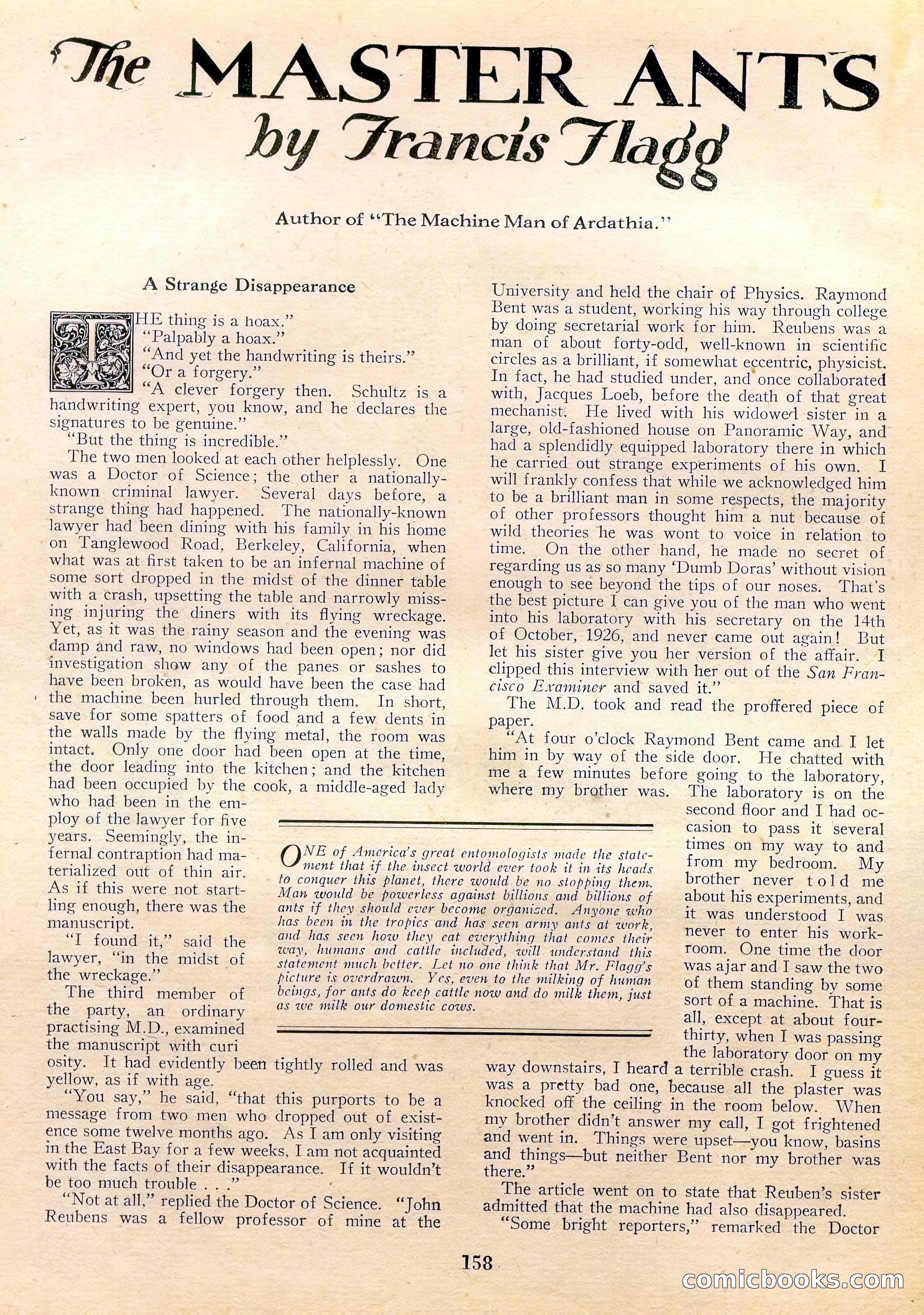
A restored page from Pulp Fiction, 1928. Page through the whole issue in the reader above.
📄 Transcribed text from this page (OCR, searchable)
Machine-transcribed from the original scan — historical spelling and the odd misread are preserved.
Tie MASTER ANTS by Trancts Flagg Author of ‘*The Machine Man of Ardathia.”’ A Strange Disappearance HE thing is a hoax.” “Palpably a hoax.” “And yet the handwriting is theirs.” “Or a forgery.” “A clever forgery then. Schultz is a handwriting expert, you know, and he declares the signatures to be genuine.” “But the thing is incredible.” The two men looked at each other helplessly, One was a Doctor of Science; the other a nationally- known criminal lawyer. Several days before, a strange thing had happened. The nationally-known lawyer had been dining with his family in his home on Tanglewood Road, Berkeley, California, when what was at first taken to be an infernal machine of some sort dropped in the midst of the dinner table with a crash, upsetting the table and narrowly miss- ing injuring the diners with its flying wreckage, Yet, as it was the rainy season and the evening was damp and raw, no windows had been open; nor did investigation show any of the panes or sashes to have been broken, as would have been the case had the machine been hurled through them. In short, save for some spatters of food and a few dents in the walls made by the flying metal, the room was intact. Only one door had been open at the time, the door leading into the kitchen; and the kitchen had been occupied by the cook, a middle-aged lady who had been in the em- ploy of the lawyer for five University and held the chair of Physics. Raymond Bent was a student, working his way through college by doing secretarial work for him. Reubens was a man of about forty-odd, well-known in scientific circles as a brilliant, if somewhat eccentric, physicist. In fact, he had studied under, and once collaborated with, Jacques Loeb, before the death of that great mechanist. He lived with his widowed sister in a large, old-fashioned house on Panoramic Way, and had a splendidly equipped laboratory there in which he carried out strange experiments of his own. I will frankly confess that while we acknowledged him to be a brilliant man in some respects, the majority of other professors thought him a nut because of wild theories he was wont to voice in relation to time. On the other hand, he made no secret of regarding us as so many ‘Dumb Doras’ without vision enough to see beyond the tips of our noses. That's the best picture I can give you of the man who went into his laboratory with his secretary on the 14th of October, 1926, and never came out again! But let his sister give you her version of the affair. I clipped this interview with her out of the San Fran- cisco Examiner and saved it.” The M.D. took and read the proffered piece of paper. “At four o'clock Raymond Bent came and I let him in by way of the side door. He chatted with me a few minutes before going to the laboratory, where my brother was. The laboratory is on the second floor and I had oc- years. Seemingly, the in- : “ NE of America’s great entomologists made the state- fernal contraption had ma Ope that if the insect world ever took it in its heads fo conquer this planet, there would be no stopping them. Man would be powerless against billions and billions of ants if they should ever become organised, Anyone who has been in the tropics and has seen arnvy ants at work, and has seen how they eat everything that comes their way, humans and catile included, will understand this Statement much better. Let no one think that Mr. Flagg’s picture is overdrawn, Yes, even to the milking of human beings, for ants do keep cattle now and do milk them, gust as we milk our domestic cows. terialized out of thin air. As if this were not start- ling enough, there was the manuscript. “T found it,” said the lawyer, “in the midst of the wreckage.” The third member of the party, an ordinary casion to pass it several times on my way to and from my bedroom. My brother never told me about his experiments, and it was understood I was never to enter his work- room. One time the door was ajar and I saw the two of them standing by some sort of a machine. That is all, except at about four- practising M.D., examined the manuscript with curi osity. It had evidently been tightly rolled and was yellow, as if with age. “You say,” he said, “that this purports to be a message from two men who dropped out of exist- ence some twelve months ago. As I am only visiting in the East Bay for a few weeks, I am not acquainted with the facts of their disappearance. If it wouldn’t be too much trouble . . .” ee “Not at all,” replied the Doctor of Science. “John Reubens was a fellow professor of mine at the ES ————————————— 158 . thirty, when I was passing the laboratory door on my way downstairs, I heard a terrible crash. I guess it was a pretty bad one, because all the plaster was knocked off the ceiling in the room below. When my brother didn’t answer my call, I got frightened and went in. Things were upset—you know, basins ae things—but neither Bent nor my brother was there.” The article went on to state that Reuben’s sister admitted that the machine had also disappeared. “Some bright reporters,” remarked the Doctor connicloooks.conn