
Pulp Fiction, 1928 · page 65 of 100
Amazing Stories, Vol. 3, No. 2 — page 65: what you’re looking at
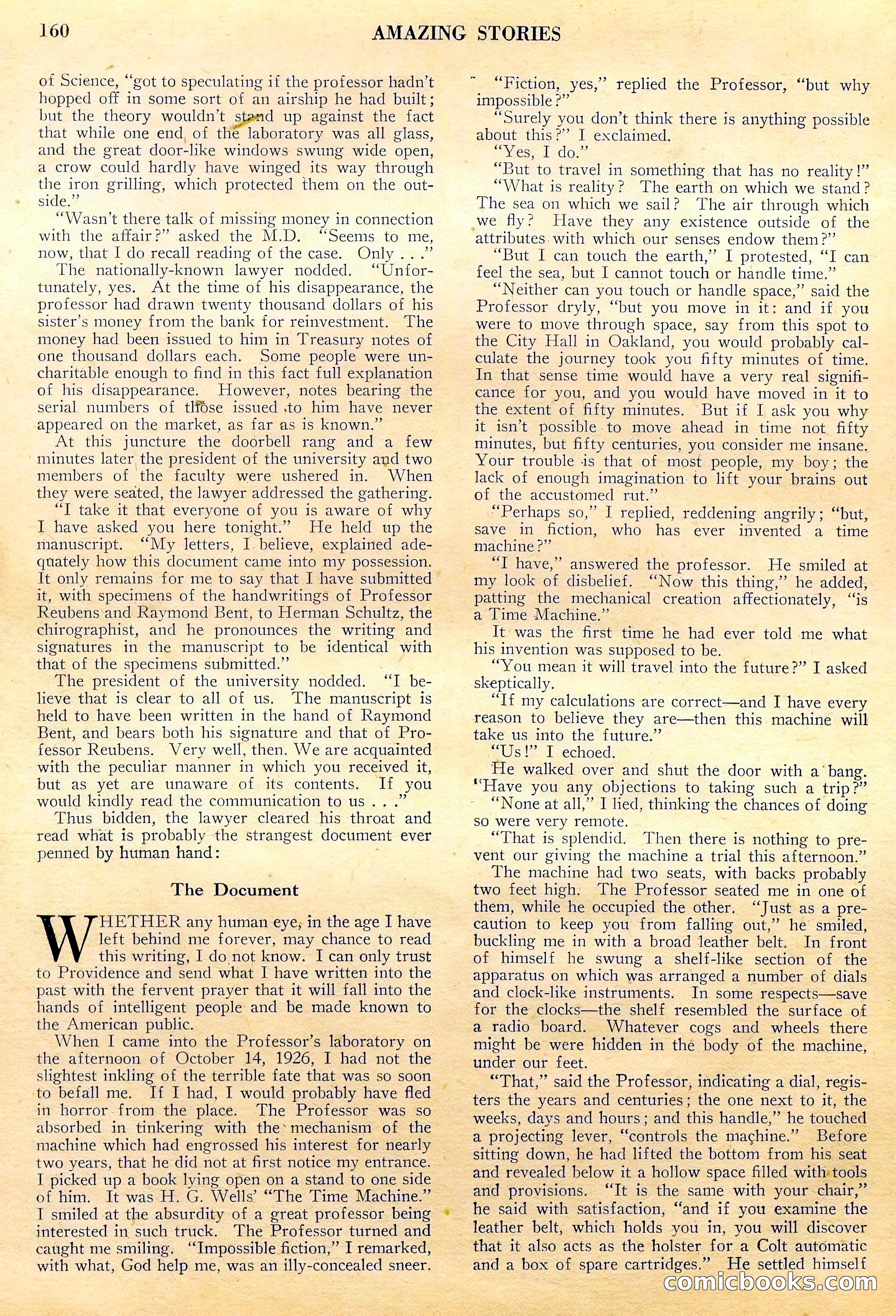
A restored page from Pulp Fiction, 1928. Page through the whole issue in the reader above.
📄 Transcribed text from this page (OCR, searchable)
Machine-transcribed from the original scan — historical spelling and the odd misread are preserved.
160 AMAZING STORIES of Science, “got to speculating if the professor hadn't hopped off in some sort of an airship he had built; but the theory wouldn’t stand up against the fact that while one end, of the laboratory was all glass, and the great door-like windows swung wide open, a crow could hardly have winged its way through the iron grilling, which protected them on the out- side.” “Wasn't there talk of missing money in connection with the affair?” asked the M.D. ‘Seems to me, now, that I do recall reading of the case. Only...” The nationally-known lawyer nodded. “Unfor- tunately, yes. At the time of his disappearance, the professor had drawn twenty thousand dollars of his sister's money from the bank for reinvestment. The money had been issued to him in Treasury notes of one thousand dollars each. Some people were un- charitable enough to find in this fact full explanation of his disappearance. However, notes bearing the serial numbers of tlfOse issued to him have never appeared on the market, as far as is known.” At this juncture the doorbell rang and a few minutes later the president of the university and two members of the faculty were ushered in. When they were seated, the lawyer addressed the gathering. “T take it that everyone of you is aware of why I have asked you here tonight.” He held up the manuscript. “My letters, I believe, explained ade- quately how this document came into my possession. It only remains for me to say that I have submitted it, with specimens of the handwritings of Professor Reubens‘and Raymond Bent, to Herman Schultz, the chirographist, and he pronounces the writing and signatures in the manuscript to be identical with that of the specimens submitted.” The president of the university nodded. “I be- lieve that is clear to all of us. The manuscript is held to have been written in the hand of Raymond Bent, and bears both his signature and that of Pro- fessor Reubens. Very well, then. We are acquainted with the peculiar manner in which you received it, but as yet are unaware of its contents. If you would kindly read the communication to us...” Thus bidden, the lawyer cleared his throat and read what is probably the strangest document ever penned by human hand: : The Weacuineat ' \ 7 HETHER any human eye; in the age I have ; left behind me forever, may chance to read this writing, I do not know. I can only trust to Providence and send what I have written into the past with the fervent prayer that it will fall into the hands of intelligent people and be made known to the American public. When I came into the Professor’s laboratory on the afternoon of October 14, 1926, I had not the slightest inkling of the terrible fate that was so soon to befall me. If I had, I would probably have fled in horror. from the place. The Professor was so absorbed in tinkering with the’ mechanism of the machine which had engrossed his interest for nearly two years, that he did not at first notice my entrance. I picked up a book lying open on a stand to one side of him. It was H. G. Wells’ “The Time Machine.” I smiled at the absurdity of a great professor being interested in such truck. The Professor turned and caught me smiling. ‘Impossible fiction,’ I remarked, with what, God help me, was an illy-concealed sneer. “Fiction, yes,” replied the Professor, “but why impossible ?” “Surely you don’t think there is anything possible about this?” I exclaimed. “Yes, I do.” “But to travel in something that has no reality!” “What is reality? The earth on which we stand? The sea on which we sail? The air through which we fly? Have they any existence outside of the attributes. with which our senses endow them?” “But I can touch the earth,’ I protested, “I can feel the sea, but I cannot touch or handle time.” “Neither can you touch or handle space,” said the Professor dryly, “but you move in it: and if you were to move through space, say from this spot to the City Hall in Oakland, you would probably cal- culate the journey took you fifty minutes of time. In that sense time would have a very real signifi- cance for you, and you would have moved in it to the extent of fifty minutes. But if I ask you why it isn’t possible.to move ahead in time not fifty minutes, but fifty centuries, you consider me insane. Your trouble is that of most people, my boy; the lack of enough imagination to lift your brains out of the accustomed rut.” “Perhaps so,” I replied, reddening angrily; “but, save in fiction, who has ever invented a time machine?” “T have,” answered the professor. He smiled at my look of disbelief. “Now this thing,’ he added, patting the mechanical creation affectionately, “is a Time Machine.” It was the first time he had ever told me what his invention was supposed to be. “You mean it will travel into the future?” I asked skeptically, “If my calculations are correct—and I have every reason to believe they are—then this. machine will take us into the future.” “Us!” T echoed. He walked over and shut the door with a bang. “Have you any objections to taking such a trip?” “None at all,” I hed, thinking the chances of doing so were very remote. “That is splendid. Then there is nothing to pre- vent our giving the machine a trial this afternoon.” The machine had two seats, with backs probably two feet high. The Professor seated me in one of them, while he occupied the other. “Just as a pre- caution to keep you from falling out,” he smiled, buckling me in with a broad leather belt. In front of himself he swung a shelf-like section of the apparatus on which was arranged a number of dials and clock-like instruments. In some respects—save for the clocks—the shelf resembled the surface of a radio board. Whatever cogs and wheels there might be were hidden in the body of the machine, under our feet. “That,” said the Professor, indicating a dial, regis- ters the years and centuries; the one next to it, the weeks, days and hours; and this handle,” he touched a projecting lever, “controls the machine.” Before sitting down, he had lifted the bottom from his seat and revealed below it a hollow space filled with: tools and provisions. “It is the same with your chair,” he said with satisfaction, “and if you examine the leather belt, which holds you in, you will discover that it also acts as the holster for a Colt automatic and a box of spare cartridges.” He settled himself conmiclooolks. com