
Pulp Fiction, 1928 · page 68 of 100
Amazing Stories, Vol. 3, No. 2 — page 68: what you’re looking at
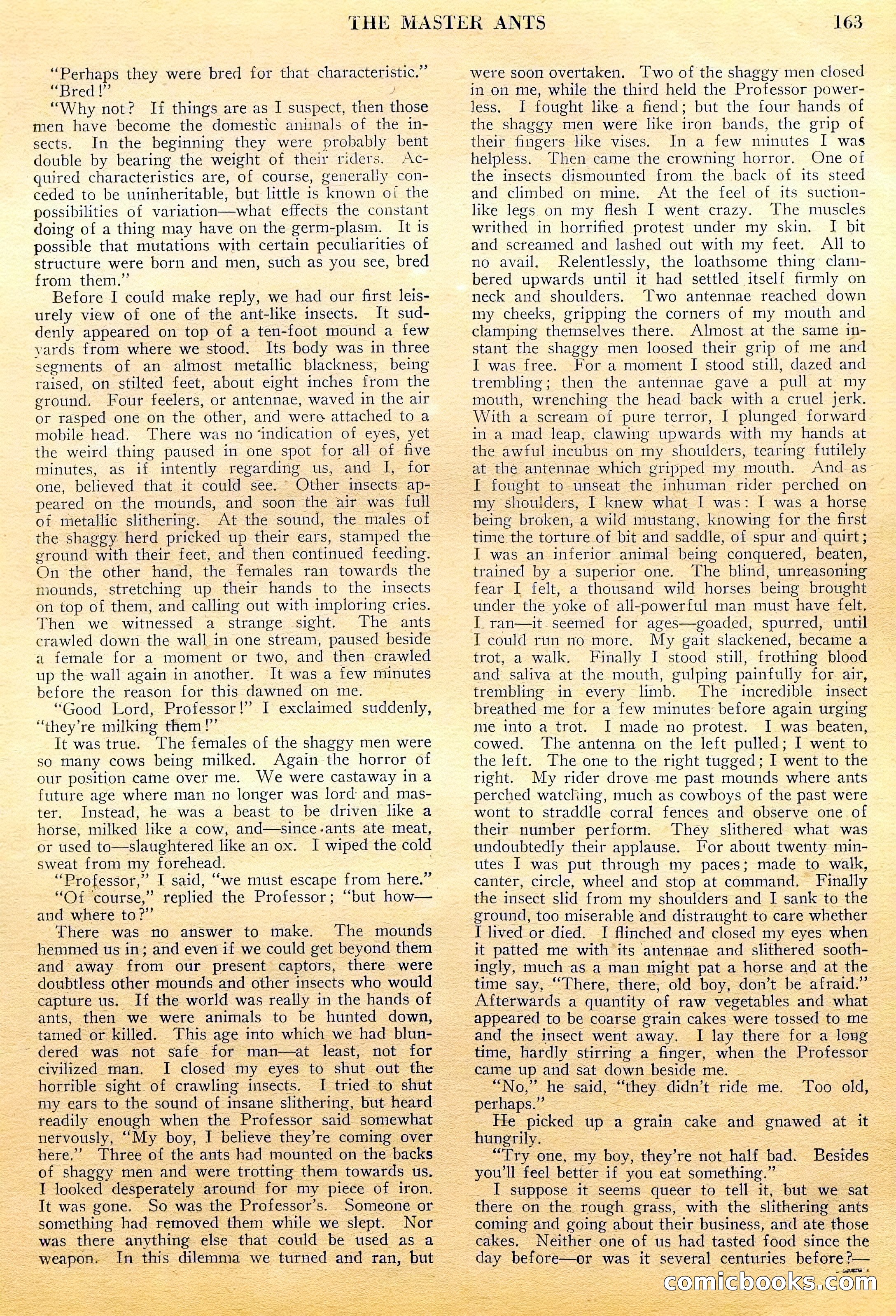
A restored page from Pulp Fiction, 1928. Page through the whole issue in the reader above.
📄 Transcribed text from this page (OCR, searchable)
Machine-transcribed from the original scan — historical spelling and the odd misread are preserved.
THE MASTER ANTS 163 “Perhaps they were bred for that characteristic.” “Bred!” 4 “Why not? If things are as I suspect, then those men have become the domestic animals of the in- sects, In the beginning they were probably bent double by bearing the weight of their riders, Ac- quired characteristics are, of course, generally con- ceded to be uninheritable, but little is known of the possibilities of variation—what effects the constant doing of a thing may have on the germ-plasm. It is possible that mutations with certain peculiarities of structure were born and men, such as you see, bred from them.” Before I could make reply, we had our first leis- urely view of one of the ant-like insects. It sud- denly appeared on top of a ten-foot mound a few yards from where we stood. Its body was in three segments of an almost metallic blackness, being raised, on stilted feet, about eight inches from the ground. Four feelers, or antennae, waved in the air or rasped one on the other, and were attached to a mobile head. There was no ‘indication of eyes, yet the weird thing paused in one spot for all of five minutes, as if intently regarding us, and J, for one, believed that it could see. Other insects ap- peared on the mounds, and soon the air was full of metallic slithering. At the sound, the males of the shaggy herd pricked up their ears, stamped the ground with their feet, and then continued feeding. On the other hand, the females ran towards the mounds, stretching up their hands to the insects on top of them, and calling out with imploring cries. Then we witnessed a strange sight. The ants crawled down the wall in one stream, paused beside a female for a moment or two, and then crawled up the wall again in another. It was a few minutes before the reason for this dawned on me. “Good Lord, Professor!” I exclaimed suddenly, “they’re milking them !”’ It was true. The females of the shaggy men were so many cows being milked. Again the horror of our position cate over me. We were castaway in a future age where man no longer was lord and mas- ter. Instead, he was a beast to be driven like a horse, milked like a cow, and—since-ants ate meat, or used to—slaughtered like an ox. I wiped the cold sweat from my forehead. “Professor,” I said, “we must escape from here.” “Of course,” replied the Professor; “but how— and where to?” There was no answer to make. The mounds hemmed us in; and even if we could get beyond them and away from our present captors, there were doubtless other mounds and other insects who would capture us, If the world was really in the hands of ants, then we were animals to be hunted down, tamed or killed. This age into which we had blun- dered was not safe for man—at least, not for civilized man, I closed my eyes to shut out the horrible sight of crawling insects. I tried to shut my ears to the sound of insane slithering, but heard readily enough when the Professor said somewhat nervously, “My boy, I believe they’re coming over here.” Three of the ants had mounted on the backs of shaggy men and were trotting them towards us. I looked desperately around for my piece of iron. Tt was gone. So was the Professor’s. Someone or something had removed them while we slept. Nor was there anything else that could be used as a weapon. In this dilemma we turned and ran, but were soon overtaken. Two of the shaggy men closed in on me, while the third held the Professor power- less. I fought like a fiend; but the four hands of the shaggy men were like iron bands, the grip of their fingers like vises. In a few minutes I was helpless. Then came the crowning horror. One of the insects dismounted from the back of its steed and climbed on mine, At the feel of its suction- like legs on my flesh I went crazy. The muscles writhed in horrified protest under my skin. I bit and screamed and lashed out with my feet. All to no avail. Relentlessly, the loathsome thing clam- bered upwards until it had settled itself firmly on neck and shoulders. Two antennae reached down my cheeks, gripping the corners of my mouth and clamping themselves there. Almost at the same in- stant the shaggy men loosed their grip of me and I was free. For a moment I stood still, dazed and trembling; then the antennae gave a pull at my mouth, wrenching the head back with a cruel jerk. With a scream of pure terror, I plunged forward in a mad leap, clawing upwards with my hands at the awful incubus on my shoulders, tearing futilely at the antennae which gripped my mouth. And as I fought to unseat the inhuman rider perched on my shoulders, I knew what I was: I was a hors being broken, a wild mustang, knowing for the first time the torture of bit and saddle, of spur and quirt; I was an inferior animal being conquered, beaten, trained by a superior one. The blind, unreasoning fear I felt, a thousand wild horses being brought under the yoke of all-powerful man must have felt. I ran—it. seemed for ages—goaded, spurred, until T could run no more. My gait slackened, became a trot, a walk. Finally I stood still, frothing blood and saliva at the mouth, gulping painfully for air, trembling in every limb. The incredible insect breathed me for a few minutes before again urging me into a trot. I made no protest. I was beaten, cowed. The antenna on the left pulled; I went to the left. The one to the right tugged; I went to the right. My rider drove me past mounds where ants perched watcliing, much as cowboys of the past were wont to straddle corral fences and observe one of their number perform. They slithered what was undoubtedly their applause. For about twenty min- utes I was put through my paces; made to walk, canter, circle, wheel and stop at command. Finally the insect slid from my shoulders and I sank to the ground, too miserable and distraught to care whether I lived or died. I flinched and closed my eyes when — it patted me with its antennae and slithered sooth- ingly, much as a man might pat a horse and at the time say, “There, there, old boy, don’t be afraid.” Afterwards a quantity of raw vegetables and what appeared to be coarse grain cakes were tossed to me and the insect went away. I lay there for a long time, hardly stirring a finger, when the Professor came up and sat down beside me. ae “No,” he said, “they didn’t ride me. Too old, perhaps.” He picked up a grain cake and gnawed at it hunerily. “Try one, my boy, they’re not half bad. Besides — you'll feel better if you eat something.” : __I suppose it seems queer to tell it, but we sat. there on the rough grass, with the slithering ants coming and going about their business, and ate those cakes. Neither one of us had tasted food since the day before—or was it several centuries before ?— Comicnooks.com