
Pulp Fiction, 1928 · page 76 of 100
Amazing Stories, Vol. 3, No. 2 — page 76: what you’re looking at
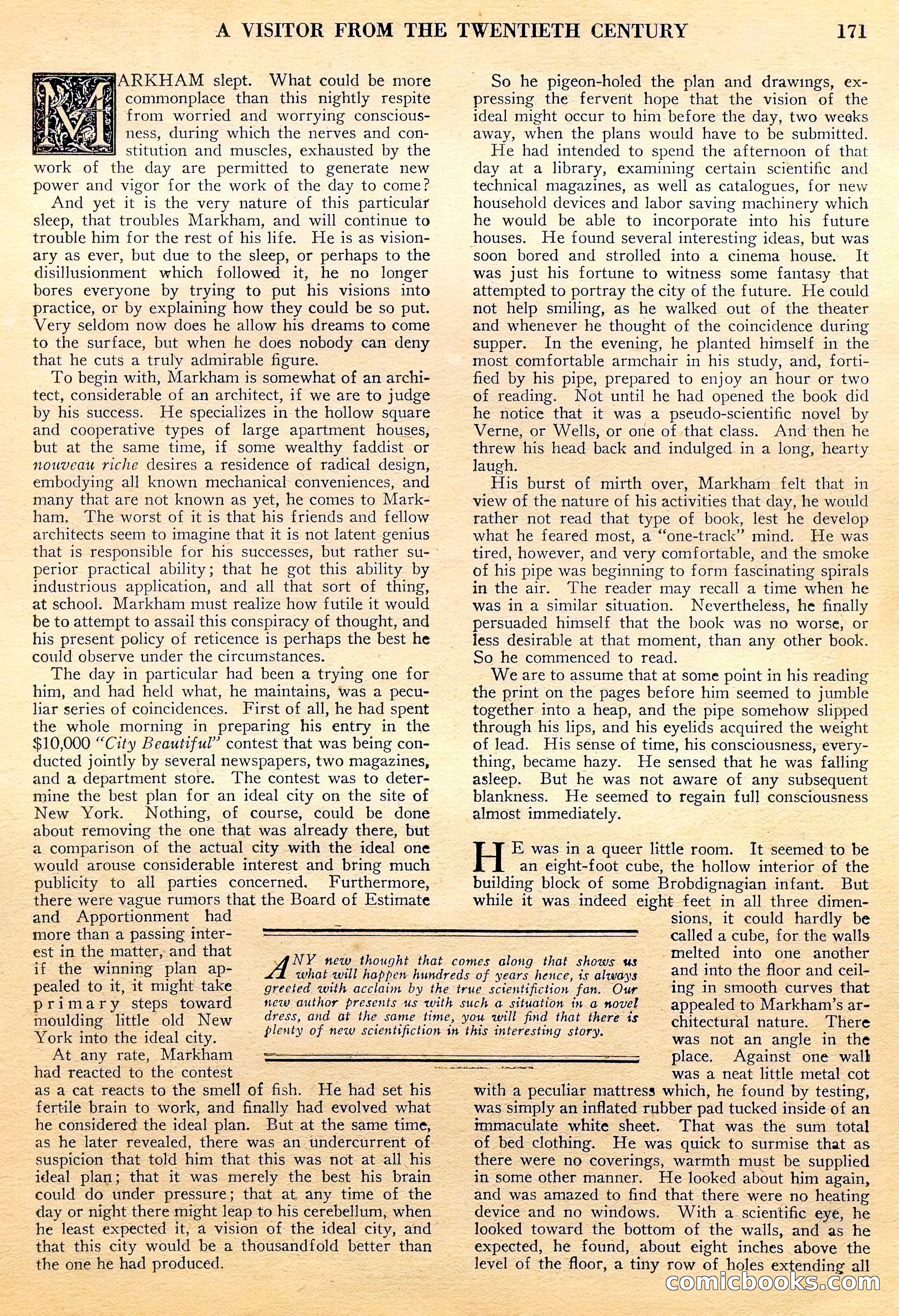
A restored page from Pulp Fiction, 1928. Page through the whole issue in the reader above.
📄 Transcribed text from this page (OCR, searchable)
Machine-transcribed from the original scan — historical spelling and the odd misread are preserved.
A VISITOR FROM THE TWENTIETH CENTURY 171 aARKHAM slept. What could be more commonplace than this nightly respite from worried and worrying conscious- ness, during which the nerves and con- stitution and muscles, exhausted by the work of the day are permitted to generate new power and vigor for the work of the day to come? And yet it is the very nature of this particular sleep, that troubles Markham, and will continue to trouble him for the rest of his life. He is as vision- ary as ever, but due to the sleep, or perhaps to the disillusionment which followed it, he no longer bores everyone by trying to put his visions into practice, or by explaining how they could be so put. Very seldom now does he allow his dreams to come to the surface, but when he does nobody can deny that he cuts a truly admirable figure. To begin with, Markham is somewhat of an archi- tect, considerable of an architect, if we are to judge by his success. He specializes in the hollow square and cooperative types of large apartment houses, but at the same time, 1f some wealthy faddist or nouveau riche desires a residence of radical design, embodying all known mechanical conveniences, and many that are not known as yet, he comes to Mark- ham. ‘The worst of it is that his friends and fellow architects seem to imagine that it is not latent genius that is responsible for his successes, but rather su- ' perior practical ability; that he got this ability by industrious application, and all that sort of thing, at school. Markham must realize how futile it would be to attempt to assail this conspiracy of thought, and his present policy of reticence is perhaps the best he could observe under the circumstances. The day in particular had been a trying one for him, and had held what, he maintains, was a pecu- liar series of coincidences. First of all, he had spent the whole morning in preparing his entry in the $10,000 “City Beautiful” contest that was being con- ducted jointly by several newspapers, two magazines, and a department store. The contest was to deter- mine the best plan for an ideal city on the site of New York. Nothing, of course, could be done about removing the one that was already there, but a comparison of the actual city with the ideal one would arouse considerable interest and bring much publicity to all parties concerned. Furthermore, there were vague rumors that the Board of Estimate and Apportionment had more than a passing inter- So he pigeon-holed the plan and drawings, ex- pressing the fervent hope that the vision of the ideal might occur to him before the day, two weeks away, when the plans would have to be submitted. He had intended to spend the afternoon of that day at a library, examining certain scientific and technical magazines, as well as catalogues, for new household devices and labor saving machinery which he would be able to incorporate into his future houses. He found several interesting ideas, but was soon bored and strolled into a cinema house. It was just his fortune to witness some fantasy that attempted to portray the city of the future. He could not help smiling, as he walked out of the theater and whenever he thought of the coincidence during supper. In the evening, he planted himself in the most comfortable armchair in his study, and, forti- fied by his pipe, prepared to enjoy an hour or two of reading. Not until he had opened the book did he notice that it was a pseudo-scientific novel by Verne, or Wells, or one of that class. And then he threw his head back and indulged. in a long, hearty laugh, His burst of mirth over, Markham felt that in view of the nature of his activities that day, he would rather not read that type of book, lest he develop what he feared most, a ‘“‘one-track” mind. He was tired, however, and very comfortable, and the smoke of his pipe was beginning to form fascinating spirals in the air. The reader may recall a time when he was in a similar situation. Nevertheless, he finally persuaded himself that the book was no worse, or less desirable at that moment, than any other book. So he commenced to read. Weare to assume that at some point in his reading the print on the pages before him seemed to jumble together into a heap, and the pipe somehow slipped through his lips, and his eyelids acquired the weight of lead. His sénse of time, his consciousness, every- thing, became hazy. He sensed that he was falling asleep. But he was not aware of any subsequent blankness. He seemed to regain full consciousness almost immediately. H E was in a queer little room. It seemed to be an eight-foot cube, the hollow interior of the building block of some Brobdignagian infant. But while it was indeed eight feet in all three dimen- sions, it could hardly be est in the matter, and that if the winning plan ap- A pealed to it, it might take primary steps toward moulding little old New York into the ideal city. NY new thought that comes along that shows us what will happen hundreds of years hence, is always greeted with acclaim by the true sctentifiction fan. Our new author presents us with such a situation in a novel dress, and at the same time, you will find that there is blenty of new scientifiction in this interesting story. called a cube, for the walls melted into one another and into the floor and ceil- ing in smooth curves that _ appealed to Markham’s ar- chitectural nature. There was not an angle in the At any rate, Markham == had reacted to the contest as a cat reacts to the smell of fish. He had set his fertile brain to work, and finally had evolved what he considered the ideal plan. But at the same time, as he later revealed, there was an tindercurrent of suspicion that told him that this was not at all his ideal plan; that it was merely the best his brain could do under pressure; that at any time of the day or night there might leap to his cerebellum, when he least expected it, a vision of the ideal city, and that this city would be a thousandfold better than the one he had produced. ——— place. Against one walk was a neat little metal cot with a peculiar mattress which, he found by testing, was simply an inflated rubber pad tucked inside of an tmmaculate white sheet. That was the sum total of bed clothing. He was quick to surmise that as there were no coverings, warmth must be supplied in some other manner. He looked about him again, and was amazed to find that there were no heating device and no windows. With a scientific eye, he looked toward the bottom of the walls, and as he expected, he found, about eight inches above the level of the floor, a tiny row of holes extending all COMIC DOOKS.COnN