
Pulp Fiction, 1928 · page 79 of 100
Amazing Stories, Vol. 3, No. 2 — page 79: what you’re looking at
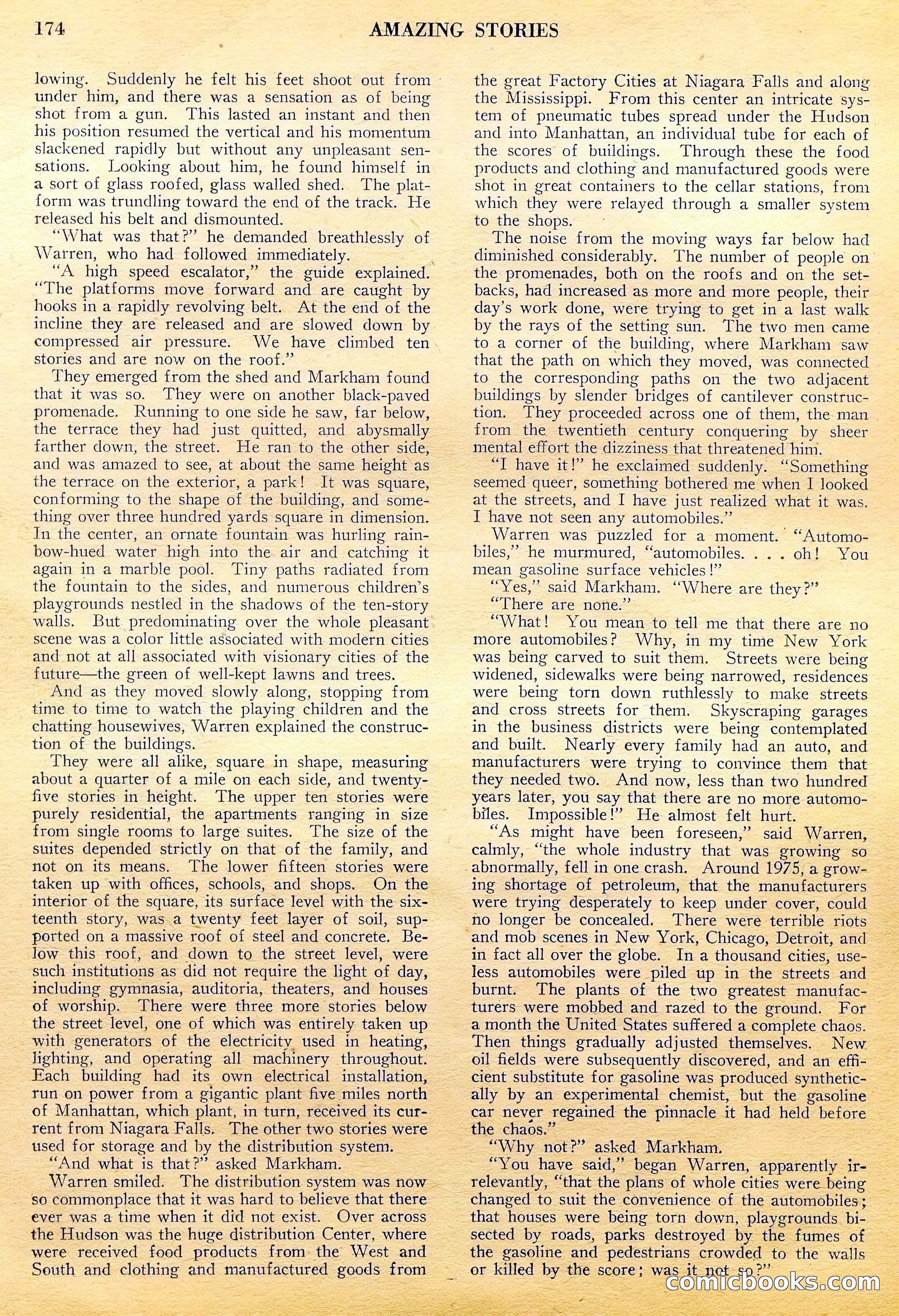
A restored page from Pulp Fiction, 1928. Page through the whole issue in the reader above.
📄 Transcribed text from this page (OCR, searchable)
Machine-transcribed from the original scan — historical spelling and the odd misread are preserved.
174 AMAZING STORIES lowing. under him, and there was a sensation as of being shot from a gun. This lasted an instant and then his position resumed the vertical and his momentum slackened rapidly but without any unpleasant sen- sations. Looking about him, he found himself in a sort of glass roofed, glass walled shed. The plat- form was trundling toward the end of the track. He released his belt and dismounted. “What was that?” he demanded breathlessly of Warren, who had followed immediately. “A high speed escalator,” “The platforms move forward and are caught by hooks in a rapidly revolving belt. At the end of the incline they are released and are slowed down by compressed air pressure. We have climbed ten stories and are now on the roof.” They emerged from the shed and Markham found that it was so. They were on another black-paved promenade. Running to one side he saw, far below, the terrace they had just quitted, and abysmally farther down, the street. He ran to the other side, and was amazed to see, at about the same height as the terrace on the exterior, a park! It was square, conforming to the shape of the building, and some- thing over three hundred yards square in dimension. In the center, an ornate fountain was hurling rain- bow-hued water high into the. air and catching it again in a marble pool. ‘Tiny paths radiated from the fountain to the sides, and numerous children’s playgrounds nestled in the shadows of the ten-story walls. But predominating over the whole pleasant scene was a color little associated with modern cities and not at all associated with visionary cities of the future—the green of well-kept lawns and trees. And as they moved slowly along, stopping from time to time to watch the playing children and the chatting housewives, Warren explained the construc- tion of the buildings. They were all alike, square in shape, measuring about a quarter of a mile on each side, and twenty- five stories in height. The upper ten stories were purely residential, the apartments ranging in size from single rooms to large suites. The size of the stutes depended strictly on that of the family, and not on its means. The lower fifteen stories were taken up with offices, schools, and shops. On the interior of the square, its surface level with the six- teenth story, was a twenty feet layer of soil, sup- ported on a massive roof of steel and concrete. Be- low this roof, and down to the street level, were such institutions as did not require the light of day, including gymnasia, auditoria, theaters, and houses of worship. There were three more stories below the street level, one of which was entirely taken up with generators of the electricity used in heating, lighting, and operating all machinery throughout. Each building had its own electrical installation, tun on power from a gigantic plant five miles north of Manhattan, which plant, in turn, received its cur- rent from Niagara Falls. The other two stories were used for storage and by the distribution system. “And what is that?’ asked Markham. Warren smiled. The distribution system was now — so commonplace that it was hard to believe that there ever was a time when it did not exist. Over across the Hudson was the huge distribution Center, where were received food products from: the West and South and clothing and manufactured goods from Suddenly he felt his feet shoot out from - the guide explained. the great Factory Cities at Niagara Falls and along the Mississippi. From this center an intricate sys- tem of pneumatic tubes spread under the Hudson and into Manhattan, an individual tube for each of the scores of buildings. Through these the food products and clothing and manufactured goods were shot in great containers to the cellar stations, from which they were relayed through a smaller system to the shops. The noise from the moving ways far below had diminished considerably. The number of people on’ the promenades, both on the roofs and on the set- backs, had increased as more and more people, their day’s work done, were trying to get in a last walk by the rays of the setting sun. The two men came to a corner of the building, where Markham saw that the path on which they moved, was connected to the corresponding paths on the two adjacent buildings by slender bridges of cantilever construc- tion. They proceeded across one of them, the man from the twentieth century conquering by sheer mental effort the dizziness that threatened him. “T have it!” he exclaimed suddenly. “Something seemed queer, something bothered me when I looked at the streets, and I have just realized what it was. I have not seen any automobiles.’’ Warren was puzzled for a moment. “Automo- biles,”’ he murmured, “automobiles. ... oh! You mean gasoline surface vehicles!” “Yes,” said Markham. ‘Where are they?” “There are none.” “What! You mean to tell me that there are no more automobiles? Why, in my time New York was being carved to suit them. Streets were being widened, sidewalks were being narrowed, residences were being torn down ruthlessly to make streets and cross streets for them. Skyscraping garages in the business districts were being contemplated and built. Nearly every family had an auto, and manufacturers were trying to convince them that they needed two. And now, less than two hundred years later, you say that there are no more automo- biles. Impossible!” He almost felt hurt. “As might have been foreseen,” said Warren, calmly, “the whole industry that was growing so -abnormally, fell in one crash. Around 1975, a grow- ing shortage of petroleum, that the manufacturers were trying desperately to keep under cover, could no longer be concealed. There were terrible riots ‘and mob scenes in New York, Chicago, Detroit, and in fact all over the globe. In a thousand cities, use- less automobiles were piled up in the streets atid The plants of the two greatest manufac- turers were mobbed and razed to the ground. For burnt. a month the United States suffered a complete chaos. Then things gradually adjusted themselves. New oil fields were subsequently discovered, and an effi- o cient substitute for gasoline was produced synthetic- ally by an experimental chemist, but the gasoline _ car never regained the pinnacle it had held before meee) - the chaos.” : “Why not?” asked Markham. “You have said,” began Warren, apparently ir-— relevantly, “that the plans of whole cities were being _ changed to suit the convenience of the automobiles; that houses were being torn down, playgrounds bi- sected by roads, parks destroyed by the fumes of the gasoline and pedestrians crowded to the walls or killed by the score: was it net so?” ee See SCONE NOOKS COT Cc