
Pulp Fiction, 1928 · page 93 of 100
Amazing Stories, Vol. 3, No. 2 — page 93: what you’re looking at
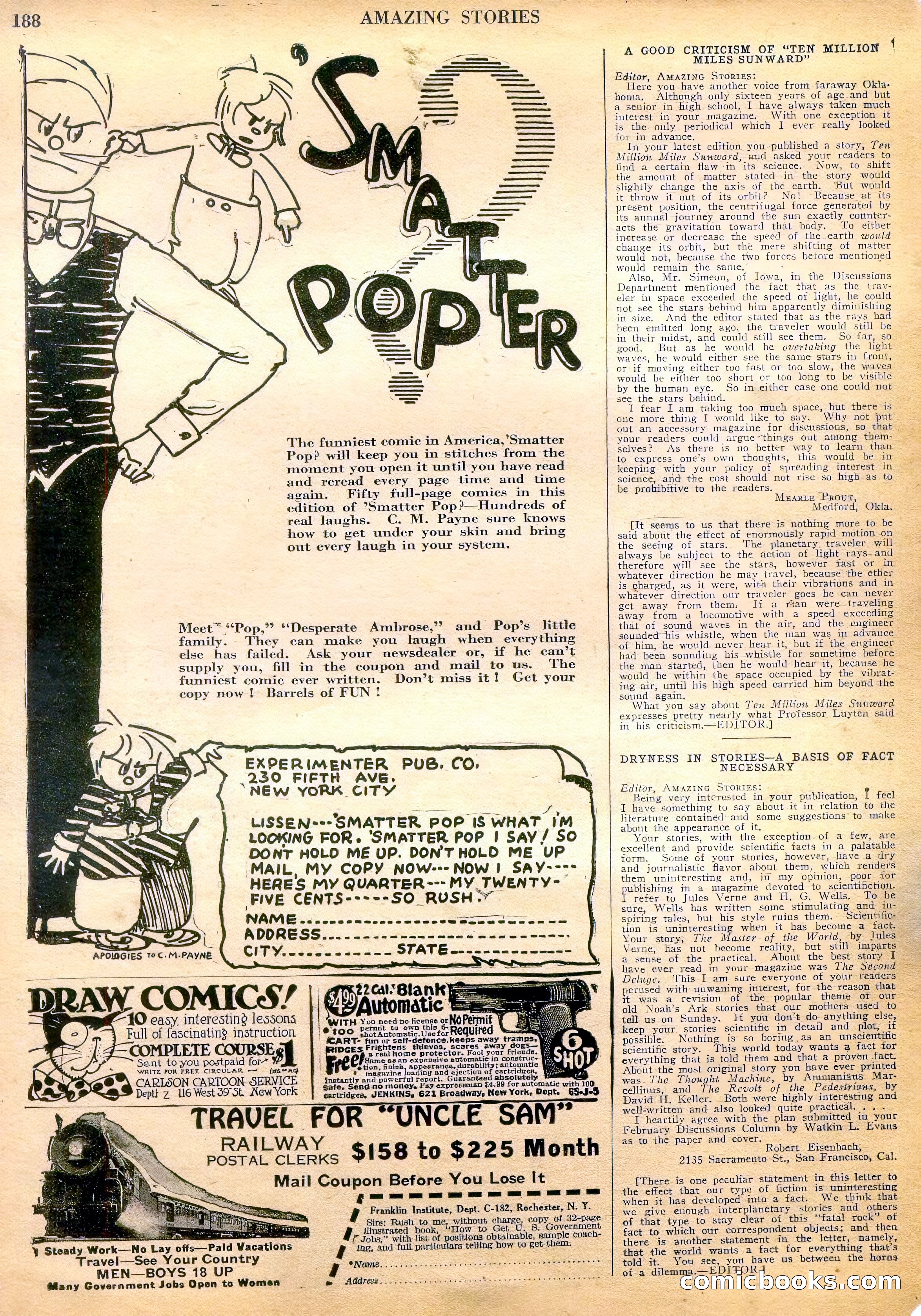
A restored page from Pulp Fiction, 1928. Page through the whole issue in the reader above.
📄 Transcribed text from this page (OCR, searchable)
Machine-transcribed from the original scan — historical spelling and the odd misread are preserved.
AMAZING STORIES The funniest comic in America,’Smatter Pop? will keep you in stitches from the moment you open it until you haye read and reread every page time and time again. Fifty full-page comics in this edition of ?Smatter Pop?—Hundreds of real laughs. C. M. Payne sure knows how to get under your skin and bring out every laugh in your system. Meet™ “Pop,” “Desperate Ambrose,””? and Pop’s little family. They can make you laugh when _ everything else has failed. Ask your newsdealer or, if he can’t supply you, fill in the coupon and mail to us. The funniest comic ever written. Don’t miss it! Get your copy now! Barrels of FUN ! EXPERIMENTER PUB. CO, .230 FIFTH AVE. NEW YORK CITY %, eee ry ies fy LISSEN-:- SMATTER POP IS WHAT IM LOOKING FOR. 'SMATTER POP | SAY/ SO DONT HOLO ME UP. DONT HOLO ME UP ‘MAIL, MY COPY NOW--- NOW | SAY---> | HERES MY QUARTER---MY TWENTY- ~ FIVE CENTS--~--SO_ RUSH.” NAIM EG cnccenaucccsueacvaucbucasccaum= ADORESS....------------.—--------. CITY. --.<.---~--- STATE.------------- APOLOGIES T° c.M.PAYNE COMICS/ QBAutomatic — 10 easy, interesting lessons g ITM Yoo need no license orNO Permit f Full of fascinating instruction | \@#00 Per wmete Unetor Required CART: fin or sell-detonce. keeps away tramns,¥ COMPLETE COURSE hte (GES Frightens thieves, scares away dozs— srealhome protector. Fool your friends, Sent toyou postpaid for~ he WRITE FOR FREE CIRCULAR — (mee AQ ~ TRAVEL FOR “UNCLE SAM” CARLSON CARTOON SERVICE safe. Send-.no marley. Pay exprosuman $4.99 for automatic with 100. RAILWAY ; $158 to $225 Month @ magazine loading und cisction of csrtridxer, Dept z U6 West 39°St. New York | Gartridges, JENKINS, 622 Broadway, New York, Dont. Ga-S-S POSTAL CLERKS Mail Coupon Before You Lose It & | Franklin Institute, Dept. C-182, Rochester, N. 2 a Sirs: Rush to me, without charge, copy_of $2-page y | fustrated book, “How to Get U. 8. Government F Jobs,” with list of p Ftlona obtainable, sample cosach- rs teliing how to get-them. Steady Work—No Lay offs—Pald Wacatlons Travel—See Your Country MEN—BOYS 18 UP @any Government Jobs Open to Women a | ing, and full partic A GOOD CRITICISM OF “TEN MILLION { MILES SUNWARD” Editor, AMAZING StToriEs: Here you have another voice from faraway Okla: homa, Although only sixteen years of age and but a senior in high school, I have always taken much interest in your magazine. With one exception it is the only periodical which I ever really looked for in adyance. In your latest edition you published a story, Ten Million Miles Sunivard, and asked your readers to find a certain flaw in its science. Now, to shift the amount of matter stated in the story would slightly change the axis of the earth. ‘But would it throw it out of its orbit? No! ~ Because at its present position, the centrifugal force generated by its annual journey around the sun exactly cotnter- acts the gravitation toward that body, ‘To either jnerease or decrease the speed of the earth ould change its orbit, but the mere shifting of matter would not, because the tio forces before mentioned would remain the same, : i Also, Mr. Simeon, of Towa, in the Discussions Department mentioned the fact that as the trav- eler in space exceeded the speed of ight, he could not see the stars behind him apparently diminishing in size. And the editor stated that as the rays had been emitted long ago, the traveler would still be in their midst, and could still see them, So far, so good, Zut as he would be overtaking the light waves, he would either see the same stars in front, or if moving either too fast or too slow, the waves would be either too short or too long to be visible by the human eye. So in either case one could not see the stars behind. J fear I am taking too much space, but there is one more thing I would like to say. Why not put out an accessory magazine for discussions, so that your readers could argue~things out among them- selves? As there is mo better way to learn than to express one’s own thoughts, this would be in keeping with your policy of spreading interest in science, and the cost should not rise so high as to be prohibitive to the readers. é e Mearrze Prout, Medford, Okla, there is nothing more to be said about the effect of enormously rapid motion on c the seeing of stars, ‘The planetary traveler will = always be subject to the action of light rays- and therefore will see the stars, however fast or in whatever direction he may travel, because the ether is charged, as it were, with their vibrations and in whatever direction our traveler goes he can never get away from them, If a rman were traveling away from a locomotive with a speed exceeding that of sound waves in the air, and the engineer sounded his whistle, when the man was in advance of him, he would never hear it, but if the engineer had been sounding his whistle for sometime betore the man started, then he would hear it, because he would be within the space occupied by the vibrat- ing air, until his high speed carried him beyond the sound again, What you say about Ten Million Miles Sunward expresses pretty nearly what Professor Luyten said in his criticism.—EDITOR.] (It seems to us tha DRYNESS IN STORIES—A BASIS OF FACT NECESSARY Editor, AMAZING STORIES: Being very interested in your publication, { feel IT have something to say about it in relation to the literature contained and some suggestions to make about the appearance of it, Your stories, with the exception of a few, are excellent and provide scientific facts in a palatable form. Some of your stories, however, have a dry and journalistic flavor about them, which renders them uninteresting and, in my opinion, poor for publishing in a magazine devoted to scientifiction. i refer to Jules Verne and H, G. Wells. To he sure, Wells has written some stimulating and in- spiring tales, but his style ruins them. Scientific- tion is uninteresting when it has become @ faoks= Your story, The Master of the World, by jitles === Verne, has not become reality, but still imparts a sense of the practical, About the best story I have ever read in your magazine was The Second Deluge, This I am sure everyone of your readers’ erused with unwaning interest, for the reason that it was a revision of ‘the popular theme of our” old Noah’s Ark stories that our mothers used to- tell us on Sunday. If you don’t do anything else, keep your stories scientific in detail and plot, if possible. Nothing is so boring,as an unscientific scientific story. This world today wants a fact for everything that is told them and that a proven fact. About the most original story you bave ever printed was. The Thought Machine, by Ammaniaus Mar- cellinus, and The Revolt of the Pedestrians, by David H. Keller. Both were highly interestmg and well-written and also looked quite practical... . I heartily agree with the plan submitted in your Februaty Discussions Column by Watkin L. Evans as to the paper and cover, ss Robert Eisenbach, 2135 Sacramento St., San Francisco, Cal. [There is one peculiar statement in this letter to the effect that our type of fiction is uninteresting — when it has developed into a fact. We think that we give enough interplanetary stories and others” — of that type to stay clear of this “fatal tock” of fact to which our correspondent objects; and then there is another statement in the letter, namely, | that the world wants a fact for everything that’s told it. You see, you have us ‘between the horns of a dilemma.—EDIFOR icomicbooksscom