
Pulp Fiction, 1864 · page 5 of 52
The Secret Shot; Or, The Rivals Of Misty Mount — page 5: what you’re looking at
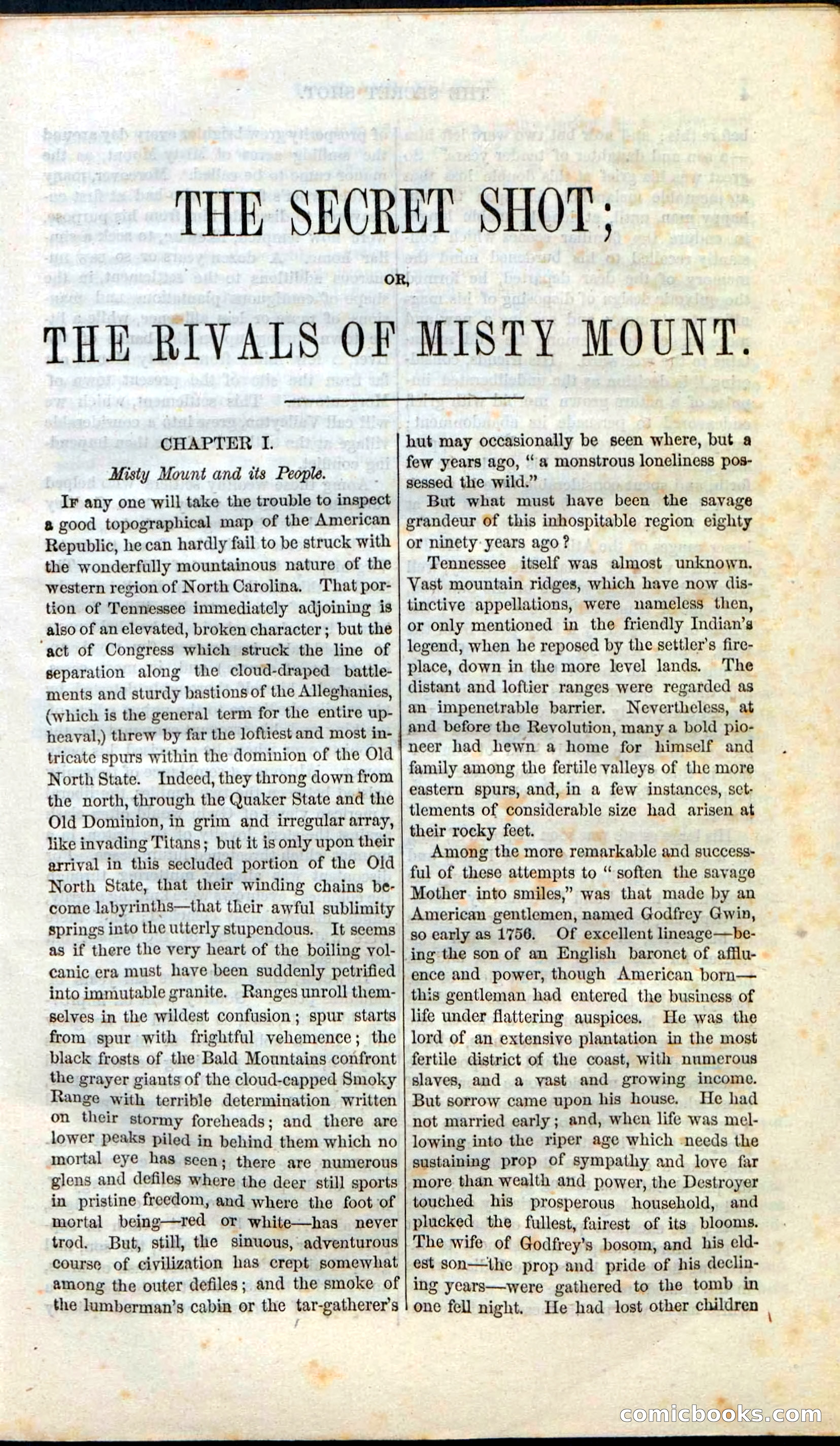
A restored page from Pulp Fiction, 1864. Page through the whole issue in the reader above.
📄 Transcribed text from this page (OCR, searchable)
Machine-transcribed from the original scan — historical spelling and the odd misread are preserved.
THE SECRET SHOT; OR, THE RIVALS OF MISTY MOUNT. CHAPTER I. Misty Mount and iis People. Ir any one will take the trouble to inspect & good topographical map of the American Republic, he can hardly fail to be struck with the wonderfully mountainous nature of the western region of North Carolina, That por- tion of Tennessee immediately adjoining is also of an elevated, broken character; but the ‘act of Congress which struck the line of separation along the cloud-draped battle- ments and sturdy bastions of the Alleghanies, (which is the general term for the entire up- heayal,) threw by far the loftiest and most in- tricate spurs within the dominion of the Old North State. Indeed, they throng down from the north, through the Quaker State and the Old Dominion, in grim and irregular array, like invading Titans; but it is only upon their arrival in this secluded portion of the Old North State, that their winding chains be- come labyrinths—that their awful sublimity springs into the utterly stupendous. It seems as if there the very heart of the boiling yol- canic era must have been suddenly petrified into immutable granite. Ranges unroll them- selves in the wildest confusion; spur starts from spur with frightful yehemence; the black frosts of the’ Bald Mountains confront the grayer giants of the cloud-capped Smoky Range with terrible determination written on their stormy foreheads; and there are lower peaks piled in behind them which no mortal eye has seen; there are numerous glens and defiles where the deer still sports in pristine freedom, and where the foot of mortal being—red or white—has never trod. But, still, the sinuous, adventurous course of civilization has crept somewhat among the outer defiles; and the smoke of the luamberman’s cabin or the tar-gatherer’s hut may occasionally be seen where, but a few years ago, “a monstrous loneliness pos- sessed the wild.” ; But what must have been the savage grandeur of this inhospitable region eighty or ninety years ago? Tennessee itself was almost unknown, Vast mountain ridges, which have now dis- tinctive appellations, were nameless then, or only mentioned in the friendly Indian’s legend, when he reposed by the settler’s fire- place, down in the more level lands. The distant and loflier ranges were regarded as an impenetrable barrier. Nevertheless, at and before the Revolution, many a bold pio- neer had hewn a home for himself and family among the fertile valleys of the more eastern spurs, and, in a few instances, set: tlements of considerable size had arisen at their rocky feet. Among the more remarkable and success- ful of these attempts to “soften the savage Mother. into smiles,” was that made by an American gentlemen, named Godfrey Gwin, so early as 1756. Of excellent lineage—be- ing the son of an English baronet of afflu- ence and power, though American born— this gentleman had entered the business of life under flattering auspices. He was the lord of an extensive plantation in the most fertile district of the coast, with numerous slaves, and a yast and. growing income. But sorrow came upon his house. He had not married early ; and, when life was mel- lowing into the riper age which needs the sustaining prop of sympathy and love far more than wealth and power, the Destroyer touched his prosperous household, and plucked the fullest, fairest of its blooms. The wife of Godfrey's bosom, and his eld- est son—the prop and pride of his declin- ing years—were gathered to the tomb in one fell night. He had lost other children * I a[byoye) (E(0) nn} S (E(0) in ccc ccc,