
Pulp Fiction, 1928 · page 11 of 99
Amazing Stories — page 11: what you’re looking at
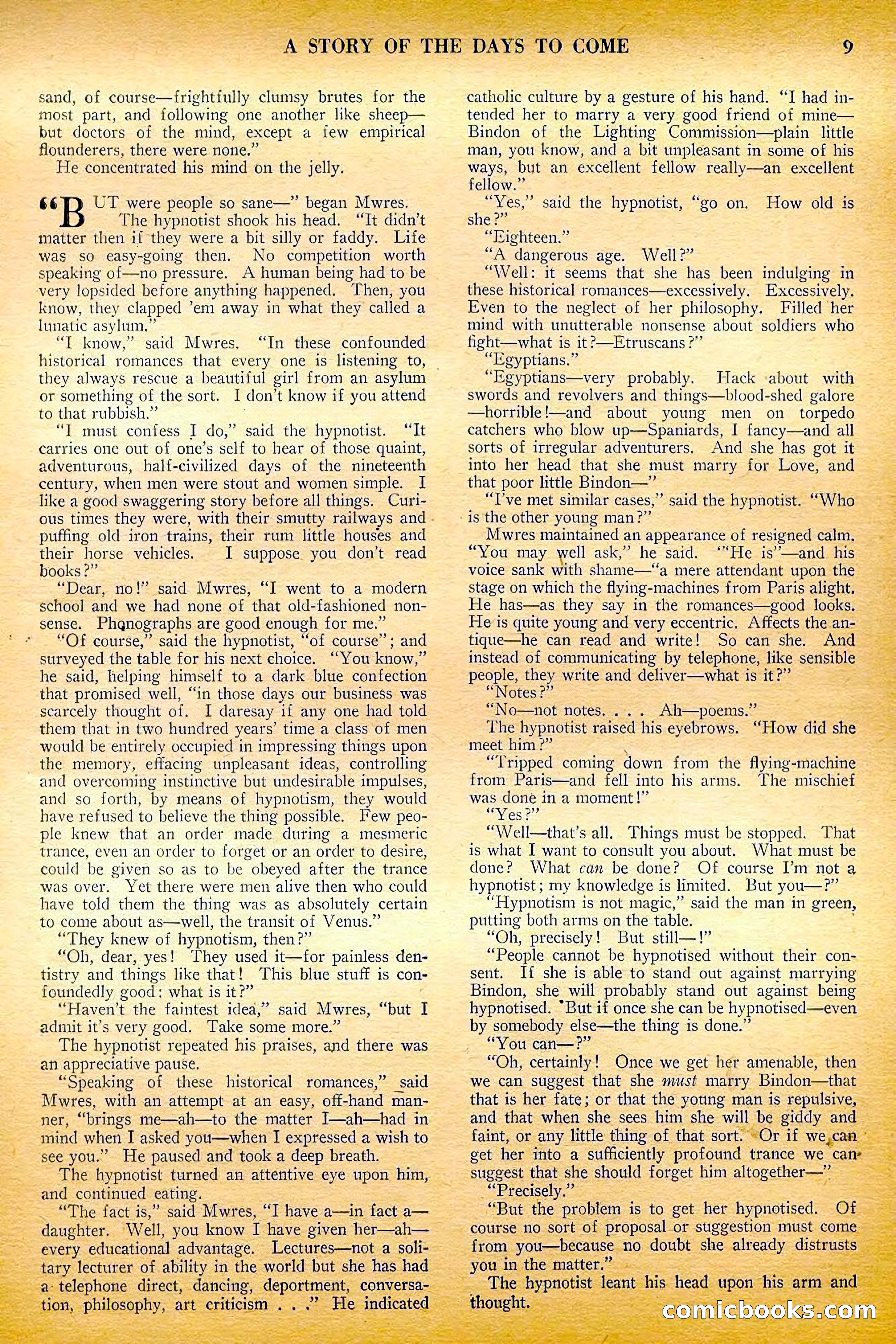
A restored page from Pulp Fiction, 1928. Page through the whole issue in the reader above.
📄 Transcribed text from this page (OCR, searchable)
Machine-transcribed from the original scan — historical spelling and the odd misread are preserved.
sand, of course—frightfully clumsy brutes for the most part, and following one another like sheep— but doctors of the mind, except a few empirical flounderers, there were none.” He concentrated his mind on the jelly. 66 UT were people so sane—” began Mwres. The hypnotist shook his head. “It didn’t matter then if they were a bit silly or faddy. Life was so easy-going then. No competition worth speaking of—no pressure. A human being had to be very lopsided before anything happened. Then, you know, they clapped ’em away in what they called a lunatic asylum,” “T know,” said Mwres. “In these confounded historical romances that every one is listening to, | they always rescue a beautiful girl from an asylum or something of the sort. I don’t know if you attend to that rubbish.” “J must confess I do,” said the hypnotist. “It carries one out of one’s self to hear of those quaint, adventurous, half-civilized days of the nineteenth century, when men were stout and women simple. I like a good swaggering story before all things. Curi- ous times they were, with their smutty railways and - puffing old iron trains, their rum little houses and their horse vehicles. I suppose you don’t read books ?” “Dear, no!” said Mwres, “I went to a modern school and we had none of that old-fashioned non- sense. Phgnographs are good enough for me.” “Of course,’ said the hypnotist, “of course’; and surveyed the table for his next choice. “You know,” he said, helping himself to a dark blue confection that promised well, “in those days our business was scarcely thought of. I daresay if any one had told them that in two hundred years’ time a class of men would be entirely occupied in impressing things upon the memory, effacing unpleasant ideas, controlling and overcoming instinctive but undesirable impulses, and so forth, by means of hypnotism, they would have refused to believe the thing possible. Few peo- ple knew that an order made during a mesmeric trance, even an order to forget or an order to desire, could be given so as to be obeyed after the trance was over. Yet there were men alive then who could have told them the thing was as absolutely certain to come about as—well, the transit of Venus.” “They knew of hypnotism, then?” “Oh, dear, yes! They used it—for painless den- tistry and things like that! This blue stuff is con- foundedly good: what is it?” “Haven't the faintest idea,” said Mwres, admit it’s very good. Take some more.” - The hypnotist repeated his praises, and there was 3 an appreciative pause. “Speaking of these historical romances,” said Mwres, with an attempt at an easy, off-hand man- “but I _ mind when I asked you—when I expressed a wish to see you.” He paused and took a deep breath. and continued eating. is the other young man?” ner, “brings me—ah—to the matter I—ah—had in and that when he sees him she will be. SAly a The hypnotist turned an attentive eye upon: him, =e _ “The fact is,” said Mwres, “T have a—in fact ae _ Well, you know it have giver her—ah— S Lec catholic culture by a gesture of his hand. “I had in- tended her to marry a very good friend of mine— Bindon of the Lighting Commission—plain little man, you know, and a bit unpleasant in some of his ways, but an excellent fellow really—an excellent fellow.” “Yes,” said the hypnotist, “go on. How old is — she ?” oe “Eighteen.” “A dangerous age. Well?” “Well: it seems that she has been indulging in these historical romances—excessively. Excessively, Even to the neglect of her philosophy. Filled ‘her mind with unutterable nonsense about soldiers who fight—what is it ?—Etruscans ?” “Iigyptians.” “Egyptians—very probably. Hack about with swords and revolvers and things—blood-shed galore —horrible!—and about young men on torpedo catchers who blow up—Spaniards, I fancy—and all sorts of irregular adventurers. And she has got it = into her head that she must mar ry for Love, and — that poor little Bindon—" “T’ve met similar cases,’ said the hypnotist. “Who Mwres maintained an appearance of resigned Glin “You may well ask,” he said. ‘“He is’—and. his voice sank with shame—‘“a mere attendant upon the | stage on which the flying-machines from Paris alight. - He has—as they say in the romances—good looks He is quite young and very eccentric. Affects the a tique—he can read and write! So can she. An instead of communicating by telephone, like sensible people, they write and deliver—what is it? CS ee “Notes?” =: ‘“No—not notes, .. . Ah—poems.” The hypnotist raised his eyebrows. “How did she meet him?” “Tripped coming down from the flying-machine from Paris—and fell into his arms. The mischief was done in a moment!” “Ves ee “Well—that’s all. Things must be stopped. That is what I want to consult you about. What must be done? What can be done? Of course I’m not a hypnotist; my knowledge is limited. But you—?” “Hypnotism is not magic,” said the man in green, putting both arms on the table. “Oh, precisely! But still—!” “People cannot be hypnotised without their con- sent. If she is able to stand out against marrying Bindon, she will probably stand out against being hypnotised. “But if once she can be hypnotised—even pies by somebody else—the thing is done.” : “You Cates < Tee Pathan ast faint, or any little thing of that sort. “Or if w stiggest ‘that she ARSE for get h him altogether “Precisely.” =