
Pulp Fiction, 1928 · page 19 of 99
Amazing Stories — page 19: what you’re looking at
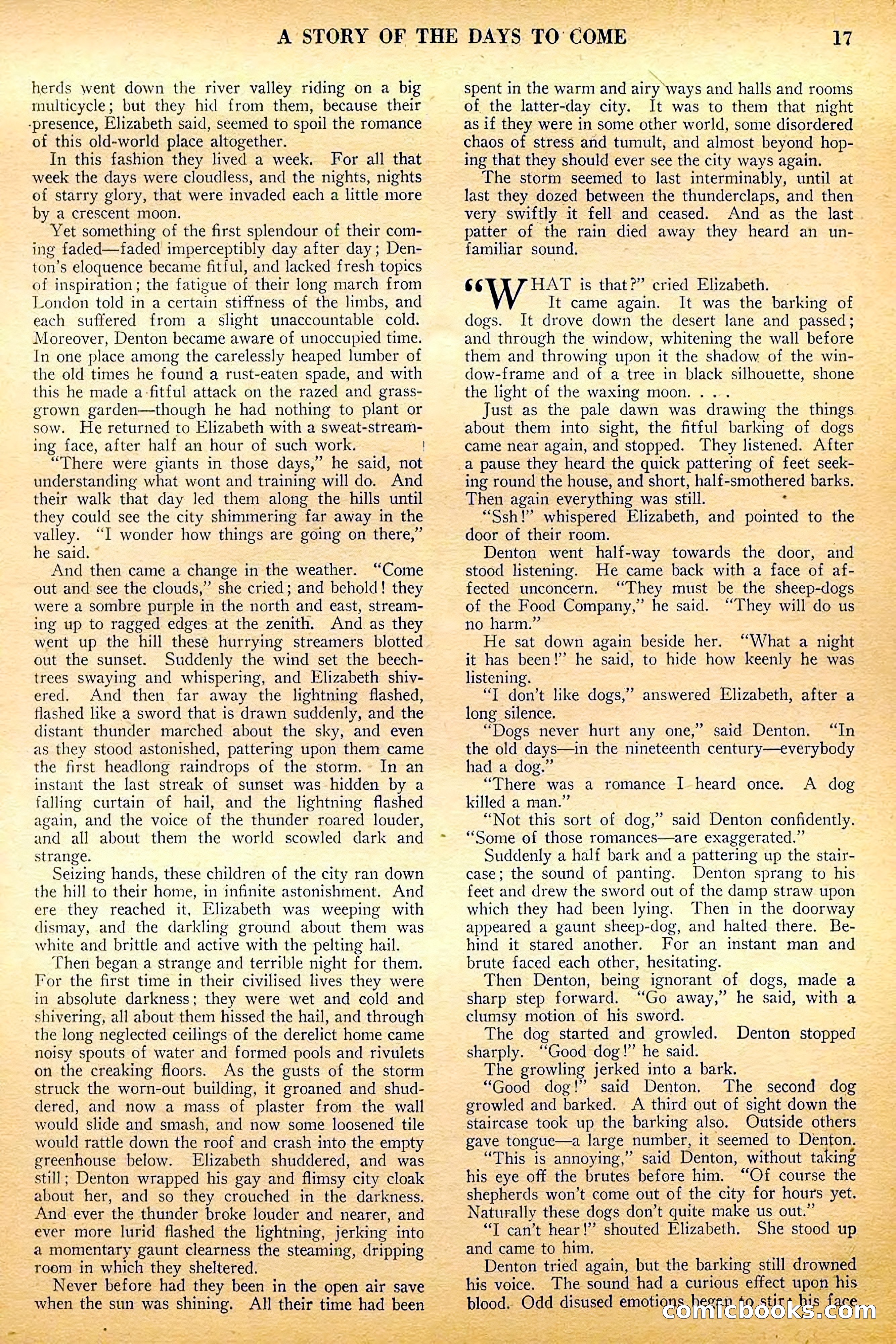
A restored page from Pulp Fiction, 1928. Page through the whole issue in the reader above.
📄 Transcribed text from this page (OCR, searchable)
Machine-transcribed from the original scan — historical spelling and the odd misread are preserved.
A STORY OF THE DAYS TO COME 3 17 herds went down the river valley riding on a big multicycle; but they hid from them, because their -presence, Elizabeth said, seemed to spoil the romance of this old-world place altogether. In this fashion they lived a week. For all that week the days were cloudless, and the nights, nights of starry glory, that were invaded each a little more by a crescent moon. Yet something of the first splendour of their com- ing faded—faded imperceptibly day after day ; Den- ton’s eloquence became fitful, and lacked fresh topics of inspiration; the fatigue of their long march from London told in a certain stiffness of the limbs, and each suffered from a slight unaccountable cold. Moreover, Denton became aware of unoccupied time. In one place among the carelessly heaped lumber of the old times he found a rust-eaten spade, and with this he made a-fitful attack on the razed and grass- grown garden—though he had nothing to plant or sow. He returned to Elizabeth with a sweat-stream- ing face, after half an hour of such work. “There were giants in those days,’ he said, not understanding what wont and training will do. And their walk that day led them along the hills until they could see the city shimmering far away in the valley. “I wonder how things are going on there,” he said. ° And then came a change in the weather. “Come out and see the clouds,” she cried; and behold! they were a sombre purple in the north and east, stream- ing up to ragged edges at the zenith. And as they went up the hill these hurrying streamers blotted out the sunset. Suddenly the wind set the beech- trees swaying and whispering, and Elizabeth shiv- ered. And then far away the lightning flashed, flashed like a sword that is drawn suddenly, and the distant thunder marched about the sky, and even as they stood astonished, pattering upon them came the first headlong raindrops of the storm. In an instant the last streak of sunset was hidden by a falling curtain of hail, and the lightning flashed again, and the voice of the thunder roared louder, and all about them the world scowled dark and strange. Seizing hands, these children of the city ran down the hill to their home, in infinite astonishment. And ere they reached it, Elizabeth was weeping with dismay, and the darkling ground about them was white and brittle and active with the pelting hail. Then began a strange and terrible night for them. For the first time in their civilised lives they were in absolute darkness; they were wet and cold and shivering, all about them hissed the hail, and through the long neglected ceilings of the derelict home came noisy spouts of water and formed pools and rivulets on the creaking floors. As the gusts of the storm struck the worn-out building, it groaned and shud- dered, and now a mass of plaster from the wall would slide and smash, and now some loosened tile would rattle down the roof and crash into the empty greenhouse below. Elizabeth shuddered, and was still; Denton wrapped his gay and flimsy city cloak about her, and so they crouched in the darkness. And ever the thunder broke louder and nearer, and ever more lurid flashed the lightning, jerking into a momentary gaunt clearness the steaming, dripping — room in which they sheltered. Never before had they been in the open air save when the sun was shining. All their time Bad been os a4 nt a eating nom WE rt Se t spent in the warm and airy ways and halls and rooms of the latter-day city. It was to them that night as if they were in some other world, some disordered chaos of stress and tumult, and almost beyond hop- ing that they should ever see the city ways again. The storm seemed to last interminably, until at last they dozed between the thunderclaps, and then very swiftly it fell and ceased. And as the last patter of the rain died away they heard an un- familiar sound. 66 HAT is that?” cried Elizabeth. It came again. It was the barking of dogs. It drove down the desert lane and passed; and through the window, whitening the wall before them and throwing upon it the shadow of the win- dow-frame and of a tree in black silhouette, shone the light of the waxing moon... . Just as the pale dawn was drawing the things about them into sight, the fitful barking of dogs came near again, and stopped. They listened. After a pause they heard the quick pattering of feet seek- ing round the house, and short, half-smothered barks. Then again everything was still. : “Ssh!” whispered Elizabeth, and pointed to the door of their room. Denton went half-way towards the door, and stood listening. He came back with a face of af- fected unconcern. “They must be the sheep-dogs of the Food Company,” he said. ‘““They will do us no harm.” He sat down again beside her. “What a night it has been!” he said, to hide how keenly he was listening. “T don’t like dogs,” long silence. “Dogs never hurt any one,” said Denton. “In the old days—in the nineteenth century—everybody had a dog.” “There was a romance I heard once. killed a man.” “Not this sort of dog,” said Denton confidently. “Some of those romances—are exaggerated.” Suddenly a half bark and a pattering up the stair- case; the sound of panting. Denton sprang to his feet and drew the sword out of the damp straw upon which they had been lying. Then in the doorway appeared a gaunt sheep-dog, and halted there. Be- hind it stared another. For an instant man and brute faced each other, hesitating. Then Denton, being ignorant of dogs, made a sharp step forward. “Go away,” he said, with a clumsy motion of his sword. The dog started and growled. sharply. “Good dog!” he said. The growling jerked into a bark. “Good dog!’ said Denton. The second dog growled and barked. A third out of sight down the staircase took up the barking also. Outside others gave tongue—a large number, it seemed to Denton. “This is annoying,’ said Denton, without taking his eye off the brutes before him. “Of course the shepherds won’t come out of the city for hours yet. Naturally these dogs don’t quite make us out.” “T can’t hear!” shouted Elizabeth. She stood ae and came to him. answered Elizabeth, after a A dog Denton stopped Denton tried again, but the barking still _ ome his voice. The sound had a curious ae ee