
Pulp Fiction, 1928 · page 28 of 99
Amazing Stories — page 28: what you’re looking at
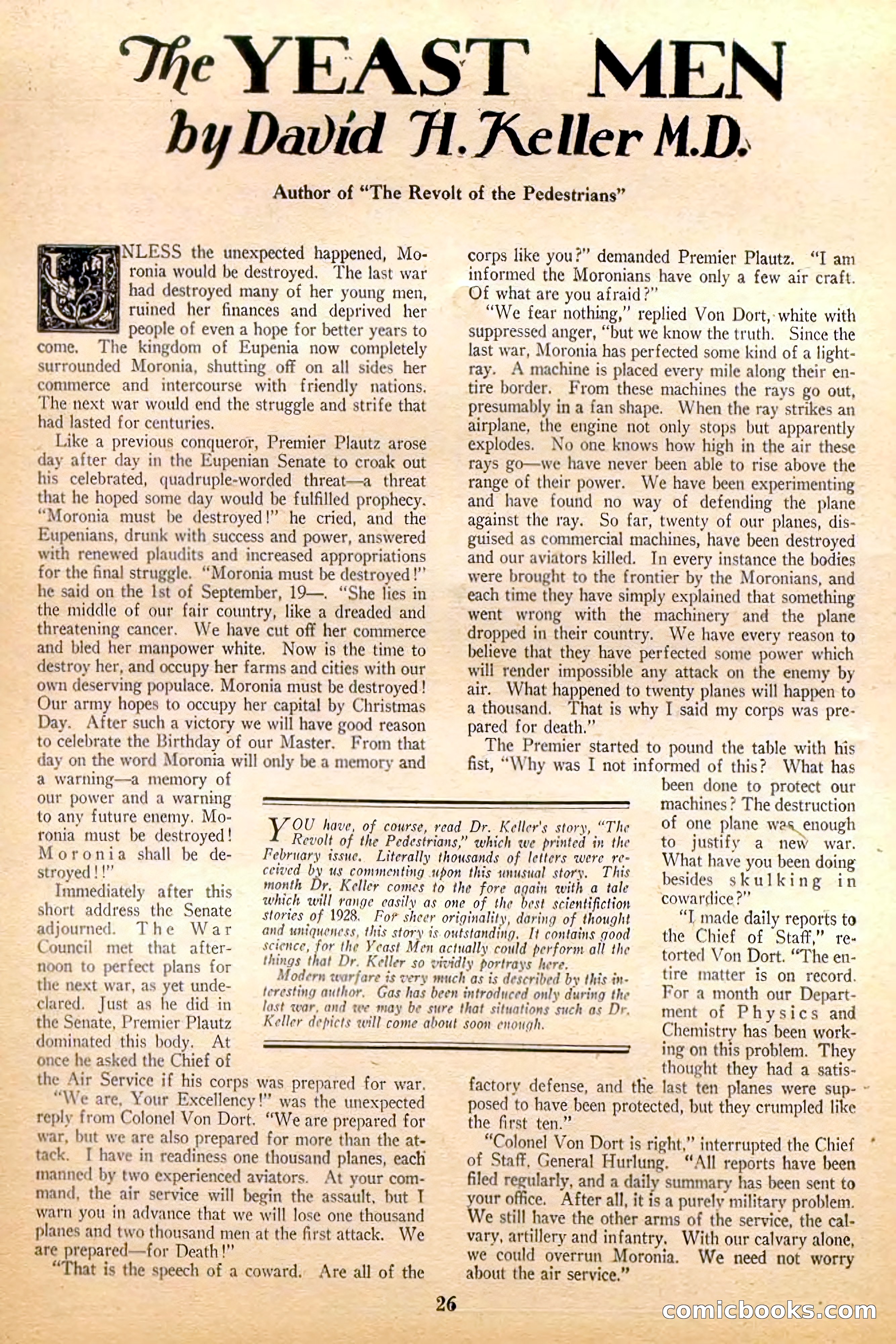
A restored page from Pulp Fiction, 1928. Page through the whole issue in the reader above.
📄 Transcribed text from this page (OCR, searchable)
Machine-transcribed from the original scan — historical spelling and the odd misread are preserved.
The YEAST MEN by David Fl. Keller M.D. Author of “The Revolt of the Pedestrians” NLESS the unexpected happened, Mo- ronia would be destroyed, The last war had destroyed many of her young men, ruined her finances and deprived her == people of even a hope for better years to come, The kingdom of Eupenia now completely surrounded Moronia, shutting off on all sides her commerce and intercourse with friendly nations. The next war would end the struggle and strife that had lasted for centuries. Like a previous conqueror, Premier Plautz arose day after day in the Eupenian Senate to croak out his celebrated, quadruple-worded threat—a threat that he hoped some day would be fulfilled prophecy. “Moronia must be destroyed!” he cried, and the Eupenians, drunk with success and power, answered with renewed plaudits and increased appropriations for the final struggle. “Moronia must be destroyed !’" he said on the Ist of September, 19—. “She lies in the middle of our fair country, like a dreaded and threatening cancer. We have cut off her commerce and bled her manpower white. Now is the time to destroy her, and occupy her farms and cities with our own deserving populace. Moronia must be destroyed! Our army hopes to occupy her capital by Christmas Day. After such a victory we will have good reason to celebrate the Birthday of our Master. From that day on the word Moronia will only be a memory and a warning—a memory of our power and a warning corps like your” demanded Premier Plautz. “I am informed the Moronians have only a few air craft. Of what are you afraid?” “We fear nothing,” replied Von Dort,: white with suppressed anger, “but we know the truth. Since the last war, Moronia has perfected some kind of a light- ray. A machine is placed every mile along their en- tire border. From these machines the rays go out, presumably in a fan shape. When the ray strikes an airplane, the engine not only stops but apparently explodes. No one knows how high in the air these rays go—we have never been able to rise above the range of their power. We have been experimenting and have found no way of defending the plane against the ray. So far, twenty of our planes, dis- guised as commercial machines, have been destroyed and our aviators killed. In every instance the bodies were brought to the frontier by the Moronians, and each time they have simply explained that something went wrong with the machinery and the plane dropped in their country. We have every reason to believe that they have perfected some power which will render impossible any attack on the enemy by air. What happened to twenty planes will happen to a thousand. That is why I said my corps was pre- pared for death,” The Premier started to pound the table with his fist, “Why was I not informed of this? What has been done to protect our machines? The destruction to any future enemy. Mo- ronia must be destroyed! Moronia shall be de- stroyed ! !” Immediately after this short address the Senate adjourned. The War Council met that after- noon to perfect plans for the next war, as yet unde- clared. Just as he did in the Senate, Premier Plautz dominated this body. At once he asked the Chief of OU have, of course, read Dr. Keller's story, “The Revolt of the Pedestrians,” which we printed in the February issue. Literally thousands of letters were _re- cewwed by us commenting upon this unusual story. This month Dr, Kelley comes to the fore again with a tale which will range casily as one of the best Sscientifiction Stories of 1928. For sheer originality, daring of thought and uniqueness, this story is outstanding, It contains good science, for the Yeast Men actually could perform all the things that Dr. Keller so vividly portrays here, Modern warfare is very much as is described by this in- teresting author, Gas has been introduced only during the last war, and twe may be sure that situations such as Dr. Keller depicts will come about soon enough. ——————— = of one plane was_enough to justify a mew war. What have you been doing besides skulking in cowar(lice ?” “I. made daily reports to the Chief of Staff,” re- torted Von Dort. “The en- tire matter is on record. For a month our Depart- ment of Physics and Chemistry has been work- ing on this problem. They the Air Service if his corps was prepared for war. “We are, Your Excellency!" was the unexpected reply from Colonel Von Dort. “We are prepared for war, but we are also prepared for more than the at- tack. I have in readiness one thousand planes, each manned by two experienced aviators. At your com- mand, the air service will begin the assault, but T warn you in advance that we will lose one thousand planes and two thousand men at the first attack. We are prepared—for Death!” “That is the speech of a coward. Are all of the 26 thought they had a satis- factory defense, and the last ten planes were sup- ~ posed to have been protected, but they crumpled like the first ten.” “Colonel Von Dort is right,” interrupted the Chief of Staff, General Hurlung. “All reports have been filed regularly, and a daily summary has been sent to our office. After all, it is a purely military problem. e still have the other arms of the service, the cal- vary, artillery and infantry. With our calvary alone, we could overrun Moronia. We need not worry about the air service.” eh — —s = —_ _ . * -~» “= COMME IOOKSaCOLN