
Pulp Fiction, 1928 · page 30 of 99
Amazing Stories — page 30: what you’re looking at
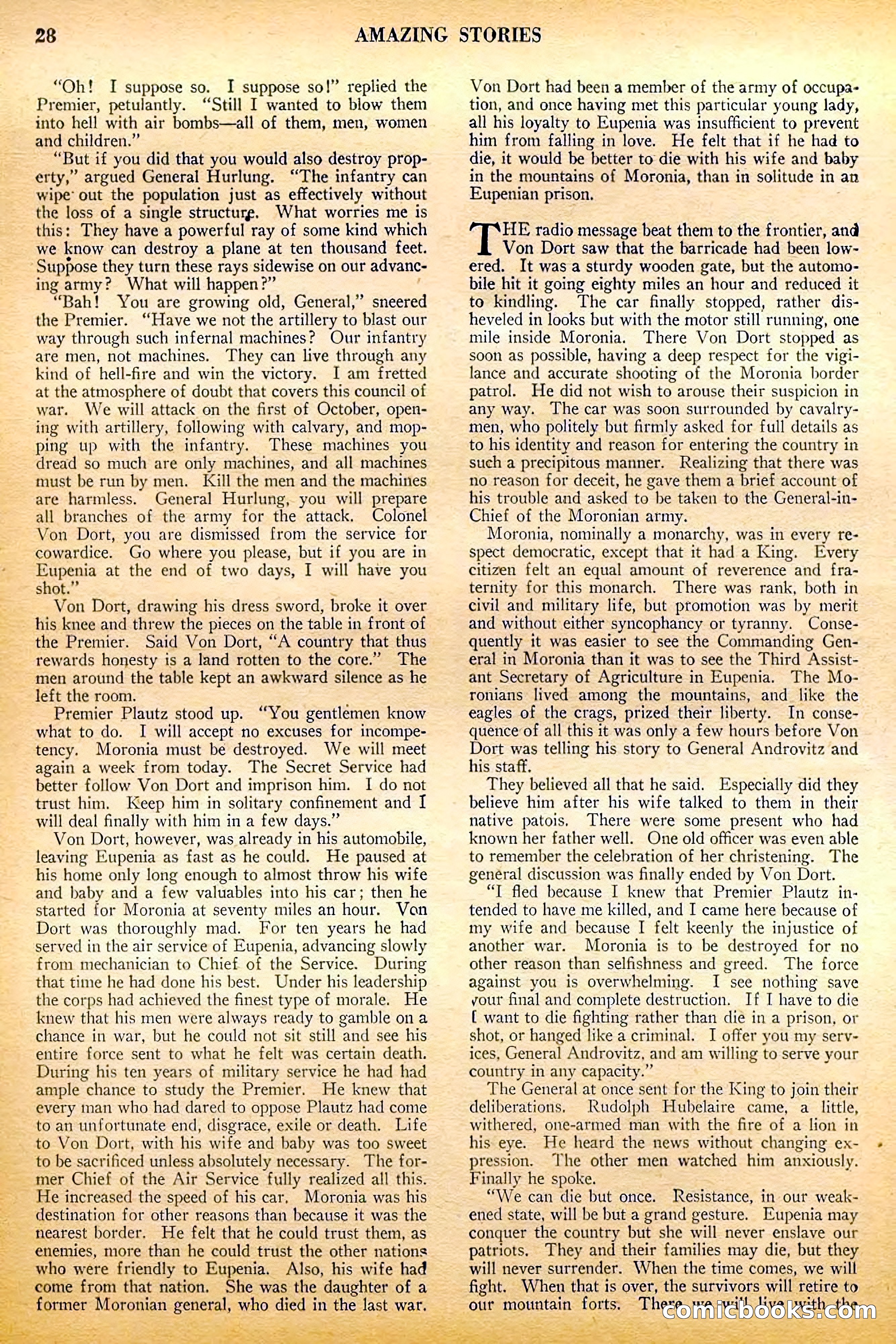
A restored page from Pulp Fiction, 1928. Page through the whole issue in the reader above.
📄 Transcribed text from this page (OCR, searchable)
Machine-transcribed from the original scan — historical spelling and the odd misread are preserved.
28 AMAZING STORIES “Oh! I suppose so. I suppose so!” replied the Premier, petulantly. “Still I wanted to blow them into hell with air bombs—all of them, men, women and children.” “But if you did that you would also destroy prop- erty,” argued General Hurlung. “The infantry can wipe’ out the population just as effectively without the loss of a single structurg, What worries me is this: They have a powerful ray of some kind which we know can destroy a plane at ten thousand feet. Suppose they turn these rays sidewise on our advanc- ing army? What will happen?” “Bah! You are growing old, General,” sneered the Premier. “Have we not the artillery to blast our way through such infernal machines? Our infantry are men, not machines. They can live through any kind of hell-fire and win the victory. I am fretted at the atmosphere of doubt that covers this council of war. We will attack on the first of October, open- ing with artillery, following with calvary, and mop- ping up with the infantry. These machines you dread so much are only machines, and all machines must be run by men. Kill the men and the machines are harmless. General Hurlung, you will prepare all branches of the army for the attack. Colonel Von Dort, you are dismissed from the service for cowardice. Go where you please, but if you are in Eupenia at the end of two days, I will have you shot.” Von Dort, drawing his dress sword, broke it over _ his knee and threw the pieces on the table in front of the Premier. Said Von Dort, “A country that thus rewards honesty is a land rotten to the core.” The men around the table kept an awkward silence as he left the room. ; Premier Plautz stood up. “You gentlemen know what to do. I will accept no excuses for incompe- tency. Moronia must be destroyed. We will meet again a week from today. The Secret Service had better follow Von Dort and imprison him. I do not trust him. Keep him in solitary confinement and I will deal finally with him in a few days.” Von Dort, however, was already in his automobile, leaving Eupenia as fast as he could. He paused at his home only long enough to almost throw his wife and baby and a few valuables into his car; then he started for Moronia at seventy miles an hour. Van Dort was thoroughly mad. For ten years he had served in the air service of Eupenia, advancing slowly from mechanician to Chief of the Service. During that time he had done his best. Under his leadership the corps had achieved the finest type of morale. He knew that his men were always ready to gamble on a chance in war, but he could not sit still and see his entire force sent to what he felt was certain death. During his ten years of military service he had had ample chance to study the Premier. He knew that every tnan who had dared to oppose Plautz had come to an unfortunate end, disgrace, exile or death. Life to Von Dort, with his wife and baby was too sweet to be sacrificed unless absolutely necessary. The for- mer Chief of the Air Service fully realized all this. _ He increased the speed of his car, Moronia was his destination for other reasons than because it was the nearest border. He felt that he could trust them, as enemies, more than he could trust the other nations who were friendly to Eupenia. Also, his wife had 1e from that nation. She was the daughter of a oronian gercali: who eed ‘in the Jast war. Von Dort had been a member of the army of occupa- tion, and once having met this particular young lady, all his loyalty to Eupenia was insufficient to prevent him from falling in love. He felt that if he had to die, it would be better to die with his wife and baby in the mountains of Moronia, than in solitude in an Eupenian prison. HE radio message beat them to the frontier, and Von Dort saw that the barricade had been low- ered. It was a sturdy wooden gate, but the automo- bile hit it going eighty miles an hour and reduced it to kindling. The car finally stopped, rather dis- heveled in looks but with the motor still running, one mile inside Moronia. There Von Dort stopped as soon as possible, having a deep respect for the vigi- lance and accurate shooting of the Moronia border patrol. He did not wish to arouse their suspicion in any way. The car was soon surrounded by cavalry- men, who politely but firmly asked for full details as to his identity and reason for entering the country in such a precipitous manner. Realizing that there was no reason for deceit, he gave them a brief account of his trouble and asked to be taken to the General-in- Chief of the Moronian army. Moronia, nominally a monarchy, was in every re- spect democratic, except that it had a King. Every citizen felt an equal amount of reverence and fra- ternity for this monarch. There was rank, both in civil and military life, but promotion was by merit and without either syncophancy or tyranny. Conse- quently it was easier to see the Commanding Gen- eral in Moronia than it was to see the Third Assist- ant Secretary of Agriculture in Eupenia. The Mo- ronians lived among the mountains, and like the eagles of the crags, prized their liberty. In conse- quence of all this it was only a few hours before Von Dort was telling his story to General Androvitz and his staff. They believed all that he said. Especially did they believe him after his wife talked to them in their native patois, There were some present who had known her father well. One old officer was even able to remember the celebration of her christening. The general discussion was finally ended by Von Dort. “T fled because I knew that Premier Plautz in- tended to have me killed, and I came here because of my wife and because I felt keenly the injustice of another war. Moronia is to be destroyed for no other reason than selfishness and greed. The force against you is overwhelming. I see nothing save your final and complete destruction. If I have to die { want to die fighting rather than die in a prison, or shot, or hanged like a criminal. I offer you my serv- ices, General Androvitz, and am willing to serve your country in any capacity.” The General at once sent for the King to join their deliberations. Rudolph Hubelaire came, a little, withered, one-armed man with the fire of a lion in his eye. He heard the news without changing ex- pression. The other men watched him anxiously. Finally he spoke. “We can die but once. Resistance, in our weak- ened state, will be but a grand gesture. Eupenia may conquer the country but she will never enslave our patriots. will never surrender. When the time comes, we will fight. They and their families may die, but they When that is over, the survivors will retire to ate pur eS ee g ucoimicbooks om = my NN at By