
Pulp Fiction, 1928 · page 44 of 99
Amazing Stories — page 44: what you’re looking at
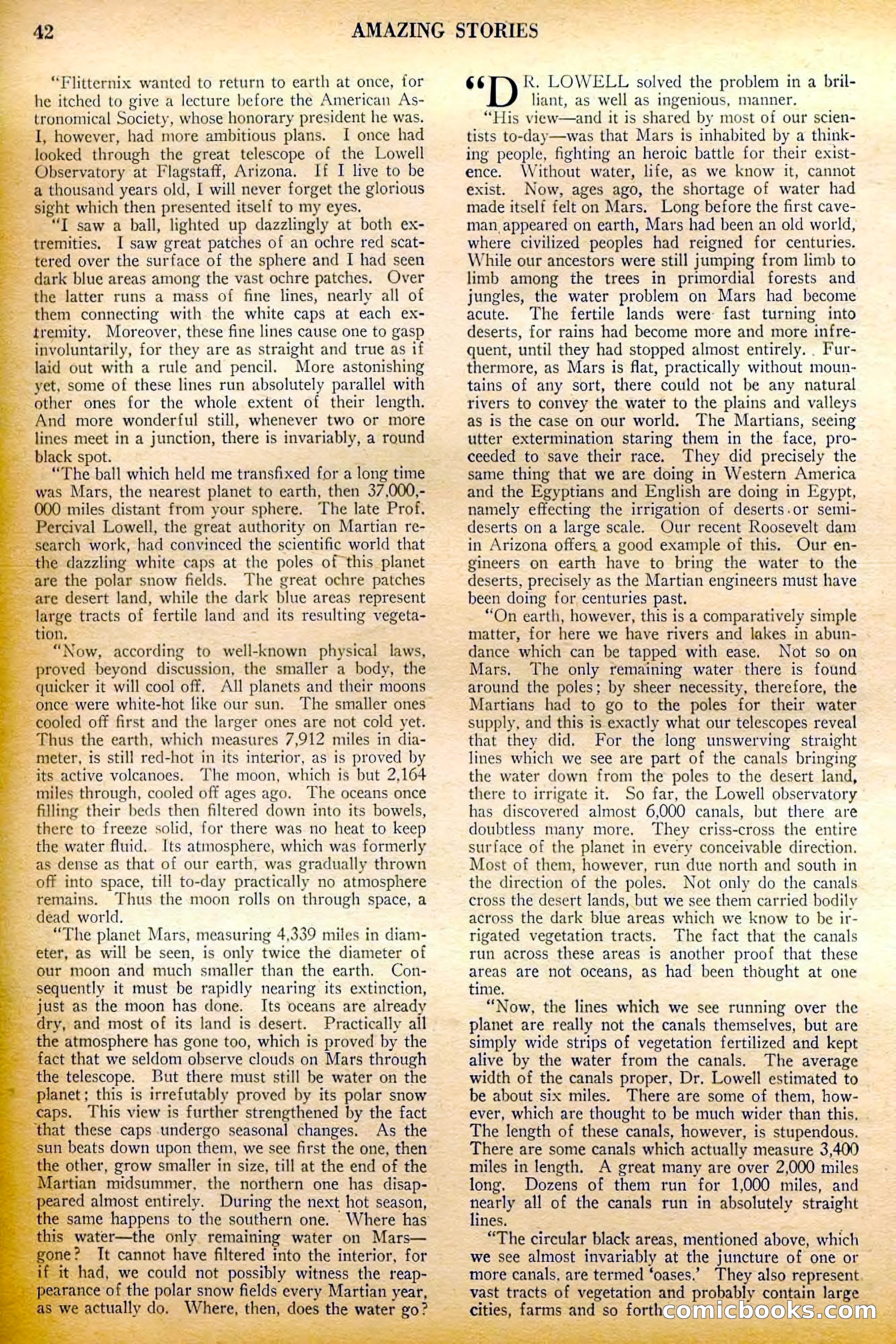
A restored page from Pulp Fiction, 1928. Page through the whole issue in the reader above.
📄 Transcribed text from this page (OCR, searchable)
Machine-transcribed from the original scan — historical spelling and the odd misread are preserved.
_— tn “Flitternix wanted to return to earth at once, for he itched to give a lecture before the American As- tronomical Society, whose honorary president he was. | however, had more ambitious plans. I once had ~ looked through the great telescope of the Lowell _ Observatory at Flagstaff, Arizona. If I live to be oa thousand years old, I will never forget the glorious _ sight which then presented itself to my eyes. “T saw a ball, lighted up dazzlingly at both ex- “ __tremities I saw great patches of an ochre red scat- tered over the surface of the sphere and I had seen _ dark blue areas among the vast ochre patches. Over ‘the latter runs a mass of fine lines, nearly all of - them connecting with the white caps at each ex- tremity. Moreover, these fine lines cause one to gasp 3 _ involuntarily, for they are as straight and true as if ~ laid out with a rule and pencil. “More astonishing yet, some of these lines run absolutely parallel with other ones for the whole extent of their length. And more wonderful still, whenever two or more lines meet in a junction, there is invariably, a round ~ black spot. “The ball which held me transfixed for a long time was Mars, the nearest planet to earth, then 37,000,- 000 miles distant from your sphere. The late Prof. ‘ Percival Lowell, the great authority on Martian re- rch work, had convinced the scientific world that af ¢ dazzling white caps at the poles of this planet are the polar snow fields. The great ochre patches are desert land, while the dark blue areas represent arge tracts of fertile land and its resulting vegeta- n. _ “Now, according to well-known physical laws, proved beyond discussion, the smaller a body, the icker it will cool off. All planets and their moons once were white-hot like our sun. cooled off first and the larger ones are not cold yet. Thus the earth, which measures 7,912 miles in dia- ~ meter, is still red-hot in its interior, as is proved by - its active volcanoes. The moon, which is but 2,164 ~ miles through, cooled off ages ago. The oceans once filling their beds then filtered down into its bowels, _ there to freeze solid, for there was no heat to keep he water fluid. Its atmosphere, which was formerly as dense as that of our earth, was gradually thrown _ off into space, till to-day practically no atmosphere remains. Thus the moon rolls on through space, a dead world. “The planet Mars, measuring 4,339 miles in diam- _ eter, as will be seen, is only twice the diameter of our moon and much smaller than the earth. Con- _ sequently it must be rapidly nearing its extinction, just as the moon has done. Its oceans are already dry, and most of its land is desert. Practically all _ the ‘atmosphere has gone too, which is proved by the fact that we seldom observe clouds on Mars through telescope. But there must still be water on the inet; this is irrefutably proved by its polar snow This view is further strengthened by the fact these caps undergo seasonal changes. As the n beats down upon them, we see first the one, then other, grow smaller in size, till at the end of the fan midsummer, the northern one has disap- ed almost entirely. During the next hot season, same happens to the southern one. is water—the only. remaining water on Mars— — Tt cannot have filtered into the interior, for d, we could not possibly witness the reap- of the polar snow fields every Martian year, to ili Bel Boa ad | ie eed The smaller ones Where has Where, then. does the water go? AMAZING STORIES 66 Rk. LOWELL solved the problem in a bril- liant, as well as ingenious, manner. “His view—and it is shared by most of our scien- tists to-day—was that Mars is inhabited by a think- ing people, fighting an heroic battle for their exist- ence. Without water, life, as we know it, cannot exist. Now, ages ago, the shortage of water had made itself felt on Mars. Long before the first cave- man appeared on earth, Mars had been an old world, where civilized peoples had reigned for centuries. While our ancestors were still jumping from limb to limb among the trees in primordial forests and jungles, the water problem on Mars had become acute. The fertile lands were fast turning into deserts, for rains had become more and more infre- quent, until they had stopped almost entirely. . Fur- thermore, as Mars is flat, practically without moun- tains of any sort, there could not be any natural rivers to convey the water to the plains and valleys as is the case on our world. The Martians, seeing utter extermination staring them in the face, pro- ceeded to save their race. They did precisely the same thing that we are doing in Western America and the Egyptians and English are doing in Egypt, namely effecting the irrigation of deserts. or semi- deserts on a large scale. Our recent Roosevelt dam in Arizona offers a good example of this. Our en- gineers on earth have to bring the water to the deserts, precisely as the Martian engineers must have been doing for centuries past. “On earth, however, this is a comparatively simple matter, for here we have rivers and lakes in abun- dance which can be tapped with ease. Not so on Mars. The only remaining water there is found around the poles; by sheer necessity, therefore, the Martians had to go to the poles for their water supply, and this is exactly what our telescopes reveal that they did. For the long unswerving straight lines which we see are part of the canals bringing the water down from the poles to the desert land, there to irrigate it. So far, the Lowell observatory has discovered almost 6,000 canals, but there are doubtless many more, They criss-cross the entire surface of the planet in every conceivable direction. Most of them, however, run due north and south in the direction of the poles. Not only do the canals cross the desert lands, but we see them carried bodily across the dark blue areas which we know to be ir- rigated vegetation tracts. The fact that the canals ruin across these areas is another proof that these areas are not oceans, as had been thought at one time. “Now, the lines which we see running over the planet are really not the canals themselves, but are simply wide strips of vegetation fertilized and kept alive by the water from the canals. The average width of the canals proper, Dr. Lowell estimated to be about six miles. There are some of them, how- ever, which are thought to be much wider than this. The length of these canals, however, is stupendous. There are some canals which actually measure 3,400 miles in length. A great many are over 2,000 miles long. Dozens of them run for 1,000 miles, and a all of the canals run in absolutely straight ines, “The circular black areas, mentioned above, which we see almost invariably at the juncture of one or — more canals, are termed ‘oases.’ They also represent. vast tracts of vegetation and probably contain large _ and so_ forth OME IOOL