
Pulp Fiction, 1928 · page 47 of 99
Amazing Stories — page 47: what you’re looking at
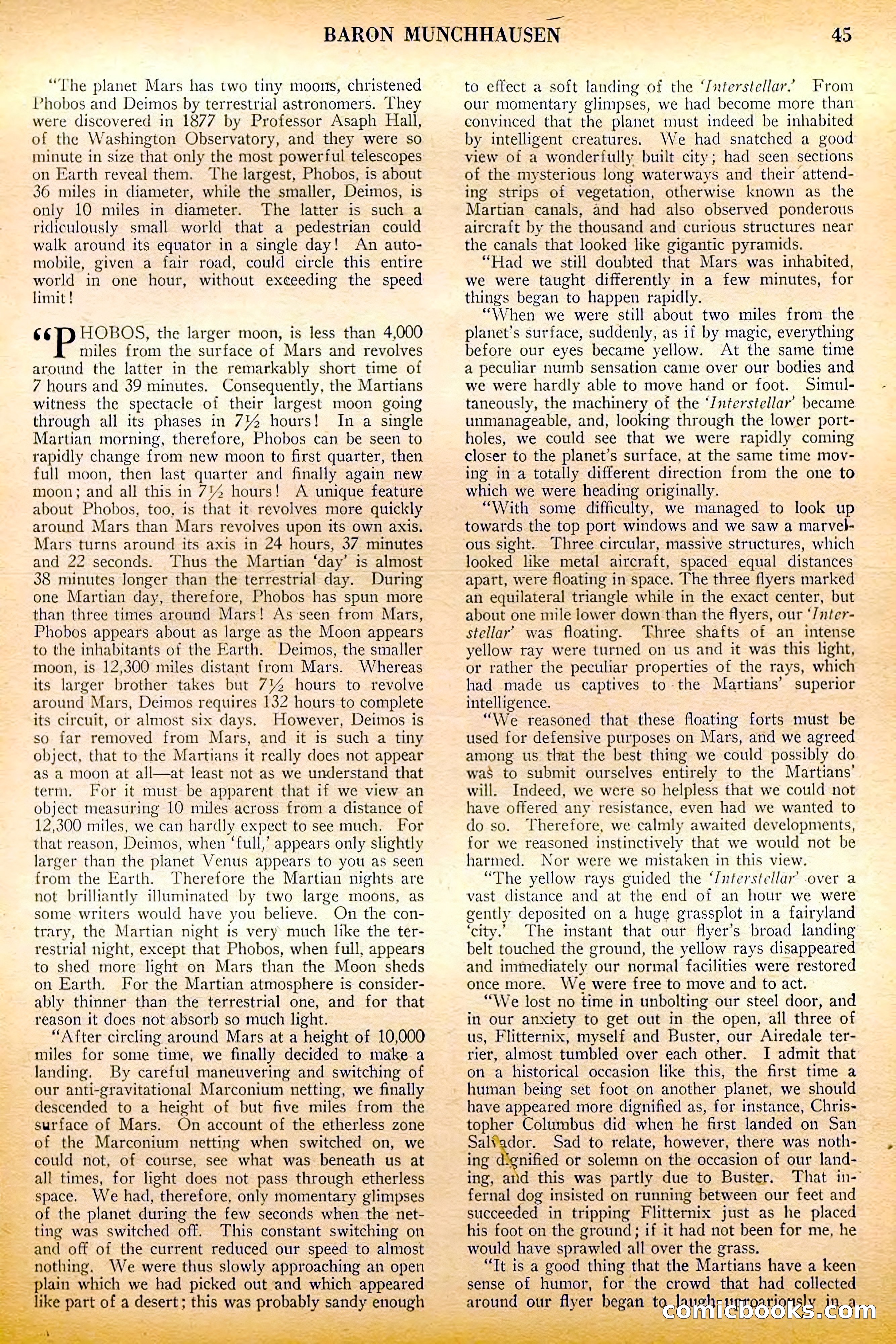
A restored page from Pulp Fiction, 1928. Page through the whole issue in the reader above.
📄 Transcribed text from this page (OCR, searchable)
Machine-transcribed from the original scan — historical spelling and the odd misread are preserved.
on BARON MUNCHHAUSEN | “The planet Mars has two tiny moorts, christened Phobos and Deimos by terrestrial astronomers. They were discovered in 1877 by Professor Asaph Hall, of the Washington Observatory, and they were so minute in size that only the most powerful telescopes on Earth reveal them. The largest, Phobos, is about 36 miles in diameter, while the smaller, Deimos, is only 10 miles in diameter. The latter is such a ridiculously small world that a pedestrian could walk around its equator in a single day! An auto- mobile, given a fair road, could circle this entire world in one hour, without exceeding the speed limit ! 661) HOBOS, the larger moon, is less than 4,000 miles from the surface of Mars and revolves around the latter in the remarkably short time of 7 hours and 39 minutes. Consequently, the Martians witness the spectacle of their largest moon going through all its phases in 7% hours! In a single Martian morning, therefore, Phobos can be seen to rapidly change from new moon to first quarter, then full moon, then last quarter and finally again new moon; and all this in 714 hours! A unique feature about Phobos, too, is that it revolves more quickly around Mars than Mars revolves upon its own axis. Mars turns around its axis in 24 hours, 37 minutes and 22 seconds. Thus the Martian ‘day’ is almost 38 minutes longer than the terrestrial day. During one Martian day, therefore, Phobos has spun more than three times around Mars! As seen from Mars, Phobos appears about as large as the Moon appears to the inhabitants of the Earth. Deimos, the smaller moon, is 12,300 miles distant from Mars. Whereas its larger brother takes but 714 hours to revolve around Mars, Deimos requires 132 hours to complete its circuit, or almost six days. However, Deimos is so far removed from Mars, and it is such a tiny object, that to the Martians it really does not appear as a moon at all—at least not as we understand that term, For it must be apparent that if we view an object measuring 10 miles across from a distance of 12,300 miles, we can hardly expect to see much. For that reason, Deimos, when ‘full,’ appears only slightly larger than the planet Venus appears to you as seen from the Earth. Therefore the Martian nights are not brilliantly illuminated by two large moons, as some writers would have you believe. On the con- trary, the Martian night is very much like the ter- restrial night, except that Phobos, when full, appears to shed more light on Mars than the Moon sheds on Earth. For the Martian atmosphere is consider- ably thinner than the terrestrial one, and for that reason it does not absorb so much light. “After circling around Mars at a height of 10,000 miles for some time, we finally decided to make a landing. By careful maneuvering and switching of our anti-gravitational Marconium netting, we finally descended to a height of but five miles from the surface of Mars. On account of the etherless zone of the Marconium netting when switched on, we could not, of course, see what was beneath us at all times, for light does not pass through etherless space. We had, therefore, only momentary glimpses _ of the planet during the few seconds when the net- ting was switched off. This constant switching on and off of the current reduced our speed to almost a nothing. We were thus slowly approaching an open Sar lain which we had a out and which. anpeated 49 to effect a soft landing of the ‘Jnterstellar.’ From our momentary glimpses, we had become more than convinced that the planet must indeed be inhabited by intelligent creatures. We had snatched a good view of a wonderfully built city; had seen sections of the mysterious long waterways and their attend- ing strips of vegetation, otherwise known as the Martian canals, and had also observed ponderous aircraft by the thousand and curious structures near the canals that looked like gigantic pyramids. “Had we still doubted that Mars was inhabited, we were taught differently in a few minutes, for things began to happen rapidly. “When we were still about two miles from the planet's surface, suddenly, as if by magic, everything before our eyes became yellow. At the same time a peculiar numb sensation came over our bodies and we were hardly able to move hand or foot. Simul- taneously, the machinery of the ‘Interstellar’ became unmanageable, and, looking through the lower port- holes, we could see that we were rapidly coming closer to the planet’s surface, at the same time mov- ing in a totally different direction from the one to which we were heading originally. “With some difficulty, we managed to look up towards the top port windows and we saw a marvel- ous sight. Three circular, massive structures, which looked like metal aircraft, spaced equal distances apart, were floating in space. The three flyers marked an equilateral triangle while in the exact center, but about one mile lower down than the flyers, our ‘Inter- stellar’ was floating. Three shafts of an intense yellow ray were turned on us and it was this light, or rather the peculiar properties of the rays, which had made us captives to-the Martians’ superior intelligence. “We reasoned that these floating forts must be used for defensive purposes on Mars, and we agreed among us that the best thing we could possibly do was to submit ourselves entirely to the Martians’ will. Indeed, we were so helpless that we could not have offered any resistance, even had we wanted to do so. Therefore, we calmly awaited developments, for we reasoned instinctively that we would not be harmed. Nor were we mistaken in this view. “The yellow rays guided the ‘/uterstellar’ over a vast distance and at the end of an hour we were gently deposited on a huge grassplot in a fairyland ‘city.’ The instant that our flyer’s broad landing belt touched the ground, the yellow rays disappeared and immediately « our normal facilities were restored once more. We were free to move and to act. “We lost no time in unbolting our steel door, and in our anxiety to get out in the open, all three of us, Flitternix, myself and Buster, our Airedale ter- rier, almost tumbled over each other. I admit that on a historical occasion like this, the first time a human being set foot on another planet, we should have appeared more dignified as, for instance, Chris- topher Columbus did when he first landed on San Salfador. Sad to relate, however, there was noth- ing dignified or solemn on the occasion of our land- ing, and this was partly due to Buster. That in-’ feral dog insisted on running between our feet and succeeded in tripping Flitternix just as he placed his foot on the ground; if it had not been for me, he would have sprawled all over the grass. “Tt is a good thing that the Martians have a keen sense of SEOs for the crowd that had collected ina