
Pulp Fiction, 1928 · page 56 of 99
Amazing Stories — page 56: what you’re looking at
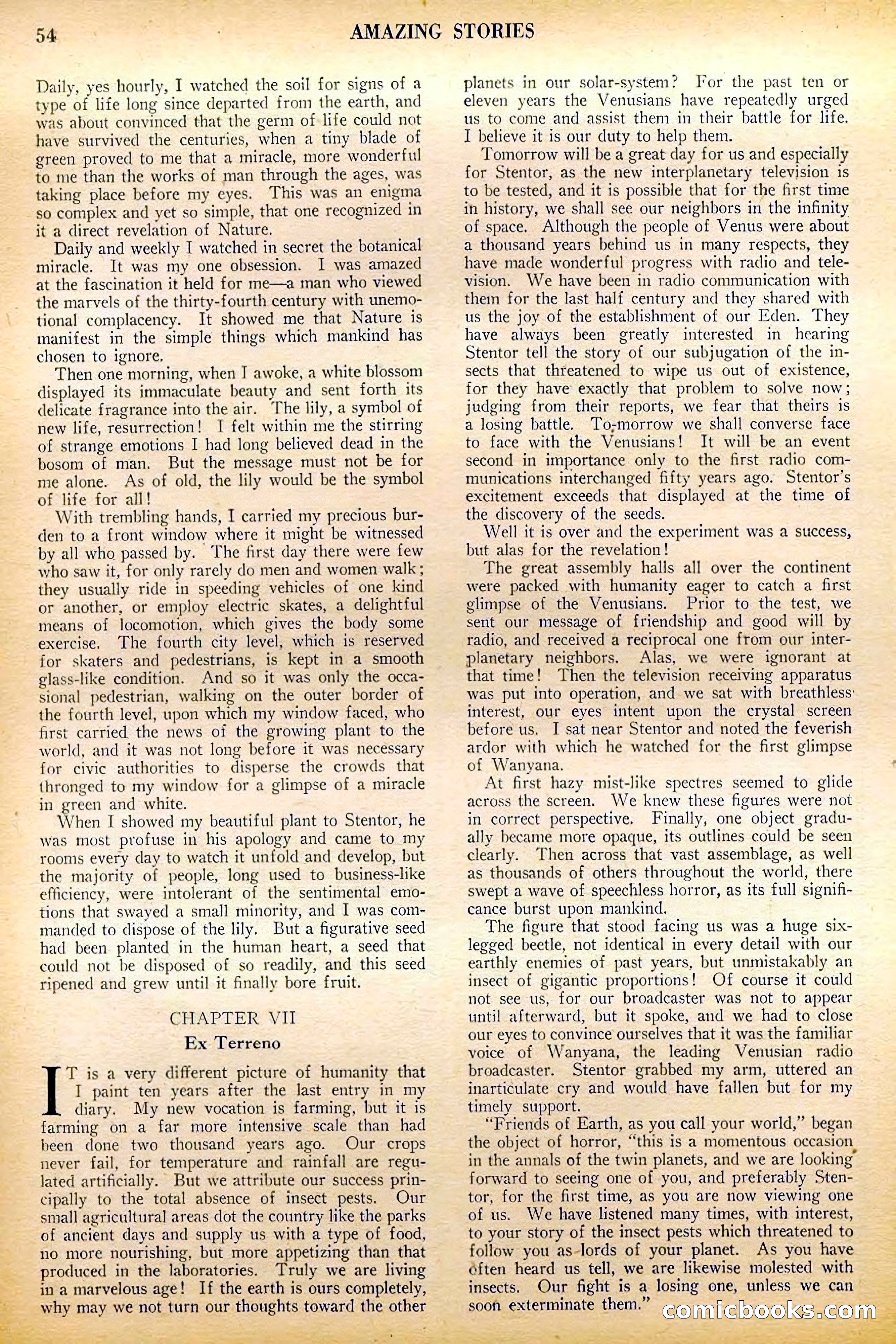
A restored page from Pulp Fiction, 1928. Page through the whole issue in the reader above.
📄 Transcribed text from this page (OCR, searchable)
Machine-transcribed from the original scan — historical spelling and the odd misread are preserved.
—— 54 ; AMAZING STORIES Daily, yes hourly, I watched the soil for signs of a type of life long since departed from the earth, and was about convinced that the germ of life could nat have survived the centuries, when a tiny blade of green proved to me that a miracle, more wonderful to me than the works of man through the ages, was taking place before my eyes. This was an enigma so complex and yet so simple, that one recognized in it a direct revelation of Nature. Daily and weekly I watched in secret the botanical miracle. It was my one obsession. I was amazed at the fascination it held for me—a man who viewed the marvels of the thirty-fourth century with unemo- tional complacency. It showed me that Nature is manifest in the simple things which mankind has chosen to ignore, Then one morning, when I awoke, a white blossom displayed its immaculate beauty and sent forth its delicate fragrance into the air. The lily, a symbol of new life, resurrection! I felt within me the stirring of strange emotions I had long believed dead in the bosom of man, But the message must not be for me alone. As of old, the lily would be the symbol of life for all! With trembling hands, I carried my precious bur- den to a front window where it might be witnessed by all who passed by. The first day there were few who saw it, for only rarely do men and women walk; they usually ride in speeding vehicles of one kind or another, or employ electric skates, a delightful means of locomotion, which gives the body some exercise. The fourth city level, which is reserved for skaters and pedestrians, is kept in a smooth glass-like condition. And so it was only the occa- sional pedestrian, walking on the outer border of the fourth level, upon which my window faced, who first carried the news of the growing plant to the world, and it was not long before it was necessary for civic authorities to disperse the crowds that thronged to my window for a glimpse of a miracle in green and white. When I showed my beautiful plant to Stentor, he was most profuse in his apology and came to my rooms every day to watch it unfold and develop, but the majority of people, long used to business-like efficiency, were intolerant of the sentimental emo- tions that swayed a small minority, and I was com- manded to dispose of the lily. But a figurative seed had been planted in the human heart, a seed that could not be disposed of so readily, and this seed ripened and grew until it finally bore fruit. CHAPTER VII Ex Terreno T is a very different picture of humanity that I I paint ten years after the Jast entry in my diary. My new vocation is farming, but it is farming on a far more intensive scale than had been done two thousand years ago. Our crops never fail, for temperature and rainfall are regu- lated artificially. But we attribute our success prin- cipally to the total absence of insect pests. Our small agricultural areas dot the country like the parks of ancient days and supply us with a type of food, no more nourishing, but more appetizing than that produced in the laboratories. Truly we are living in a marvelous age! If the earth is ours completely, why may we not turn our thoughts toward the other planets in our solar-system? For the past ten or eleven years the Venusians have repeatedly urged us to come and assist them in their battle for life. I believe it is our duty to help them. Tomorrow will be a great day for us and especially for Stentor, as the new interplanetary television is to be tested, and it is possible that for the first time in history, we shall see our neighbors in the infinity of space. Although the people of Venus were about a thousand years behind us in many respects, they have made wonderful progress with radio and tele- vision. We have been in radio communication with them for the last half century and they shared with us the joy of the establishment of our Eden. They have always been greatly interested in hearing Stentor tell the story of our subjugation of the in- sects that threatened to wipe us out of existence, for they have exactly that problem to solve now; judging from their reports, we fear that theirs is a losing battle. To-morrow we shall converse face to face with the Venusians! It will be an event second in importance only to the first radio com- munications interchanged fifty years ago. Stentor’s excitement exceeds that displayed at the time of the discovery of the seeds. Well it is over and the experiment was a success, but alas for the revelation! The great assembly halls all over the continent were packed with humanity eager to catch a first glimpse of the Venusians. Prior to the test, we sent our message of friendship and good will by radio, and received a reciprocal one from our inter- planetary neighbors. Alas, we were ignorant at that time! Then the television receiving apparatus was put into operation, and we sat with breathless: interest, our eyes intent upon the crystal screen before us. I sat near Stentor and noted the feverish ardor with which he watched for the first glimpse of Wanyana. At first hazy mist-like spectres seemed to glide across the screen. We knew these figures were not in correct perspective. Finally, one object gradu- ally became more opaque, its outlines could be seen clearly. ‘Then across that vast assemblage, as well as thousands of others throughout the world, there swept a wave of speechless horror, as its full signifi- cance burst upon mankind. The figure that stood facing us was a huge six- legged beetle, not identical in every detail with our earthly enemies of past years, but unmistakably an insect of gigantic proportions! Of course it could not see us, for our broadcaster was not to appear until afterward, but it spoke, and we had to close our eyes to convince’ ourselves that it was the familiar voice of Wanyana, the leading Venusian radio broadcaster. Stentor grabbed my arm, uttered an inarticulate cry and would have fallen but for my timely support. “Friends of Earth, as you call your world,” began the object of horror, “this is a momentous occasion in the annals of the twin planets, and we are looking” forward to seeing one of you, and preferably Sten- tor, for the first time, as you are now viewing one of us. We have listened many times, with interest, to your story of the insect pests which threatened to follow you as-lords of your planet. As you have éften heard us tell, we are likewise molested with insects. Our fight is a losing one, unless we can_ at sof, exterminate then.” (eoypaielsxoro Saxony eS ce ee ae eT te