
Pulp Fiction, 1928 · page 63 of 99
Amazing Stories — page 63: what you’re looking at
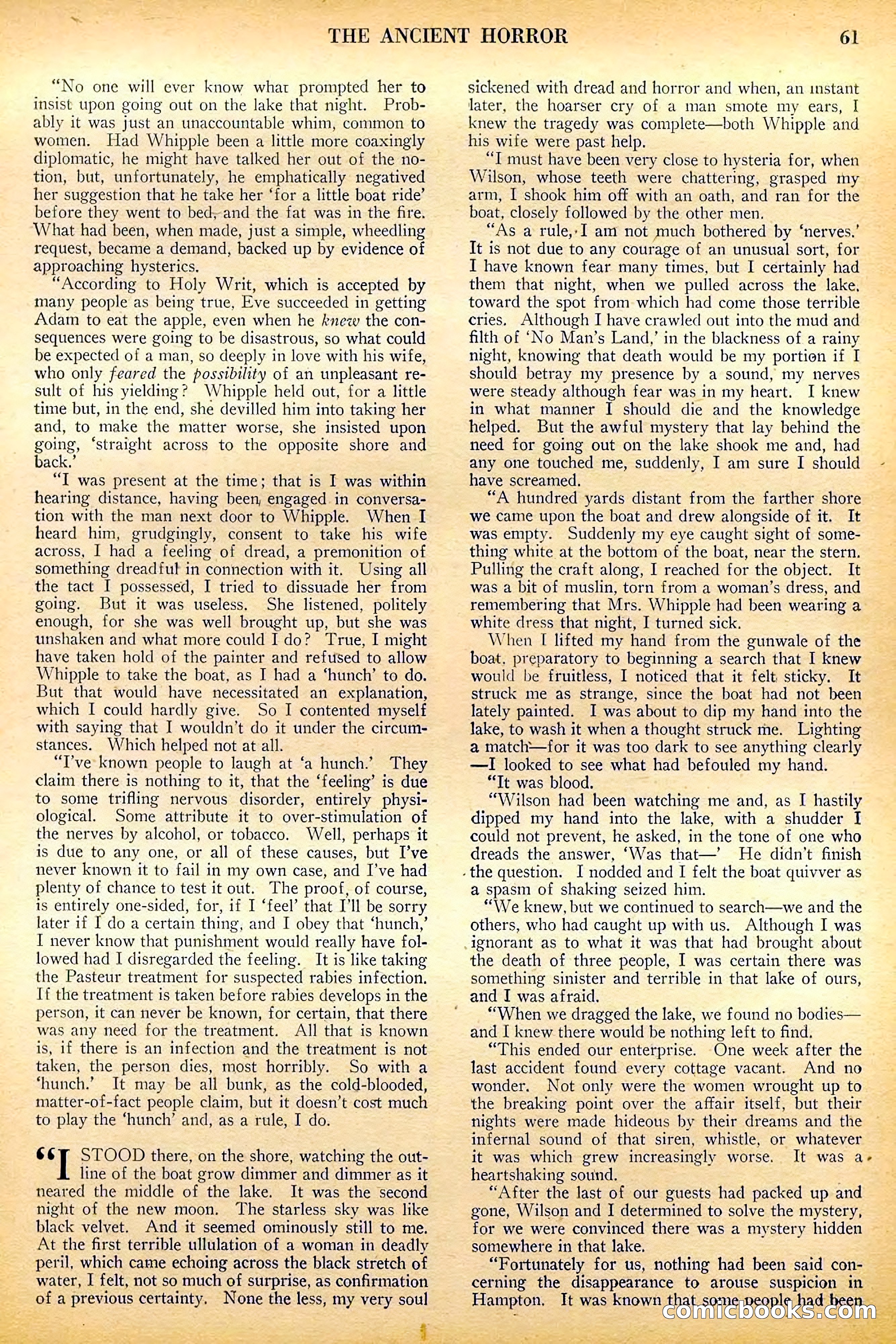
A restored page from Pulp Fiction, 1928. Page through the whole issue in the reader above.
📄 Transcribed text from this page (OCR, searchable)
Machine-transcribed from the original scan — historical spelling and the odd misread are preserved.
4% 1S “No one will ever know what prompted her to Insist upon going out on the lake that night. Prob- ably it was just an unaccountable whim, common to women. Had Whipple been a little more coaxingly diplomatic, he might have talked her out of the no- tion, but, unfortunately, he emphatically negatived her suggestion that he take her ‘for a little boat ride’ before they went to bed;-and the fat was in the fire. What had been, when made, just a simple, wheedling request, became a demand, backed up by evidence of approaching hysterics. “According to Holy Writ, which is accepted by many people as being true, Eve succeeded in getting Adam to eat the apple, even when he knew the con- sequences were going to be disastrous, so what could be expected of a man, so deeply in love with his wife, who only feared the possibility of an unpleasant re- sult of his yielding? Whipple held out, for a little time but, in the end, she devilled him into taking her and, to make the matter worse, she insisted upon going, ‘straight across to the opposite shore and back.’ “T was present at the time; that is I was within hearing distance, having been, engaged in conversa- tion with the man next door to Whipple. When I heard him, grudgingly, consent to take his wife across, I had a feeling of dread, a premonition of something dreadfut in connection with it. Using all the tact I possessed, I tried to dissuade her from going. But it was useless. She listened, politely enough, for she was well brought up, but she was unshaken and what more could Ido? True, I might have taken hold of the painter and refused to allow Whipple to take the boat, as I had a ‘hunch’ to do. But that would have necessitated an explanation, which I could hardly give. So I contented myself with saying that I wouldn’t do it under the circum- stances. Which helped not at all. “I’ve known people to laugh at ‘a hunch.’ They claim there is nothing to it, that the ‘feeling’ is due to some trifling nervous disorder, entirely physi- ological. Some attribute it to over-stimulation of the nerves by alcohol, or tobacco. Well, perhaps it is due to any one, or all of these causes, but I’ve never known it to fail in my own case, and I’ve had plenty of chance to test it out. The proof, of course, is entirely one-sided, for, if I ‘feel’ that I'll be sorry later if I do a certain thing, and I obey that ‘hunch,’ I never know that punishment would really have fol- lowed had I disregarded the feeling. It is like taking the Pasteur treatment for suspected rabies infection. If the treatment is taken before rabies develops in the person, it can never be known, for certain, that there was any need for the treatment. All that is known is, if there is an infection and the treatment is not taken, the person dies, most horribly. So with a ‘hunch.’ It may be all bunk, as the cold-blooded, matter-of-fact people claim, but it doesn’t cost much to play the ‘hunch’ and, as a rule, I do. af STOOD there, on the shore, watching the out- line of the boat grow dimmer and dimmer as it neared the middle of the lake. It was the second night of the new moon. The starless sky was like black velvet. And it seemed ominously still to me. At the first terrible ullulation of a woman in deadly peril, which came echoing across the black stretch of water, I felt, not so much of surprise, as confirmation of a previous certainty. None the less, my very soul RS tae. “4 wn an Lo eee S . oS ths THE ANCIENT HORROR 61 sickened with dread and horror and when, an instant later, the hoarser cry of a man smote my ears, I knew the tragedy was complete—both Whipple and his wife were past help. “IT must have been very close to hysteria for, when Wilson, whose teeth were chattering, grasped my arm, I shook him off with an oath, and ran for the boat, closely followed by the other men. “As a rule,-I am not much bothered by ‘nerves.’ It is not due to any courage of an unusual sort, for I have known fear many times, but I certainly had them that night, when we pulled across the lake, toward the spot from which had come those terrible cries. Although I have crawled out into the mud and filth of ‘No Man’s Land,’ in the blackness of a rainy night, knowing that death would be my portien if I should betray my presence by a sound, my nerves were steady although fear was in my heart. I knew in what manner I should die and the knowledge helped. But the awful mystery that lay behind the need for going out on the lake shook me and, had any one touched me, suddenly, I am sure I should have screamed. “A hundred yards distant from the farther shore we came upon the boat and drew alongside of it. It was empty. Suddenly my eye caught sight of some- thing white at the bottom of the boat, near the stern. Pulling the craft along, I reached for the object. It was a bit of muslin, torn from a woman’s dress, and remembering that Mrs. Whipple had been wearing a white dress that night, I turned sick. When I lifted my hand from the gunwale of the boat, preparatory to beginning a search that I knew would be fruitless, I noticed that it felt sticky. It struck me as strange, since the boat had not been lately painted. I was about to dip my hand into the lake, to wash it when a thought struck me. Lighting a match—for it was too dark to see anything clearly —TI looked to see what had befouled my hand. “Tt was blood. “Wilson had been watching me and, as I hastily dipped my hand into the lake, with a shudder [I could not prevent, he asked, in the tone of one who dreads the answer, ‘Was that—’ He didn’t finish -the question. I nodded and I felt the boat quivver as a spasm of shaking seized him. We knew, but we continued to search—we and the others, who had caught up with us. Although I was .ignorant as to what it was that had brought about the death of three people, I was certain there was something sinister and terrible in that lake of ours, and I was afraid. “When we dragged the lake, we found no bodies— and I knew there would be nothing left to find. “This ended our enterprise. One week after the last accident found every cottage vacant. And no wonder. Not only were the women wrought up to the breaking point over the affair itself, but their nights were made hideous by their dreams and the infernal sound of that siren, whistle, or whatever it was which grew increasingly worse. It was a heartshaking sound. é “After the last of our guests had packed up and gone, Wilson and I determined to solve the mystery, for we were convinced there was a mystery hidden somewhere in that lake. “Fortunately for us, nothing had been said con- cerning the disappearance to arouse suspicion in Hampton. Tt was known that some -neople,had bee te 2 .