
Pulp Fiction, 1928 · page 71 of 99
Amazing Stories — page 71: what you’re looking at
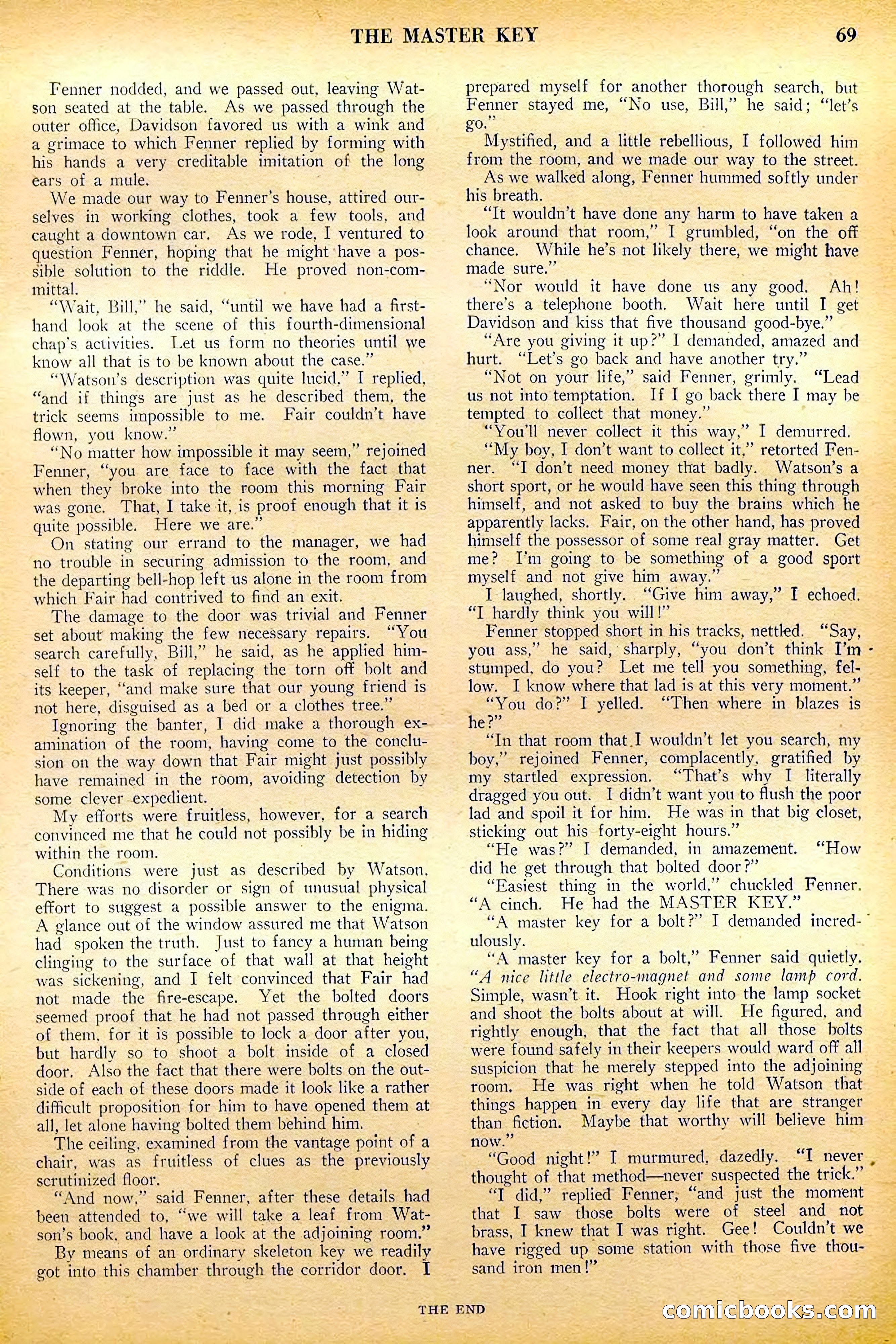
A restored page from Pulp Fiction, 1928. Page through the whole issue in the reader above.
📄 Transcribed text from this page (OCR, searchable)
Machine-transcribed from the original scan — historical spelling and the odd misread are preserved.
Fenner nodded, and we passed out, leaving Wat- son seated at the table. As we passed through the outer office, Davidson favored us with a wink and a grimace to which Fenner replied by forming with his hands a very creditable imitation of the long ears of a mule. : We made our way to Fenner’s house, attired our- selves in working clothes, took a few tools, and caught a downtown car, As we rode, I ventured to question Fenner, hoping that he might have a pos- sible solution to the riddle. He proved non-com- mittal. “Wait, Bill,” he said, “until we have had a first- hand look at the scene of this fourth-dimensional chap’s activities. Let us form no theories until we know all that is to be known about the case.” “Watson’s description was quite lucid,” I replied, “and if things are just as he described them, the trick seems impossible to me. Fair couldn’t have flown, you know.” “No matter how impossible it may seem,” rejoined Fenner, “you are face to face with the fact that when they broke into the room this morning Fair was gone, That, I take it, is proof enough that it is quite possible. Here we are.” On stating our errand to the manager, we had no trouble in securing admission to the room, and the departing bell-hop left us alone in the room from which Fair had contrived to find an exit. The damage to the door was trivial and Fenner set about making the few necessary repairs, “You search carefully, Bill,” he said, as he applied him- self to the task of replacing the torn off bolt and its keeper, “and make sure that our young friend is not here, disguised as a bed or a clothes tree.” Ignoring the banter, I did make a thorough ex- amination of the room, having come to the conclu- sion on the way down that Fair might just possibly have remained in the room, avoiding detection by some clever expedient. My efforts were fruitless, however, for a search convinced me that he could not possibly be in hiding within the room. Conditions were just as described by Watson, There was no disorder or sign of unusual physical effort to suggest a possible answer to the enigma. A glance out of the window assured me that Watson had spoken the truth. Just to fancy a human being clinging to the surface of that wall at that height was sickening, and I felt convinced that Fair had not made the fire-escape. Yet the bolted doors seemed proof that he had not passed through either of them, for it is possible to lock a door after you, but hardly so to shoot a bolt inside of a closed door. Also the fact that there were bolts on the out- side of each of these doors made it look like a rather difficult proposition for him to have opened them at all, let alone having bolted them behind him. The ceiling, examined from the vantage point of a chair, was as fruitless of clues as the previously scrutinized floor. “And now,” said Fenner, after these details had been attended to, “we will take a leaf from Wat- son’s book, and have a look at the adjoining room.” By means of an ordinary skeleton key we readily got into this chamber through the corridor door. I “—_ ore ; THE END Comichooks:co THE MAST Se ee ee ae ER KEY prepared myself for another thorough search, but Fenner stayed me, “No use, Bill,” he said; “‘let’s go.” Mystified, and a little rebellious, I followed him from the room, and we made our way to the street. As we walked along, Fenner hummed softly under his breath. “Tt wouldn’t have done any harm to have taken a look around that room,” I grumbled, “on the off chance. While he’s not likely there, we might have made sure.” “Nor would it have done us any good. Ah! there’s a telephone booth, Wait here until I get Davidson and kiss that five thousand good-bye.” “Are you giving it up?” I demanded, amazed and hurt. ‘“Let’s go back and have another try.” “Not on your life,” said Fenner, grimly. “Lead us not into temptation. If I go back there I may he tempted to collect that money.” “You'll never collect it this way,’ I demurred. “My boy, I don’t want to collect it,’ retorted Fen- ner. “I don’t need money that badly. Watson’s a short sport, or he would have seen this thing through himself, and not asked to buy the brains which he apparently lacks. Fair, on the other hand, has proved himself the possessor of some real gray matter. Get me? I’m going to be something of a good sport myself and not give him away.” I laughed, shortly. “Give him away,” I echoed. “T hardly think you will!” Fenner stopped short in his tracks, nettled. “Say, you ass,” he said, sharply, “you don’t think I’m “8 stumped, do you? Let me tell you something, fel-— low. I know where that lad is at this very moment.” 3 “You do?’ I yelled. ‘Then where in blazes is er “Tn that room that.I wouldn't let you search, my boy,” rejoined Fenner, complacently, gratified by my startled expression. “That’s why I literally dragged you out. I didn’t want you to flush the poor lad and spoil it for him. He was in that big closet, sticking out his forty-eight hours.” “He was?’ I demanded, in amazement. did he get through that bolted door ?” “Easiest thing in the world,” chuckled Fenner. “A cinch. He had the MASTER KEY.” “A master key for a bolt?” I ulously. “A master key for a bolt,” Fenner said quietly. “4 nice little electro-magnet and some lamp cord. Simple, wasn’t it. Hook right into the lamp socket and shoot the bolts about at will. He figured, and rightly enough, that the fact that all those bolts were found safely in their keepers would ward off all suspicion that he merely stepped into the adjoining room. He was right when he told Watson that things happen in every day life that are stranger than fiction. Maybe that worthy will believe him now.” “Good night!” I murmured, dazedly. “I never thought of that method—never suspected the trick.” “T did,” replied Fenner; “and just the moment that I saw those bolts were of steel and not “How brass, I knew that I was right. Gee! Couldn’t we have rigged up some station with those five thou- sand iron men!” demanded incred- ~