
Pulp Fiction, 1928 · page 73 of 99
Amazing Stories — page 73: what you’re looking at
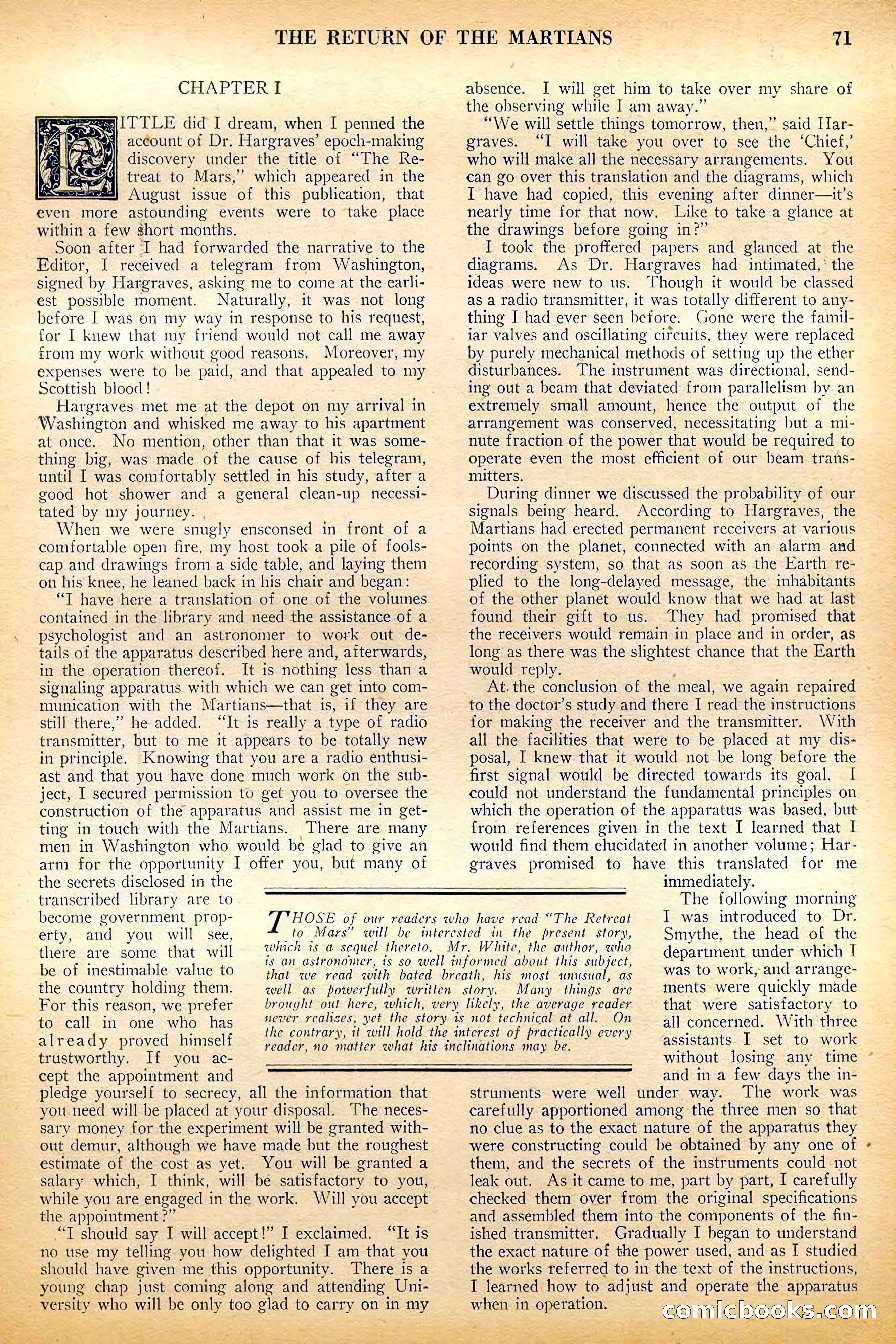
A restored page from Pulp Fiction, 1928. Page through the whole issue in the reader above.
📄 Transcribed text from this page (OCR, searchable)
Machine-transcribed from the original scan — historical spelling and the odd misread are preserved.
ey who will be only too a to carry on in my THE RETURN OF THE MARTIANS 71 CHAPTER I rer TELE did I dream, when I penned the aceount of Dr. Hargraves’ epoch-making 3 fee) discovery under the title of “The Re- ( wh treat to Mars,” which appeared in the sseeares) Aucust issue of this publication, that even more astounding events were to take place within a few short months. Soon after I had forwarded the narrative to the Editor, I received a telegram from Washington, signed ‘by Hargraves, asking me to come at the earli- est possible moment. Naturally, it was not long before I was on my way in response to his request, for I knew that my friend would not call me away from my work without good reasons. Moreover, my expenses were to be paid, and that appealed to my Scottish blood! Hargraves met me at the depot on my arrival in Washington and whisked me away to his apartment at once. No mention, other than that it was some- thing big, was made of the cause of his telegram, until I was comfortably settled in his study, after a good hot shower and a general clean-up necessi- tated by my journey. , When we were snugly ensconsed in front of a comfortable open fire, my host took a pile of fools- cap and drawings from a side table, and laying them ott his knee, he leaned back in his chair and began: “T have here a translation of one of the volumes contained in the library and need the assistance of a psychologist and an astronomer to work out de- tails of the apparatus described here and, afterwards, in the operation thereof. It is nothing less than a signaling apparatus with which we can get into com- munication with the Martians—that is, if they are still there,” he added. “It is really a type of radio transmitter, but to me it appears to be totally new in pr inciple. Knowing that you are a radio enthusi- ast and that you have done much work on the sub- ject, I secured permission to get you to oversee the construction of the apparatus and assist me in get- ting in touch with the Martians. There are many men in Washington who would be glad to give an arm for the opportunity I offer you, but many of the secrets disclosed in the absence. I will get him to take over my share of the observing while I am away.’ “We will settle things tomorrow, then,” said Har- graves. “I will take. you over to see the ‘Chief,’ who will make all the necessary arrangements. You can go over this translation and the diagrams, which I have had copied, this evening after dinner—it’s nearly time for that now. Like to take a glance at the drawings before going in?” I took the proffered papers and glanced at the diagrams. As Dr. Hargraves had intimated,‘ the ideas were new to us. Though it would be classed as a radio transmitter, it was totally different to any- thing I had ever seen before. Gone were the famil- iar valves and oscillating circuits, they were replaced by purely mechanical methods of setting up the ether disturbances. The instrument was directional, send- ing out a beam that deviated from parallelism by an extremely small amount, hence the output of the arrangement was conserved, necessitating but a mi- nute fraction of the power that would be “required to operate even the most efficient of our beam trans- mitters. During dinner we discussed the probability of our signals being heard. According to Hargraves, the Martians had erected permanent receivers at various points on the planet, connected with an alarm and recording system, so that as soon as the Earth re- plied to the long-delayed message, the inhabitants of the other planet would know that we had at last found their gift to us. They had promised that the receivers would remain in place and in order, as long as there was the slightest chance that the Earth would reply. At. the conclusion of the meal, we again repaired to the doctor’s study and there I read the instructions for making the receiver and the transmitter. With all the facilities that were to be placed at my dis- posal, I knew that it would not be long before the first signal would be directed towards its goal. I could not understand the fundamental principles on which the operation of the apparatus was based, but from references given in the text I learned that I would find them elucidated in another volume; Har- graves promised to have this translated for me immediately. transcribed library are to become government prop- THOSE of our readers who have read “The Retreat will be interested in the present story, Mr. White, the author, who is an astronomer, is so well informed about this subject, that we read with bated breath, his anost unusual, as well as powerfully writlen story. brought oul here, which, very likely, the average reader never realises, yet the story is not technical at all. On the contrary, it will hold the interest of practically every reader, no matter what his inclinations may be. erty, and you will see, to Mars” there are some that will be of inestimable value to the country holding them. For this reason, we prefer to call in one who has already proved himself trustworthy. If you ac- cept the appointment and pledge yourself to secrecy, all the information that you need will be placed at your disposal. The neces- sary money for the experiment will be granted with- out demur, although we have made but the roughest estimate of the cost as vet. You will be granted a salary which, I think, will bé satisfactory to you, - while you are engaged in the work. the appointment ?” “T should say I will accept!” I exclaimed. “Tt is no use my telling you how delighted I am that you should have given me this opportunity. There is a young chap just coming along and attending Uni- Will you accept which is a sequel thereto. The following morning I was introduced to Dr. Smythe, the head of the department under which | was to work, and arrange- ments were quickly made that were satisfactory to all concerned. With three assistants I set to work without losing any time and in a few days the in- struments were well under way. The work was carefully apportioned among the three men so that no clue as to the exact nature of the apparatus they were constructing could be obtained by any one of them, and the secrets of the instruments could not leak out. As it came to me, part by part, I carefully checked them over from the original specifications and assembled them into the components of the fin- ished transmitter. Gradually I began to understand Many things are the exact nature of the power used, and as I studied the works referred to in the text of the instructions, I learned how to adjust and operate the apparatus COMMEIOOXS, “COl ie when in operation.