
Pulp Fiction, 1928 · page 75 of 99
Amazing Stories — page 75: what you’re looking at
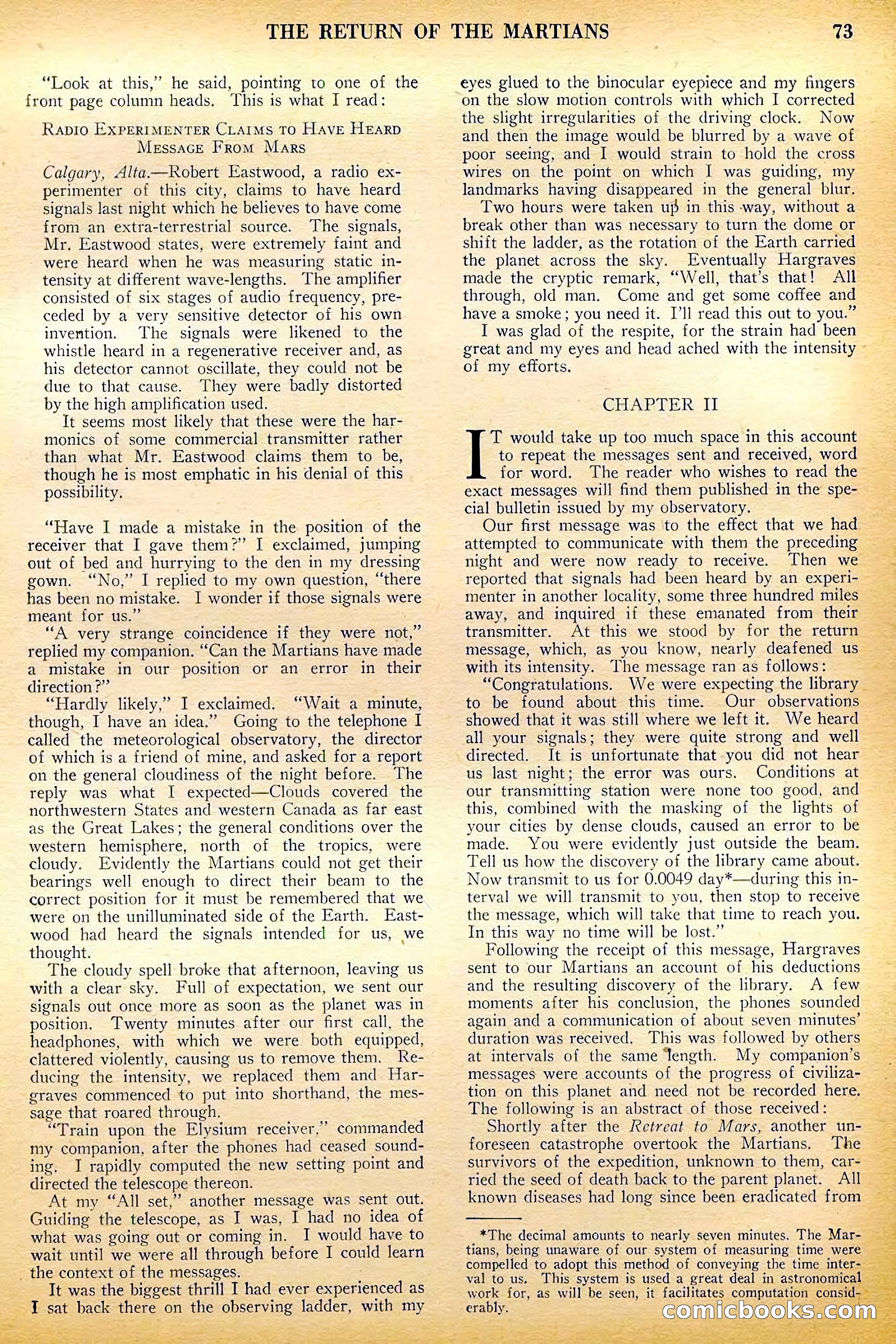
A restored page from Pulp Fiction, 1928. Page through the whole issue in the reader above.
📄 Transcribed text from this page (OCR, searchable)
Machine-transcribed from the original scan — historical spelling and the odd misread are preserved.
ae “— Pe ad) THE RETURN OF THE MARTIANS “Took at this,’ he said, pointing to one of the front page column heads. This is what I read: Rapio EXPERIMENTER CLAIMS TO Have HEARD MessacGE From Mars Calgary, Alta—Robert Eastwood, a radio ex- perimenter of this city, claims to have heard signals last night which he believes to have come from an extra-terrestrial source. The signals, Mr. Eastwood states, were extremely faint and were heard when he was measuring static in- tensity at different wave-lengths. The amplifier consisted of six stages of audio frequency, pre- ceded by a very sensitive detector of his own invention. The signals were likened to the whistle heard in a regenerative receiver and, as his detector cannot oscillate, they could not be due to that cause. They were badly distorted by the high amplification used. It seems most likely that these were the har- monics of some commercial transmitter rather than what Mr. Eastwood claims them to be, though he is most emphatic in his denial of this possibility. “Have I made a mistake in the position of the receiver that I gave them?’ I exclaimed, jumping out of bed and hurrying to the den in my dressing gown. “No,” I replied to my own question, “there has been no mistake. I wonder if those signals were meant for us.” “A very strange coincidence if they were not,” replied my companion. “Can the Martians have made a mistake in our position or an error in their direction?” “Hardly likely,” I exclaimed. “Wait a minute, though, I have an idea.” Going to the telephone I called the meteorological observatory, the director of which is a friend of mine, and asked for a report on the general cloudiness of the night before. The reply was what I expected—Clouds covered the northwestern States and western Canada as far east as the Great Lakes; the general conditions over the western hemisphere, north of the tropics, were cloudy. Evidently the Martians could not get their bearings well enough to direct their beam to the correct position for it must be remembered that we were on the unilluminated side of the Earth. East- wood had heard the signals intended for us, we thought. The cloudy spell broke that afternoon, leaving us with a clear sky. Full of expectation, we sent our signals out once more as soon as the planet was in position. Twenty minutes after our first call, the headphones, with which we were both equipped, clattered violently, causing us to remove them. Re- ducing the intensity, we replaced them and Har- graves commenced to put into shorthand, the mes- sage that roared through. ‘Train upon the Elysium receiver.” commanded my companion, after the phones had ceased sound- ing. I rapidly computed the new setting point and directed the telescope thereon. At my “All set,” another message was sent out. Guiding the telescope, as I was, I had no idea of what was going out or coming in. I would have to wait until we were all through before I could learn _ the context of the messages. ; It was the biggest thrill I had ever experienced as J sat back there on the observing ladder, with my acl ill Date pen - ee erably. ee J ik a na — le eyes glued to the binocular eyepiece and my fingers on the slow motion controls with which I corrected the slight irregularities of the driving clock. Now and then the image would be blurred by a wave of poor seeing, and I would strain to hold the cross wires on the point on which I was guiding, my landmarks having disappeared in the general blur. Two hours were taken uj in this way, without a break other than was necessary to turn the dome or shift the ladder, as the rotation of the Earth carried the planet across the sky. Eventually Hargraves made the cryptic remark, “Well, that’s that! All through, old man. Come and get some coffee and have a smoke; you need it. I’ll read this out to you.” I was glad of the respite, for the strain had been great and my eyes and head ached with the intensity ~ of my efforts. CHARTER. IT to repeat the messages sent and received, word _ for word. The reader who wishes to read the exact messages will find them published in the spe- cial bulletin issued by my observatory. Our first message was to the effect that we had attempted to communicate with them the preceding night and were now ready to receive. Then we ~ reported that signals had been heard by an experi-— menter in another locality, some three hundred miles away, and inquired if these emanated from their _ transmitter. At this we stood by for the return — message, which, as you know, nearly deafened us with its intensity. The message ran as follows: “23 “Congratulations. We were expecting the library to be found about this time. Our observations — showed that it was still where we left it. We heard all your signals; they were quite strong and well directed. It is unfortunate that you did not hear us last night; the error was ours. Conditions at our transmitting station were none too good, and this, combined with the masking of the lights of your cities by dense clouds, caused an error to be made. You were evidently just outside the beam. Tell us how the discovery of the library came about. Now transmit to us for 0.0049 day*—during this in- terval we will transmit to you, then stop to receive the message, which will take that time to reach you. In this way no time will be lost.” Following the receipt of this message, Hargraves sent to our Martians an account of his deductions and the resulting discovery of the library. A few moments after his conclusion, the phones sounded again and a communication of about seven minutes’ duration was received. This was followed by others at intervals of the same Tength. My companion’s _ messages were accounts of the progress of civiliza- tion on this planet and need not be recorded here. The following is an abstract of those received: Shortly after the Retreat to Mars, another un- foreseen catastrophe overtook the Martians. The survivors of the expedition, unknown to them, car- ried the seed of death back to the parent planet. All known diseases had long since been eradicated from | [: would take up too much space in this account *The decimal amounts to nearly seven minutes. The Mar- tians, being unaware of our system of measuring time were compelled to adopt this method of conveying the time inter val to us. This system is used a great deal in astronomic work for, as will be seen, it facilitates computation consi