
Pulp Fiction, 1928 · page 78 of 99
Amazing Stories — page 78: what you’re looking at
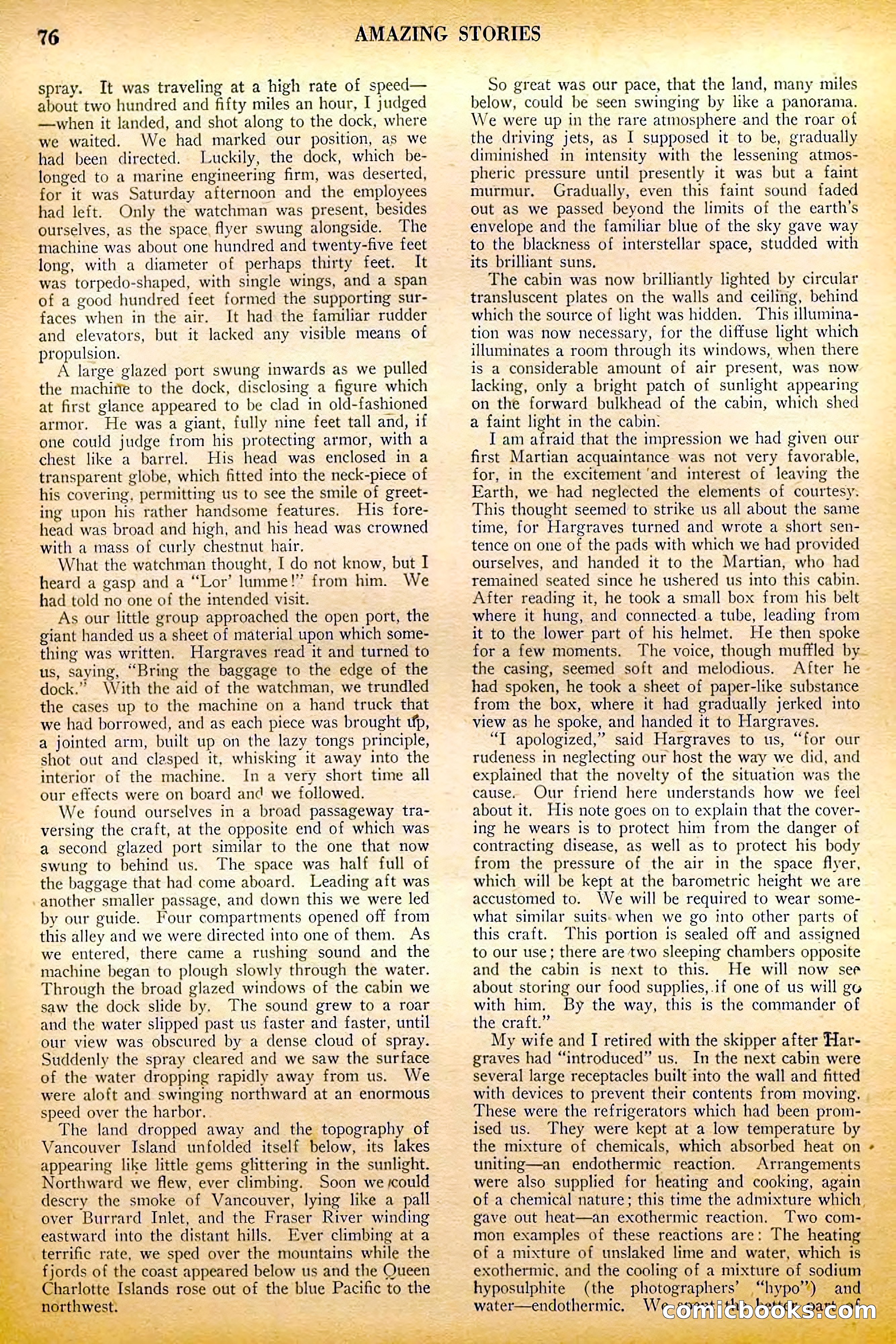
A restored page from Pulp Fiction, 1928. Page through the whole issue in the reader above.
📄 Transcribed text from this page (OCR, searchable)
Machine-transcribed from the original scan — historical spelling and the odd misread are preserved.
‘ { Cag a —T io spray. It was traveling at a high rate of speed— about two hundred and fifty miles an hour, I judged —when it landed, and shot along to the dock, where we waited. We had marked our position, as we had been directed. Luckily, the dock, which be- longed to a marine engineering firm, was deserted, for it was Saturday afternoon and the employees had left. Only the watchman was present, besides ourselves, as the space, flyer swung alongside. The machine was about one hundred and twenty-five feet long, with a diameter of perhaps thirty feet. It was torpedo-shaped, with single wings, and a span of a good hundred feet formed the supporting sur- faces when in the air. It had the familiar rudder and elevators, but it lacked any visible means of propulsion. A large glazed port swung inwards as we pulled the machitie to the dock, disclosing a figure which at first glance appeared to be clad in old-fashioned armor. He was a giant, fully nine feet tall and, if one could judge from his protecting armor, with a chest like a barrel. His head was enclosed in a transparent globe, which fitted into the neck-piece of his covering, permitting us to see the smile of greet- ing upon his rather handsome features. His fore- head was broad and high, and his head was crowned with a mass of curly chestnut hair, What the watchman thought, I do not know, but I heard a gasp and a “Lor’ lumme!” from him. We had told no one of the intended visit. As our little group approached the open port, the giant handed us a sheet of material upon which some- thing was written. Hargraves read it and turned to us, saying, “Bring the baggage to the edge of the dock.” With the aid of the watchman, we trundled the cases up to the machine on a hand truck that we had borrowed, and as each piece was brought tfp, a jointed arm, built up on the lazy tongs principle, shot out and clasped it, whisking it away into the interior of the machine. In a very short time all our effects were on board and we followed. We found ourselves in a broad passageway tra- versing the craft, at the opposite end of which was a second glazed port similar to the one that now swung to behind us. The space was half full of the baggage that had come aboard. Leading aft was -another smaller passage, and down this we were led by our guide. Four compartments opened off from this alley and we were directed into one of them. As we entered, there came a rushing sound and the machine began to plough slowly through the water. Through the broad glazed windows of the cabin we saw the dock slide by, The sound grew to a roar : and the water slipped past us faster and faster, until our view was obscured by a dense cloud of spray. Suddenly the spray cleared and we saw the surface __ of the water dropping rapidly away from us. We _-were aloft and swinging northward at an enormous speed over the harbor. 2 The land dropped away and the topography of Vancouver Island unfolded itself below, its lakes appearing like little gems glittering in the sunlight. Northward we flew, ever climbing. Soon we jcould “ eae ioe ' A Ei ua : | wilh, BAP A Mi over Burrard Inlet, and the Fraser River winding eastward into the distant hills. Ever climbing at a terrific rate, we sped over the mountains while the fjords of the coast appeared below us and the Queen ‘Charlotte Islands rose out of the blue Pacific to the ‘ ee at ? <= a se ni descry the smoke of Vancouver, lying like a pall - G STORIES So great was our pace, that the land, many miles below, could be seen swinging by like a panorama. We were up in the rare atmosphere and the roar of the driving jets, as I supposed it to be, gradually diminished in intensity with the lessening atmos- pheric pressure until presently it was but a faint murmur. Gradually, even this faint sound faded out as we passed beyond the limits of the earth’s envelope and the familiar blue of the sky gave way to the blackness of interstellar space, studded with its brilliant suns. The cabin was now brilliantly lighted by circular transluscent plates on the walls and ceiling, behind which the source of light was hidden. This illumina- tion was now necessary, for the diffuse light which illuminates a room through its windows, when there is a considerable amount of air present, was now lacking, only a bright patch of sunlight appearing on the forward bulkhead of the cabin, which shed a faint light in the cabin. I am afraid that the impression we had given our first Martian acquaintance was not very favorable, for, in the excitement ‘and interest of leaving the Earth, we had neglected the elements of courtesy. This thought seemed to strike us all about the same time, for Hargraves turned and wrote a short sen- tence on one of the pads with which we had provided ourselves, and handed it to the Martian, who had remained seated since he ushered us into this cabin. After reading it, he took a small box from his belt where it hung, and connected a tube, leading from it to the lower part of his helmet. He then spoke for a few moments. The voice, though muffled by the casing, seemed soft and melodious. After he - had spoken, he took a sheet of paper-like substance from the box, where it had gradually jerked into view as he spoke, and handed it to Hargraves. “T apologized,” said Hargraves to us, “for our rudeness in neglecting our host the way we did, and explained that the novelty of the situation was the cause. Our friend here understands how we feel about it. His note goes on to explain that the cover- ing he wears is to protect him from the danger of contracting disease, as well as to protect his body from the pressure of the air in the space flyer, which will be kept at the barometric height we are accustomed to. We will be required to wear some- what similar suits. when we go into other parts of this craft. This portion 1s sealed off and assigned to our use; there are two sleeping chambers opposite and the cabin is next to this. He will now see about storing our food supplies,.if one of us will go with him. By the way, this is the commander of the craft.” My wife and I retired with the skipper after Har- graves had “introduced” us. In the next cabin were several large receptacles built into the wall and fitted with devices to prevent their contents from moving, | These were the refrigerators which had been prom- ised us. They were kept at a low temperature by the mixture of chemicals, which absorbed heat on + — uniting—an endothermic reaction. Arrangements were also supplied for heating and cooking, again — of a chemical nature; this time the admixture which, _ gave out heat—an exothermic reaction. Two com- mon examples of these reactions are: The heati of a mixture of unslaked lime and water, which exothermic, and the cooling of a mixture of sodit ao os hyposulphite (the photographer h water—endothermic. MEomic a ma a a, — —s a ts aang oe